

Contrary to popular belief, most aftermarket aerodynamic parts increase drag far more than they improve downforce, actively slowing your car down and worsening fuel economy.
- Effective aerodynamics is a science of managing airflow with precision, focusing on the Lift-to-Drag (L/D) ratio, not just brute force downforce.
- Properly mounting a small, efficient aero device or smoothing the underbody provides more performance gains than a large, poorly-designed wing.
Recommendation: Stop thinking about aesthetics and start analyzing airflow. Test small, incremental changes and measure their impact to achieve true aerodynamic efficiency.
For many car tuners, the path to performance seems paved with aggressive spoilers, deep front splitters, and widebody kits. The visual language of racing suggests that bigger is better, and that bolting on these components will transform a street car into a corner-carving machine. This assumption, however, is where performance gains stall and fuel economy plummets. The reality is that aerodynamics is a field of punishing trade-offs, and most aftermarket parts are designed for looks, not for efficient performance.
The common approach is to add components that generate a massive amount of drag for a negligible, or sometimes even negative, amount of downforce. This creates a “dirty” aerodynamic profile, where turbulent air slows the vehicle and can even reduce stability at speed. Instead of blindly adding parts, a fundamental shift in mindset is required. The key is not to simply add downforce, but to improve the car’s overall aerodynamic efficiency—its Lift-to-Drag ratio.
This guide departs from the conventional wisdom. We will not be creating a shopping list of the biggest wings. Instead, we will explore the scientific principles that govern airflow. We will analyze why common modifications fail, demonstrate how to implement solutions that work, and even connect the dots between aerodynamic load and engine performance. This is your first lesson in thinking like an aerodynamicist.
To guide you through this scientific approach to tuning, we will deconstruct the process step-by-step. The following sections break down key areas of the vehicle, from the most visible spoilers to the often-ignored underbody, providing a complete framework for improving aerodynamic performance without the common pitfalls.
Summary: A Scientific Guide to Functional Aerodynamics
- Why Most Aftermarket Spoilers Actually Slow You Down?
- How to Mount a Front Splitter So It Doesn’t Rip Off at Highway Speeds?
- Carbon Fiber vs Fiberglass: Is the Weight Saving Worth the Cost?
- The Wheel Bearing Issue Caused by Widebody Spacers
- How to Smooth Underbody Airflow for Better Highway MPG?
- Wrap vs Paint: Which Modification Holds Better Resale Value?
- Why Manufacturers Ship Cars With “Detuned” Engine Maps?
- How to Remap Your Diesel Engine to Save 10% on Fuel Costs?
Why Most Aftermarket Spoilers Actually Slow You Down?
The most common aerodynamic modification is the rear spoiler or wing, and it’s also the most misunderstood. The primary goal of a wing is to generate downforce by creating a pressure differential between its upper and lower surfaces. A spoiler, by contrast, primarily “spoils” undesirable airflow patterns to reduce lift or drag. Many aftermarket “wings” are merely oversized spoilers that create massive airflow separation. This is a pocket of turbulent, low-pressure air that acts like a parachute, dramatically increasing drag without providing functional downforce.
The measure of a good aerodynamic device is not the raw downforce it produces, but its Lift-to-Drag (L/D) ratio. For street applications, a functional wing should ideally achieve an L/D ratio of 8:1, meaning it generates eight parts of downforce for every one part of drag. Many aesthetic spoilers have a ratio closer to 3:1 or worse. Furthermore, research shows that subtle changes have significant effects. Recent aerodynamic research from Scientific Reports shows that a modest 10 cm spoiler height set at a 0° angle of attack can provide an optimal balance, even reducing overall drag in some cases. Exaggerated angles and heights often do more harm than good and may violate local traffic regulations.
To move from aesthetic modification to functional tuning, you must focus on efficiency. This means starting small and understanding the principles of airflow attachment before investing in a large, aggressive wing that is likely to be counterproductive for a street-driven vehicle.
Action Plan: Verifying Aerodynamic Efficiency
- Install a Gurney Flap: Add a flap sized at 1-2% of the wing’s chord length. This small change can increase downforce by up to 18% with a minimal drag penalty by improving boundary layer attachment.
- Clarify Your Goal: Understand if you need a spoiler (to reduce lift on a trunk lid) or a wing (to generate significant downforce). They are not interchangeable.
- Measure the Lift-to-Drag Ratio: Aim for a minimum L/D ratio of 3:1 for any component. An 8:1 ratio is considered optimal for efficient street performance.
- Test for Separation Bubbles: Consider removing purely aesthetic spoilers that create a large “dead zone” of turbulent air directly behind the vehicle.
- Make Incremental Changes: Test with small, measurable adjustments. Even a 1 cm height difference or a single degree of angle can significantly impact efficiency and drag.
How to Mount a Front Splitter So It Doesn’t Rip Off at Highway Speeds?
A front splitter is not just a cosmetic lip; it’s a functional aerodynamic device designed to create a high-pressure zone on its top surface and a low-pressure (high-velocity) zone underneath. This pressure differential generates front-end downforce, increasing grip and stability. However, this force is immense. A poorly mounted splitter will flex, become ineffective, or worse, tear off at speed, causing catastrophic damage. The key to an effective splitter is threefold: correct ground clearance, structural rigidity, and robust mounting.
As experts in professional racing applications note, the effectiveness of a splitter is directly tied to its proximity to the ground. As stated in a guide by Professional Awesome, a leader in race-car engineering: “The splitter should mount to the vehicle as closely to the ground as possible without rubbing under braking or in corners. This is easier said than done, but critically important. Splitters’ downforce performance improves dramatically with reduced ground clearances.” This requires a stiff suspension setup to manage compression under load.
This leads to the critical aspect of mounting. A splitter should never be attached only to a flexible plastic bumper cover. It must be secured directly to the chassis or subframe using support rods and rigid brackets. These mounts transfer the hundreds of pounds of aerodynamic load safely to the car’s structure. The material choice also plays a vital role in maintaining the splitter’s shape under load, which directly impacts its performance and durability.
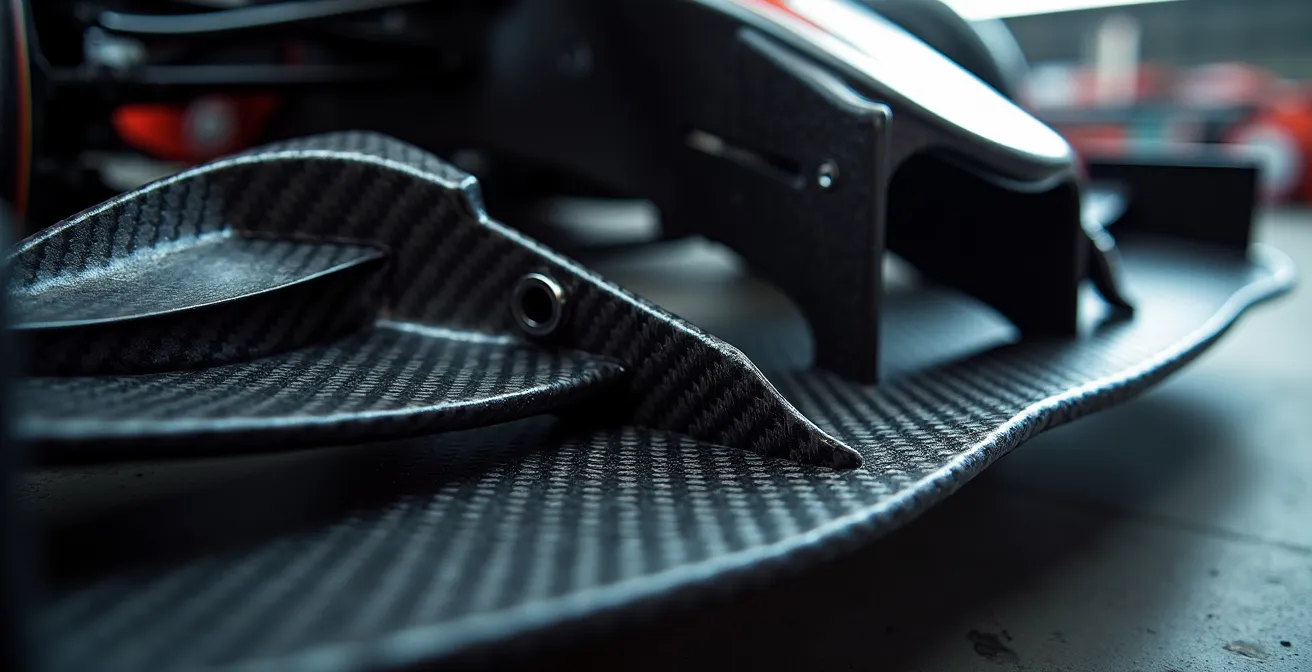
The following table provides a practical comparison of common splitter materials for street and track-day applications. While carbon fiber offers the best weight-to-stiffness ratio, materials like Alumalite provide an excellent balance of durability and cost for amateur tuners.
| Material | Durability | Cost | Repairability | Weight |
|---|---|---|---|---|
| ABS Plastic | Good | Low ($50-150) | Easy | Light |
| Alumalite | Excellent | Medium ($150-300) | Moderate | Medium |
| Fiberglass | Good | Medium ($200-400) | Easy | Light |
| Carbon Fiber | Excellent | High ($500+) | Difficult | Very Light |
Carbon Fiber vs Fiberglass: Is the Weight Saving Worth the Cost?
The debate between carbon fiber and fiberglass is common among tuners. Carbon fiber is often seen as the ultimate material due to its high strength-to-weight ratio, but its high cost raises a crucial question: is it a worthwhile investment for a street car? The answer lies in the application’s demand for rigidity. For aerodynamic components, stiffness is paramount. A wing or splitter that flexes under load changes its shape and angle of attack, destroying its effectiveness and predictability.
Carbon fiber’s primary advantage is its superior rigidity at a lower weight compared to fiberglass. This is critical in high-stakes environments. As the Formula 1 Dictionary highlights in its technical analysis on downforce:
In the case of a modern Formula 1 car, the lift-to-drag ratio Cl/Cd has a typical value of, say, 2.5, so downforce dominates performance.
– Formula 1 Dictionary, Downforce Technical Analysis
At this level, where every gram and every millimeter of flex counts, carbon fiber is non-negotiable. However, for a street car, the forces are much lower. A well-made fiberglass or Alumalite component can often provide sufficient rigidity for the speeds and loads encountered. The real performance differentiator isn’t just the material, but the design. According to aerodynamic efficiency testing, wings achieve an 8:1 lift-to-drag ratio, while simple spoilers are closer to 3:1. Investing in a well-designed wing made of fiberglass will yield far better results than a poorly designed “wing-shaped object” made of expensive carbon fiber. The weight savings of a few pounds from a carbon part is negligible on a 3,000-pound street car, whereas the efficiency gain from a better design is substantial.
Therefore, the choice depends on your budget and goals. For most tuners, focusing on a component with a proven, efficient aerodynamic design is more important than the material it’s made from. Fiberglass or ABS can be a cost-effective way to achieve 90% of the performance for 50% of the cost.
The Wheel Bearing Issue Caused by Widebody Spacers
Widebody kits and wheel spacers are popular for achieving an aggressive stance, but they introduce significant engineering compromises, impacting both mechanical reliability and aerodynamics. Pushing the wheels outward with spacers increases the car’s scrub radius—the distance between the steering axis pivot point and the center of the tire’s contact patch. This change dramatically increases the load on the wheel bearings, leading to premature failure. It also negatively affects steering feel and stability.
From an aerodynamic perspective, widening the track exposes more of the rotating tire to the oncoming airflow, which is a major source of turbulence and drag. The wheel wells act like air buckets, trapping high-pressure air that creates lift and instability. While a widebody kit may look fast, it often makes the car less aerodynamically efficient. The solution is not to simply space out the wheels, but to properly manage the air entering and exiting the wheel wells.
Effective solutions focus on relieving this pressure. As noted in an analysis of downforce techniques, installing side vents or louvers is highly advantageous. “Doing so allows air to exit the wheel wells instead of being trapped which leads to turbulence.” This turns a high-pressure problem area into a functional part of the car’s aerodynamic system. Instead of using spacers, choosing wheels with the correct offset maintains the original suspension geometry and keeps the tire shrouded within the bodywork as the engineers intended. This is always preferable to the mechanical and aerodynamic compromises of spacers.
To improve airflow around the wheels correctly, consider these methods:
- Install fender vents or louvers behind the front wheels to give high-pressure air an escape path.
- Use smoothed wheel well liners to reduce turbulence inside the fender.
- Select wheels with the proper offset to achieve the desired fit without altering the scrub radius.
- Add air curtains (small vertical vents in the bumper) to direct airflow around the front wheels.
How to Smooth Underbody Airflow for Better Highway MPG?
One of the most overlooked but highly effective areas for aerodynamic improvement is the car’s underbody. From the factory, most vehicle undersides are a chaotic landscape of exhaust pipes, suspension components, and structural members. This creates immense turbulence, which translates directly into drag and reduced fuel efficiency, especially at highway speeds. The goal is to transform this messy, high-drag area into a smooth, controlled surface.
By installing flat underbody panels, you can significantly smooth the airflow from the front to the back of the car. This helps maintain a higher-velocity airflow underneath the vehicle, creating a low-pressure area that can generate downforce and, more importantly, drastically reduce drag. This is a principle used on everything from high-end supercars to economy-focused hybrids. A smooth underbody keeps the boundary layer—the thin layer of air closest to the car’s surface—attached and orderly.
At the rear of the car, this smooth airflow can be managed by a rear diffuser. A diffuser is an upward-sloping section of the underbody that slows down and expands the exiting air, recovering pressure in a controlled manner. This reduces the car’s wake and further lowers drag. The effect can be profound, as demonstrated by enthusiasts and professional tuners alike.
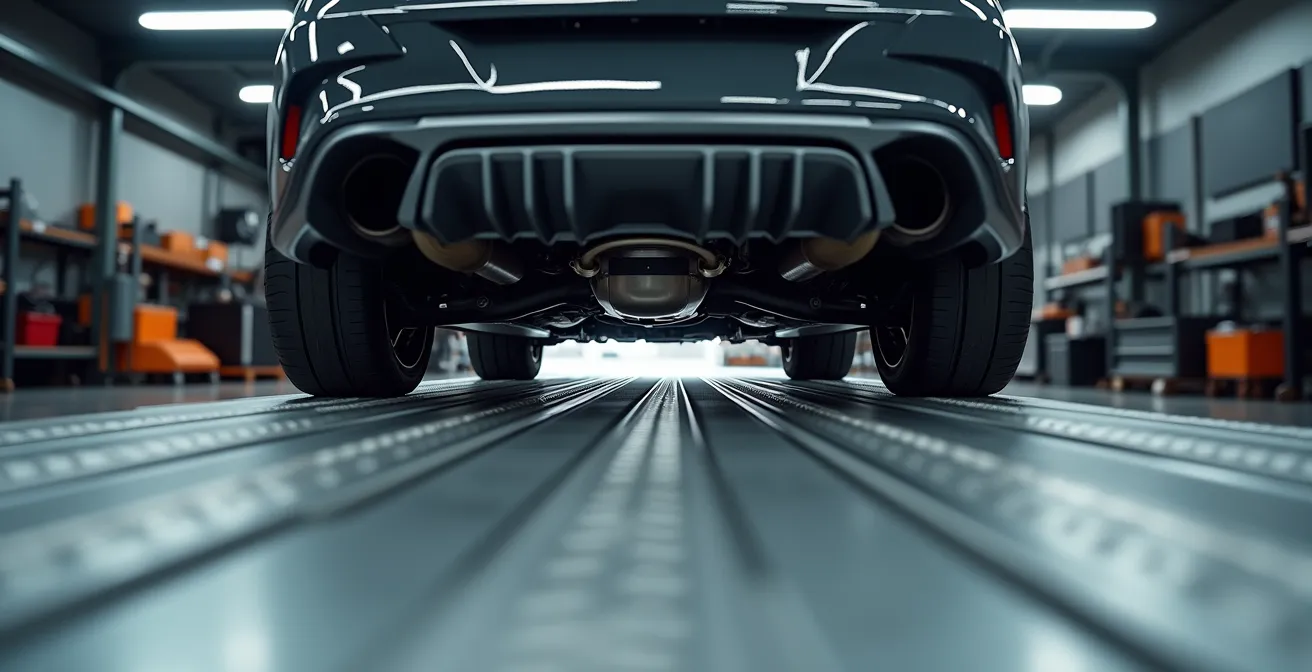
Case Study: DIY Underbody Panels on a Honda Insight
An owner of a first-generation Honda Insight fabricated and installed front and rear undertrays from ABS plastic sheet. The rear tray included an integrated diffuser. Through aerodynamic pressure measurements, the owner confirmed that the modifications generated over 140 lbs of downforce at 100 MPH, while also contributing to better fuel economy by reducing overall drag. This demonstrates that significant gains are achievable with relatively simple, well-executed modifications.
For a street car, the primary benefit of underbody smoothing is the reduction in drag, which directly translates to better highway MPG. It’s a modification that provides a tangible, everyday benefit beyond just track performance.
Wrap vs Paint: Which Modification Holds Better Resale Value?
While the choice between a vinyl wrap and a new paint job is often debated in terms of cost, durability, and aesthetics, the perspective of an aerodynamicist reveals a unique and powerful advantage for wrapping. From a resale standpoint, a high-quality wrap protects the original paint, which is a major factor in preserving a vehicle’s value. A unique or non-factory paint color can be polarizing and deter potential buyers, whereas a wrap can be easily removed. However, its true value for a tuner lies in its role as a non-permanent testing tool.
Before committing to drilling holes for permanent wings, splitters, or vents, a vinyl wrap can serve as a canvas for aerodynamic visualization. By applying small wool tufts to the surface of the wrap, one can perform a “tuft test” to see exactly how the air is flowing over the car’s body. Areas where the tufts flap wildly indicate turbulent flow or separation, while areas where they lie flat and straight indicate smooth, attached flow. This is a low-cost, real-world method to diagnose aerodynamic problems.
This testing capability transforms a cosmetic choice into a strategic engineering decision. You can use different colored vinyl sections to visually map pressure zones or even create temporary vortex generators with vinyl strips to test their placement and effectiveness. By filming these tests with a camera, you can analyze the results and make informed decisions about permanent modifications. A wrap allows you to experiment, gather data, and validate your aerodynamic theories without a single irreversible change to the car’s bodywork. This approach—testing before modifying—is the core principle of effective tuning and ultimately leads to better results than guesswork.
In this context, a wrap is not just a color change; it is an invaluable diagnostic tool that empowers a tuner to make smarter, more effective aerodynamic choices, which in turn creates a better-performing vehicle.
Why Manufacturers Ship Cars With “Detuned” Engine Maps?
Many tuners believe that manufacturers “detune” engines, leaving easy horsepower on the table. While there is often potential for more power, the factory engine map is not “detuned” but rather a complex compromise engineered for a wide range of conditions. Manufacturers must balance performance with emissions regulations, fuel quality variations across different regions, long-term reliability, and a spectrum of climates. The factory ECU map is designed to be a robust, one-size-fits-all solution.
Aerodynamics plays a significant role in this equation. The power required to overcome aerodynamic drag increases with the cube of velocity. This means doubling your speed requires eight times the power just to push the air out of the way. The load on the engine from drag is a primary factor in fuel consumption and performance at highway speeds. A manufacturer’s engine map is calibrated for the car’s specific, factory-tested aerodynamic profile. According to McLaren aerodynamics specialists, F1 cars can generate up to five times their own weight in downforce, which creates immense drag that the engine must overcome on the straights.
While a street car’s numbers are far lower, the principle holds. The engine is tuned to work efficiently with the car’s known drag coefficient. This is why a single “performance” map isn’t always optimal. As seen in Formula 1, teams use different aerodynamic packages and engine maps for different tracks. In a track-specific strategy analysis, it’s noted, “If a car spends a lot of time on straights, like in Monza, you need low drag… But in Monaco, where you have a lot of low-speed corners… you would want a large rear wing.” This illustrates the deep connection between aerodynamic setup and power requirements. A car with a high-downforce, high-drag setup requires a different tuning strategy than a low-drag car. The manufacturer’s map is simply a baseline designed for the average, unmodified vehicle.
When you start adding aerodynamic components, you change this fundamental balance. A high-drag wing requires the engine to work harder at speed, which can negatively affect both performance and fuel economy if the engine map isn’t adjusted to account for the increased load.
Key Takeaways
- True aerodynamic performance comes from improving the Lift-to-Drag (L/D) ratio, not just adding the largest components.
- Structural rigidity and proper chassis mounting are more critical for splitters and wings than the material they are made from.
- The most significant and cost-effective aerodynamic gains for a street car often come from smoothing the underbody airflow.
How to Remap Your Diesel Engine to Save 10% on Fuel Costs?
After optimizing your vehicle’s aerodynamic profile to reduce drag, the final frontier for efficiency is the engine’s electronic control unit (ECU). An “economy remap” for a diesel engine focuses on adjusting fueling and turbocharger boost parameters to increase torque at lower RPMs. This allows the engine to operate more efficiently under typical driving conditions, particularly at highway cruising speeds. By delivering more torque earlier in the rev range, the driver doesn’t need to use as much throttle to maintain speed, which is the primary mechanism for fuel savings.
A professional tuner can modify the injection timing, fuel pressure, and boost levels to optimize the combustion process for fuel economy rather than peak power. The goal is to hit the engine’s thermal efficiency sweet spot more often during a typical drive cycle. For a diesel engine, this often means enabling the car to hold a higher gear for longer, keeping RPMs low where fuel consumption is minimal. A 10% saving on fuel costs is a realistic target for many modern turbodiesel engines through a carefully calibrated economy map.
However, it is critical to understand that this is the final step in a holistic process. Attempting to achieve maximum fuel savings with an economy remap on a car that is aerodynamically inefficient is like trying to run a marathon in hiking boots. If the engine is constantly fighting the excessive drag from a poorly designed wing or a turbulent underbody, it will be forced to use more fuel regardless of its ECU map. The remap’s benefits will be significantly diminished.
The most effective strategy is to first minimize the vehicle’s drag by applying the principles discussed previously: ensuring spoilers are efficient, smoothing the underbody, and managing wheel well turbulence. Once the aerodynamic load on the engine has been reduced, the economy remap can deliver its full potential, allowing the optimized engine to work against minimal resistance. This synergy between mechanical and aerodynamic tuning is the ultimate path to performance and efficiency.
Begin applying these scientific principles today to transform your vehicle’s performance with modifications that are functional, not just fashionable. The path to true efficiency starts with understanding the physics of airflow.