
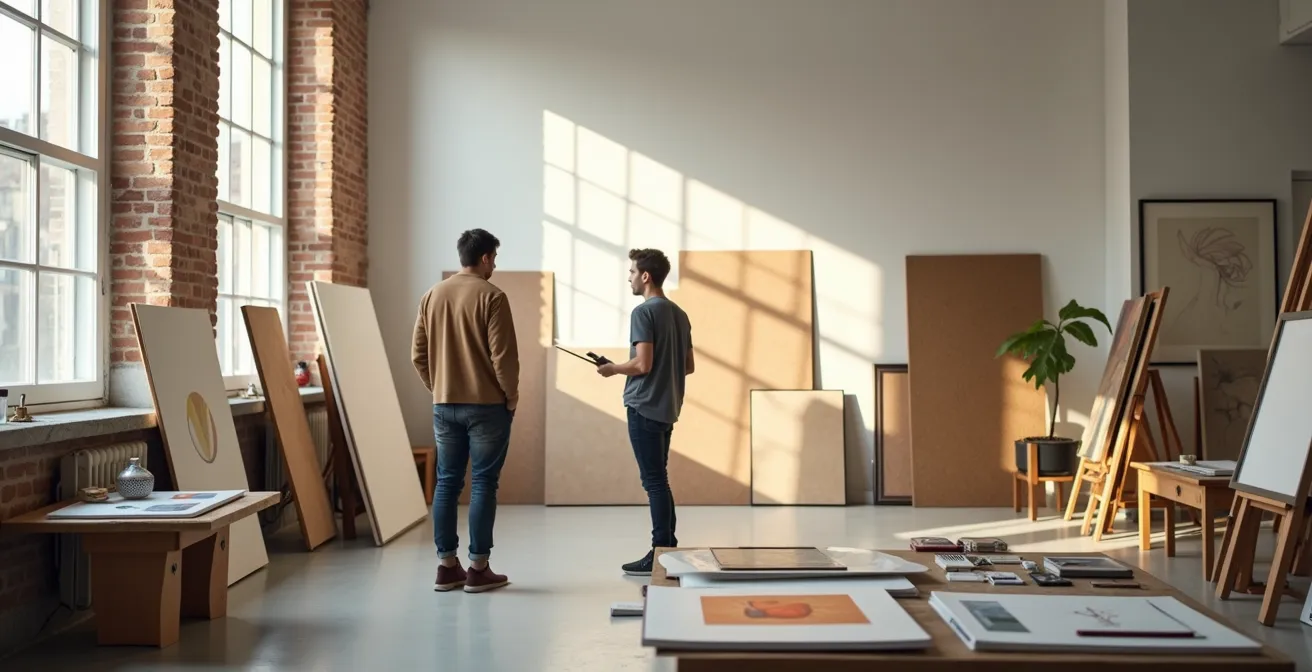
The secret to starting an art collection on a budget isn’t finding cheap decor; it’s adopting the mindset of a patron to build a collection with personal and financial value.
- Focus on strategic entry points like graduate shows and limited editions to acquire unique work.
- Look beyond the purchase price by considering the total cost of ownership, including framing and display.
Recommendation: Shift your goal from “buying art” to “becoming a patron” by focusing on the story, the artist, and the personal connection to each piece you acquire.
The art world can feel like an exclusive club with an impossibly high cost of entry. For many young professionals, the pristine white walls of a gallery and the hushed, reverent atmosphere are more intimidating than inviting. The dream of owning real, meaningful art—not mass-produced posters—seems to clash with the reality of a tight budget. It’s easy to assume that a $500 limit relegates you to the world of decorative prints, forever on the outside looking in.
The common advice often feels generic: “buy what you love” or “just visit more galleries.” While well-intentioned, this counsel ignores the core anxieties: the fear of making a bad investment, the awkwardness of talking to a gallerist, and the hidden costs that can derail a modest budget. These platitudes fail to provide a genuine strategy for navigating this complex landscape with confidence.
But what if the key wasn’t about finding a loophole to afford expensive art, but about fundamentally changing your approach? This guide proposes a new perspective: to become a collector, you must first shift your identity from a consumer to a patron. It’s about investing in stories, supporting emerging talent, and building a cohesive collection that reflects your identity—all while making smart, strategic decisions that maximize both the personal and potential financial value of every dollar spent.
This framework will guide you through the essential strategies, from identifying high-potential artists and demystifying gallery interactions to understanding the true cost of ownership and displaying your collection with professional flair. It’s a roadmap to building a collection you are proud of, one piece at a time.
This article provides a complete framework for starting your collection. It explores where to find affordable, high-potential art, how to interact with art professionals, make smart purchasing choices, and ultimately, build a collection that holds deep personal and potential financial value.
Summary: Building an Art Collection on a $500 Budget
- Why Buying from Graduating Art Students Is a Smart Strategy?
- How to Talk to Gallerists Without Feeling Intimidated?
- Limited Edition Print vs Original Drawing: Which is Better for Beginners?
- The Framing Cost Shock That Doubles Your Budget
- How to Hang Art Like a Pro to Elevate a Cheap Piece?
- Why Do We Attach Our Identity to Material Possessions?
- Gold vs Real Estate: Which Is the Better Hedge Against Inflation?
- How to Use Family Heirlooms to Unlock Your Genealogy?
Why Buying from Graduating Art Students Is a Smart Strategy?
To begin collecting with a modest budget, your greatest advantage is not wealth, but vision. While established artists command high prices, the most fertile ground for a new collector is at the source of creation: art school graduate shows. These exhibitions are a treasure trove of raw talent, offering a unique opportunity to acquire original work before an artist’s career—and their prices—take off. Buying at this stage is a strategic entry point; you are investing in potential, not just a finished product.
This approach embodies the patronage mindset. You are not merely purchasing an object; you are providing crucial, early-stage support to an artist, becoming part of their story from the very beginning. This connection adds a layer of personal meaning to your collection that a simple transaction can never replicate. Furthermore, prices at these shows are often at their lowest, reflecting the artist’s need for funds and recognition rather than market speculation. A $500 budget, which might not even cover a small print in a commercial gallery, can often secure a significant original painting or sculpture here.
The story of Herbert and Dorothy Vogel, postal and library workers in New York, serves as a powerful testament to this strategy. They adopted a simple, personal rule: they only bought pieces they loved and could carry home on public transport. Their passion and early support for then-unknown artists like Sol LeWitt and Richard Tuttle allowed them to amass a world-class collection of over 4,500 works on a civil-servant budget. Their story proves that a clear vision and a commitment to supporting artists you believe in are far more valuable than a large bank account.
By focusing on graduate shows, you gain access to affordability, originality, and the profound satisfaction of patronage. It’s an investment in the future of art and a foundational strategy for building a collection with a compelling narrative.
How to Talk to Gallerists Without Feeling Intimidated?
Walking into a sleek, minimalist gallery can feel like stepping onto a stage without a script. The silence, the enigmatic art, and the impeccably dressed gallerist can make even the most confident person feel like an impostor. This “gallery fear” is a significant barrier for new collectors. The key to overcoming it is to reframe the interaction: you are not there to be judged, but to learn. A gallerist’s primary role is to be a passionate advocate for their artists, and your genuine curiosity is their greatest asset.
Preparation is the antidote to intimidation. Before you even speak to anyone, visit the gallery’s website. Understand their “point of view”—do they specialize in abstract painting, conceptual photography, or emerging local artists? Research the artists they represent. On your first visit, simply look. Don’t feel pressured to engage immediately. Sign the guest book; it’s a subtle way of registering your presence and interest. If you see a piece you like, take a photo (if permitted) and consider posting it on social media, tagging the gallery. This builds a low-pressure rapport before a conversation even begins.

When you are ready to talk, don’t ask about the price first. This signals a purely transactional interest. Instead, focus on the art and the artist. Ask open-ended questions that demonstrate your engagement. As industry experts suggest, a powerful and disarming question is: “What about this artist’s practice convinced you to represent them?” This question shifts the dynamic, inviting the gallerist to share their passion and expertise. It shows you care about the “why” behind the work, not just the “how much.” Once a dialogue is established, it becomes much more natural to inquire about other, more affordable works by the artist, such as smaller pieces, studies, or prints that might be kept in the back room and fall within your budget.
Limited Edition Print vs Original Drawing: Which is Better for Beginners?
For a collector with a $500 budget, the first major decision often comes down to choosing between a limited edition print by an established artist or a unique original drawing by an emerging one. There is no single “right” answer; the best choice depends entirely on your personal goals, risk tolerance, and the kind of value you want to build. Both are excellent strategic entry points into the art market, but they offer very different propositions.
A limited edition print, especially one that is signed and numbered, offers a lower-risk way to own a piece of an artist’s legacy. You are acquiring an artwork by a creator with a proven track record and an existing market. While not a one-of-a-kind piece, its value is protected by its scarcity. Prints often have better liquidity, meaning they can be easier to resell if needed. An original drawing or work on paper, on the other hand, is a one-of-a-kind object. It offers a direct connection to the artist’s hand and creative process. The risk is higher—if the emerging artist’s career doesn’t take off, the work may not appreciate in value—but the potential reward is also significantly greater. Owning a unique piece from the early days of a successful artist is the dream of many collectors.
A pragmatic approach is to balance your small collection. For example, experts suggest allocating approximately $350 for a unique work and $150 for a print from an established artist. This strategy allows you to experience the thrill of owning a unique object while also hedging your bets with a more recognized name.
To make an informed decision, it’s helpful to compare these two options side-by-side. The following table, based on a recent market analysis, breaks down the key differences for a new collector.
| Aspect | Limited Edition Prints | Original Drawings |
|---|---|---|
| Entry Price | $50-$300 | $200-$500+ |
| Risk Level | Lower (established artists available) | Higher (emerging artists) |
| Potential Return | Moderate (especially signed editions) | Higher ceiling if artist succeeds |
| Liquidity | Easier to resell known artists | Harder if artist remains unknown |
| Uniqueness | One of many (but limited) | One-of-a-kind piece |
Ultimately, the choice reflects your collecting philosophy. Are you more comfortable with the proven value of a known entity, or are you drawn to the potential and unique story of a rising star? A well-rounded new collection might even include both.
The Framing Cost Shock That Doubles Your Budget
You’ve found the perfect piece of art, a beautiful drawing on paper for $250, well within your budget. You’re elated—until you take it to a custom framer and receive an estimate for $300 or more. This is the “framing cost shock,” a harsh reality that derails many aspiring collectors. Framing is not an afterthought; it is a significant part of the Total Cost of Ownership (TCO) and must be factored into your budget from the very beginning. Ignoring it means you can only afford half the art you think you can.
Custom framing is expensive because it involves skilled labor and high-quality, archival materials (like acid-free mats and UV-protective glass) that are essential for preserving the artwork. However, the biggest cost driver is non-standard dimensions. A custom-built frame for an oddly sized piece will always be costly. The single most effective strategy to manage this is to be “frame-aware” during the purchasing process. By actively seeking out art created in standard sizes (like 8×10, 16×20 inches, or A4/A3), you can use high-quality, pre-made frames available at a fraction of the custom price. This simple consideration can lead to a reduction in framing costs of up to 80%.
Beyond standard frames, you can also explore creative and modern display methods that bypass traditional framing altogether. A minimalist aesthetic can be both stylish and budget-friendly. Options like acrylic blocks, magnetic wood hangers, or even simple gallery clips can look sophisticated and intentional. Some works, like paintings on stretched canvas or mounted pieces, don’t require framing at all, eliminating the cost entirely. Before buying any work on paper, always calculate the TCO: artwork price + shipping + a realistic framing estimate.
Action Plan: Implementing a Frame-Aware Purchasing Strategy
- Filter Your Search: When browsing online or at art fairs, specifically look for works in standard dimensions (e.g., 8×10, 16×20, A4, A3).
- Calculate Total Cost: Before committing, create a quick budget: Artwork Price + ~10% for Shipping/Taxes + Pre-Made Frame Estimate. Does it still fit your budget?
- Explore Alternatives: Actively consider if the piece could work with an unframed aesthetic using acrylic blocks, magnetic hangers, or gallery clips.
- Inquire with the Artist: Ask the artist directly if they offer any pre-framed options from their studio, which can often be more affordable.
- Prioritize “Ready-to-Hang”: Give preference to works that do not require framing, such as paintings on stretched canvas or pieces mounted on wood panels.
By treating framing as part of the acquisition strategy, not an afterthought, you protect your budget and ensure you can continue to build your collection without unpleasant financial surprises.
How to Hang Art Like a Pro to Elevate a Cheap Piece?
The way art is displayed is as important as the art itself. Professional hanging and thoughtful placement can elevate an inexpensive piece, making it look like a high-value treasure, while poor presentation can make even a masterpiece look insignificant. For a collector on a budget, mastering the art of the hang is a free and powerful tool to maximize the impact and aesthetic dividend of your collection. It’s not about having the most expensive art, but about presenting what you have with intention and confidence.
One of the most effective techniques is creating a gallery wall. Grouping several smaller, inexpensive pieces can create a single, powerful visual statement with more weight and presence than one larger piece. To make it look cohesive rather than cluttered, find a unifying element: a consistent color palette, a common theme in the subject matter, or identical frame styles. This “high/low” effect—mixing a few high-quality frames with simpler artwork—can lend an air of sophistication to the entire arrangement.
Lighting is another professional secret that is surprisingly accessible. You don’t need a complex gallery lighting system. A single, affordable LED picture light (often available for under $50) directed at a specific piece can instantly create a focal point, drawing the eye and signaling that the work is important. This simple addition dramatically changes the ambiance of a room and communicates a sense of curatorial care.
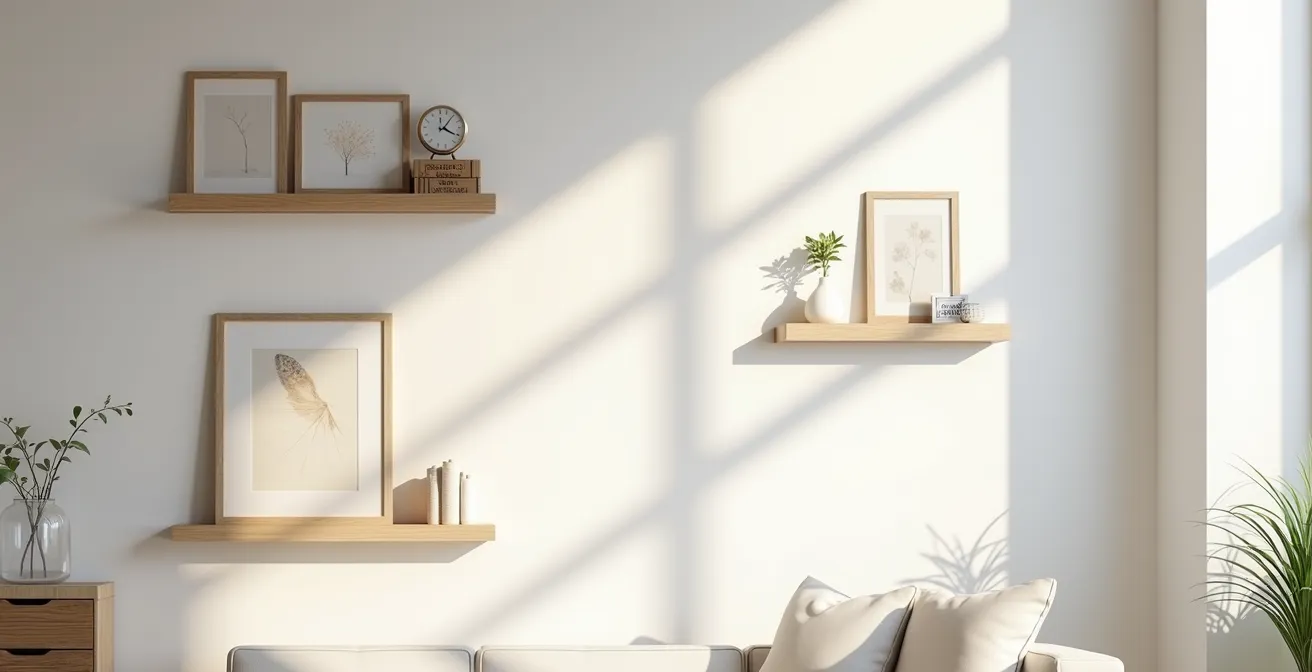
Finally, think beyond the traditional eye-level placement. Create dynamic displays by leaning larger works against a wall on the floor or by creating small “tableaus” of art on bookshelves, windowsills, or mantels. This approach, often used in contemporary homes and galleries, adds a layer of effortless style and personality. Consider the narrative relationship between pieces. Placing two artworks next to each other can create a dialogue, sparking new meanings and interpretations. This thoughtful, narrative placement is the hallmark of a true collector, not just a decorator.
Why Do We Attach Our Identity to Material Possessions?
Collecting art is fundamentally different from acquiring other material goods. While a new phone or a designer bag can be a status symbol, an art collection becomes an extension of your identity. The pieces you choose to live with are a reflection of your taste, your intellectual curiosity, and your values. This is because art is not a passive object; it is a conversation starter, a daily source of joy, and a piece of someone else’s creativity that you have chosen to champion. This act of choosing is an act of identity formation.
This is where the patronage mindset becomes a deeply personal philosophy. When you buy a piece of art for $500, especially from an emerging artist, you’re not just buying a possession; as art psychology experts note, “you are becoming a patron.” This shift in perspective is crucial. You are no longer a consumer acquiring a product; you are a supporter enabling a creative practice. Your identity becomes linked not to the object’s price tag, but to your role in its existence and the story behind its creation. This transforms the act of spending money into an act of building a legacy, however small.
To cultivate this connection, it’s essential to define your own collection thesis. This doesn’t need to be a formal academic statement, but rather a guiding principle or theme that reflects your authentic interests. Are you drawn to technology and its impact on society? Perhaps you’ll focus on generative or digital art. Are you passionate about environmental causes? Your collection could explore landscapes and nature. This thesis provides a coherent narrative, turning a group of individual purchases into a meaningful whole. It guides your future acquisitions and ensures your collection is a genuine reflection of who you are.
The best way to develop this taste and define your thesis is to spend time with art. Visit galleries, museums, and art fairs with the goal of self-discovery. Take note of what moves you, what challenges you, and what you can’t stop thinking about. The more you see, the more confident you will become in your own taste, moving away from collecting as a means of status and toward collecting as a form of personal expression.
Gold vs Real Estate: Which Is the Better Hedge Against Inflation?
When considering where to place a modest sum of $500, traditional investment vehicles like gold or real estate often come to mind as hedges against inflation. However, for such a small amount, these options are often impractical and lack a key benefit that art provides. A $500 investment in gold gets you a tiny, non-diversified sliver of a commodity that sits in a vault, offering no daily utility. Similarly, $500 in real estate likely means buying a fractional share in a REIT (Real Estate Investment Trust)—a paper asset with no tangible connection to a physical property.
Emerging art, while considered a higher-risk asset class, offers a unique proposition. That same $500 can purchase one or even two unique pieces from a graduating student or a limited edition print from an established artist. While the financial return is not guaranteed and is highly variable, art delivers a powerful, non-financial return that other assets cannot: the aesthetic dividend. This is the daily value you receive from living with a piece of art you love. It enriches your environment, sparks conversations, and provides a constant source of intellectual and emotional stimulation. This daily utility is a form of return that gold bars and REIT shares can never offer.

From a purely financial perspective, the art market is complex. It’s important to have realistic expectations. Art is not a get-rich-quick scheme, and liquidity can be low. However, it is a tangible asset that is uncorrelated with the stock market, which can be a benefit in a diversified portfolio. While large-scale studies often focus on blue-chip art, the principle of art as a store of value has historical precedent. A Stanford research paper reveals a Sharpe Ratio of 0.04 for art versus 0.30 for US equities, indicating lower risk-adjusted returns historically, but this doesn’t account for the high variability at the emerging end of the market or the non-financial returns.
The following table puts a $500 investment into perspective across these different asset classes.
| Asset | $500 Investment Gets You | Growth Potential | Daily Utility |
|---|---|---|---|
| Gold | Small un-diversified sliver | Stable but limited | None (stored away) |
| Real Estate | Fractional share/REIT | Moderate | None (paper asset) |
| Emerging Art | 1-2 unique pieces | High variability | Daily aesthetic enjoyment |
For a new investor with a small budget, the choice is clear. While gold and real estate are sterile, passive investments at this scale, emerging art is an active, engaging asset that pays daily dividends in quality of life, making it a uniquely rewarding place to start.
Key takeaways
- Adopt a “patronage mindset”: You are supporting an artist’s career, not just buying a product.
- Plan for the Total Cost of Ownership: Factor in framing, shipping, and taxes before you buy.
- Build a “collection thesis”: Let your personal story and interests guide your acquisitions for a more meaningful collection.
How to Use Family Heirlooms to Unlock Your Genealogy?
Every art collection, no matter how humble its beginnings, holds the potential to become a collection of future heirlooms. The pieces you choose today are the artifacts that will tell your story to future generations. Thinking about your collection through this lens—the “Heirloom Test”—infuses your purchasing decisions with greater meaning and long-term vision. Before you buy a piece, ask yourself: “Would my grandchild be proud to own this?” This simple question shifts the focus from fleeting trends to enduring quality and personal significance.
Creating tomorrow’s heirlooms is an intentional act of documentation. The financial value of an artwork is only one part of its worth; its story and provenance are what truly enrich it over time. For every piece you acquire, start a “Collection File.” This file should contain the sales receipt, the artist’s biography, a statement about the work, and, most importantly, a personal note from you. Write down why you bought it. What did it make you feel? What was happening in your life at that moment? This personal context transforms the object from a simple possession into a chapter of your family’s history.
This long-term perspective is the ultimate expression of the patronage mindset. As Art Pharmacy Director Emilya Colliver advises, “I would start setting a yearly budget of $500 upwards to put towards art. In 10 years you will have 10 amazing pieces with a great story.” This patient, consistent approach is how meaningful collections are built. It’s not about a single, splashy purchase, but about a decade-long commitment to curiosity, discovery, and support for the arts.
Your Action Plan for Creating Future Heirlooms
- Create a “Collection File”: For each new piece, immediately save the receipt, the artist’s bio, and any gallery information.
- Document the “Why”: Write a short, personal note about why you were drawn to the artwork and the story of its purchase. Store it in the file.
- Research the Lineage: Add notes about the artist’s background—who were their teachers, what were their influences, which gallery first showed them?
- Apply the “Heirloom Test”: Before your next purchase, pause and ask yourself if this is a piece you could proudly see passing down through generations.
- Think in Decades, Not Days: Reframe your $500 budget as the first step in a long-term journey of building a collection with a rich, documented history.
By collecting with this intention, you are not just decorating your home; you are curating your legacy. The art you champion today becomes the thread that connects your life to the lives of those who will come after you, unlocking a form of personal genealogy written in color, texture, and form.
Your journey into art collecting starts not with a massive budget, but with a single step fueled by curiosity. Begin by exploring an online platform for emerging artists or visiting a local university’s graduate exhibition. The goal is not to buy immediately, but to look, learn, and start defining what moves you. Take this first step today to transform your appreciation for art into a personal collection with a story.