
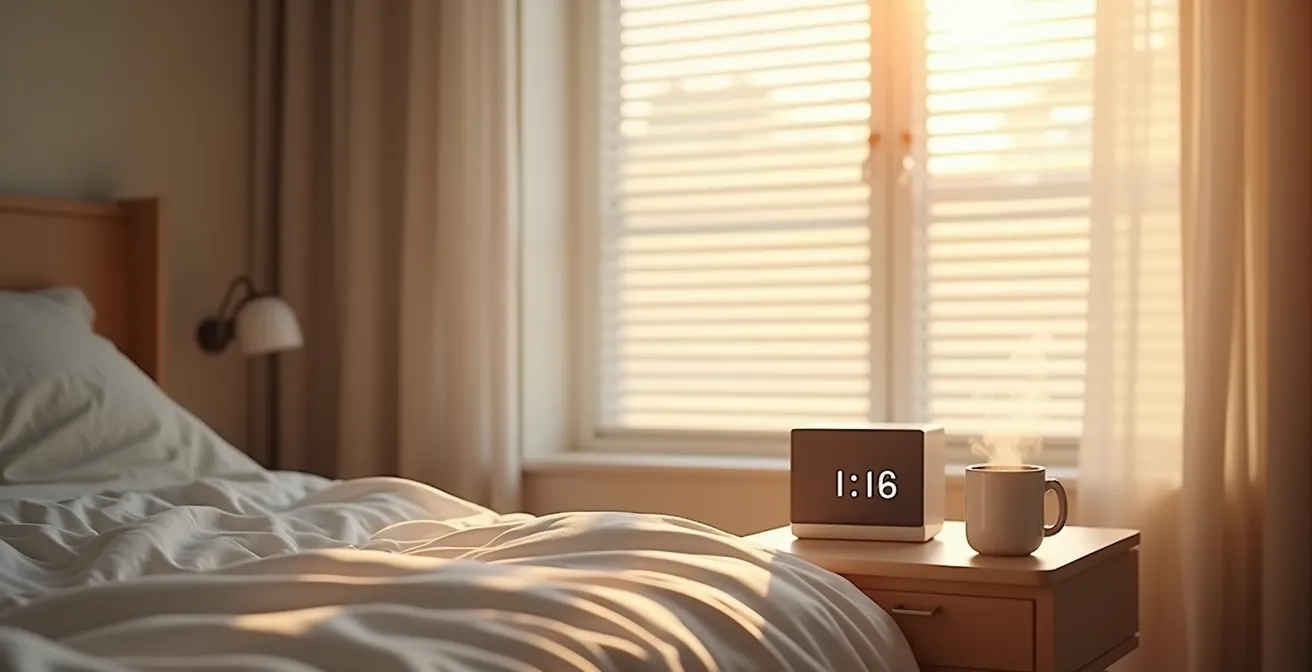
The secret to a better morning isn’t more willpower; it’s less friction. By automating small decisions, you build a routine that runs on momentum, not effort.
- Eliminating just a handful of micro-decisions before 8 AM drastically reduces mental fatigue and improves your mood.
- Effective automation creates a “sensory ramp”—gently waking your body with gradual light and warmth, not shocking it into alertness.
Recommendation: Start by automating one thing that annoys you the most, like pre-heating the bathroom, and build from there.
That blaring alarm clock. The cold floor. The frantic internal debate over hitting snooze just one more time. For non-morning people, the start of the day feels less like a gentle awakening and more like a battle against time and your own body. You’ve probably heard the usual advice: lay out your clothes, prep your coffee maker, just “be more disciplined.” But these solutions still require something that’s in desperately short supply before 9 AM: willpower.
What if the entire approach is wrong? The problem isn’t a lack of discipline, but an excess of friction. Every tiny choice you make—what to wear, what to eat, whether the coffee is strong enough—is a small drain on your mental energy. The key to reclaiming your morning isn’t to power through these obstacles, but to systematically eliminate them. This is where true automation comes in. It’s not about collecting fancy gadgets; it’s about re-engineering your environment to create a willpower-free routine that flows effortlessly from one task to the next.
Instead of fighting a sensory assault, you can build a gentle “sensory ramp” that coaxes your body and mind into a state of readiness. This guide will show you how to move beyond simple smart plugs and create a holistic, automated system. We’ll explore how to stack automations for maximum effect, choose the right triggers for your lifestyle, and ultimately design a morning that gives you back time, energy, and a surprising amount of joy.
To help you build this frictionless start to your day, this article breaks down the core strategies for effective morning automation. We’ll cover everything from the psychology of decision fatigue to the practical steps for setting up your smart devices.
Summary: Your Blueprint for an Effortless Morning
- Why Removing Small Decision Frictions Improves Your Mood?
- How to Trigger Your Coffee Maker and News Briefing Simultaneously?
- Time-Based vs Event-Based: Which Trigger Is Better for Waking Up?
- The Complexity Trap That Makes Your Smart Home Annoying for Guests
- How to Warm Up the Bathroom Before You Step Out of Bed?
- How to Reduce Morning Chaos by Preparing the Night Before?
- How to Wake Up Without Grogginess Using Light Therapy?
- How to Double Your Output by Mastering Deep Work Sessions?
Why Removing Small Decision Frictions Improves Your Mood?
The grogginess and irritation many of us feel in the morning aren’t just from a lack of sleep. They’re symptoms of decision fatigue, a very real psychological phenomenon where the quality of your choices deteriorates after a long session of decision-making. Your brain has a finite amount of “executive function” bandwidth, and every choice, no matter how small, depletes it. The question “black socks or blue socks?” uses the same mental resource pool as “how should I tackle this major work project?”
When you wake up, your willpower is a fresh but limited resource. By forcing yourself to make a series of trivial choices—what to have for breakfast, which podcast to listen to, whether to check emails now or later— you’re creating decision friction. This friction burns through your best mental energy before the day has even truly begun. You arrive at your desk already feeling drained and slightly irritable, without even knowing why.
The goal of automation is to wipe these micro-decisions off your mental plate entirely. By making these choices once and then setting them on autopilot, you conserve that precious cognitive fuel for things that actually matter. Automation engineers suggest that removing even 5-6 tiny decisions before 8 AM can have a noticeable impact on your mood and focus for the rest of the day. A willpower-free routine means your morning runs on a pre-determined track, letting you glide into your day with a clear mind and a calmer disposition.
How to Trigger Your Coffee Maker and News Briefing Simultaneously?
The magic of a truly automated morning lies in creating chain reactions, not just isolated events. This is the concept of automation stacking: linking multiple actions to a single trigger to create a seamless flow. Anyone can use a smart plug to start their coffee maker, but a life hacker connects that coffee maker to their blinds opening, their lights turning on, and their favorite playlist starting—all from one initial cue. This turns a series of chores into a single, fluid experience.
The key is to use a central hub or platform like IFTTT (“If This Then That”), Google Home Routines, or Apple HomeKit’s Automations. These services act as the digital glue, allowing devices from different brands to talk to each other. For example, you can create a routine called “Good Morning” that is triggered by dismissing your alarm. This single action can then set off a cascade of events: your smart speaker announces the weather, your smart bulbs slowly brighten, your coffee maker starts brewing, and the TV turns on to your favorite news channel.

By stacking these automations, you’re not just saving time; you’re building a powerful psychological cue. The smell of coffee brewing becomes inextricably linked with the soft light and the sound of your news briefing, signaling to your brain that the day is beginning in a controlled, pleasant way. This multi-sensory experience is far more effective at waking you up than a jarring, single-note alarm.
Case Study: The Multi-Device Morning Sequence
A Consumer Tech Test Editor at Popular Mechanics showcased a perfect example of automation stacking. Their sequence begins with the blinds opening automatically at 8 AM. At 8:15 AM, the coffee starts brewing. Finally, at 8:35 AM, a Google Nest Hub plays the alarm, displays a sleep report, announces the weather and calendar, and then the TV automatically tunes to the news. This isn’t just a routine; it’s a carefully choreographed morning launch sequence.
Time-Based vs Event-Based: Which Trigger Is Better for Waking Up?
An automation is only as good as its trigger. Choosing the right one is the difference between a routine that serves you and one that annoys you. The world of morning automation is primarily governed by two types of triggers: time-based and event-based. Understanding your own lifestyle is crucial to picking the right one for your wake-up sequence.
A time-based trigger is the simplest: “At 6:30 AM, turn on the lights.” This is perfect for people with rigid schedules, like those who need to be out the door at the same time every single day. Its strength is its reliability and simplicity. Its weakness? Inflexibility. If you decide to sleep in on a Saturday, your entire smart home will spring to life at 6:30 AM anyway, unless you remember to disable it.
An event-based trigger is more dynamic: “When my ‘Wake Up’ alarm is dismissed, start the coffee maker.” This is ideal for those with more variable schedules. The trigger isn’t the time itself, but the action of you consciously starting your day. This category can get even more sophisticated with sensor-based events, like “when the motion sensor in the bedroom detects movement after 6 AM, warm up the bathroom.” This creates an adaptive trigger ecology that responds to your actual behavior, not just the clock. For waking up, event-based triggers that rely on alarm dismissal or sleep cycle apps are often superior, as they align the automation with your actual wake-up moment, preventing a cold cup of coffee or a house that’s been lit up for an hour before you even get out of bed. In fact, studies have shown that people gradually exposed to light are less sleepy when getting out of bed, an effect best achieved with an event-based trigger that starts a sunrise simulation right before you wake.
The table below, based on an analysis from NextPit, breaks down the core trigger types to help you decide which is best for your morning routine.
| Trigger Type | Best For | Flexibility | Setup Complexity |
|---|---|---|---|
| Time-Based | Fixed schedules | Low | Simple |
| Alarm Dismissal | Variable wake times | Medium | Simple |
| Sleep Cycle | Optimal wake feeling | High | Complex |
| Presence Sensing | Adaptive routines | High | Medium |
The Complexity Trap That Makes Your Smart Home Annoying for Guests
There’s a fine line between a smart home and a complicated home. The “complexity trap” is what happens when your automations become so personalized and intricate that no one else can figure out how to simply turn on a light. If a guest, partner, or housesitter needs a manual to operate your living room, you haven’t built a smart home; you’ve built a personal science project. As one blogger at Life Listed aptly put it, this is a common pitfall.
Too many home automation products simply add a wow factor without being actually useful.
– Life Listed Blogger, Life Listed Blog on Home Automation
The most robust smart home is one that adds a layer of automation without removing the intuitive, physical controls. A light switch should still work like a light switch, even if the bulb is also controlled by a motion sensor and a “Movie Night” scene. The goal is augmentation, not replacement. This is especially critical for morning routines. Your intricate, multi-step wake-up sequence is for you, but your partner might just want to get up and flip a switch without triggering a disco ball and a weather report.
To avoid this trap, always prioritize automations that fail gracefully. This means creating a “Guest Mode” or a simple way to pause complex routines. It means keeping physical switches functional and labeling any non-obvious smart controls. For a non-morning person, an overly complex system can become another source of decision friction when it misfires. The ultimate “life hack” is a system that’s smart enough to know when to get out of the way. If your automation adds more mental overhead than it removes, it’s not a solution—it’s just another problem.
How to Warm Up the Bathroom Before You Step Out of Bed?
One of the most jarring parts of waking up is the “sensory shock” of a cold environment. Stepping from a warm, cozy bed onto an ice-cold bathroom floor is a brutal way to start the day. This is where automation can create one of its most profound and comforting effects: building a sensory ramp with temperature.
The goal is to have the bathroom already warm and inviting the moment you step into it. This simple luxury completely changes the character of your morning, making it feel less like a chore and more like a spa experience. There are several ways to achieve this. A smart thermostat connected to your home’s central heating is one option, but for targeted warmth, dedicated bathroom devices are more efficient.
A smart plug connected to a small, safe space heater is a common starting point. You can set it to turn on 15 minutes before your alarm. More integrated solutions include smart underfloor heating systems or Wi-Fi-enabled heated towel racks, which provide a gentle, ambient warmth. When you stack this automation with others—for example, triggering the heat when your sunrise-simulating lamp begins to brighten—you create a holistic wake-up environment. The gradual increase in light is paired with a gradual increase in physical comfort, gently nudging your body out of sleep mode.

This isn’t just about comfort; it’s about removing a significant point of physical resistance. If your brain knows that a warm, pleasant space is waiting, it’s far less likely to fight to stay in bed. You’re hacking your own motivation by making the “next step” of your routine physically appealing. It’s a small change with a massive psychological payoff.
How to Reduce Morning Chaos by Preparing the Night Before?
The smoothest mornings are born the night before. Shifting tasks from your hectic morning to your calm evening is a classic productivity hack, but automation can elevate it to a new level of efficiency. An “evening shutdown” routine doesn’t just remind you to do things; it actively prepares your environment for a frictionless start the next day, saving you precious time and mental energy when you need it most.
Instead of manually checking the weather and your calendar, you can create an automation that displays tomorrow’s first appointment and the forecast on a smart display at 10 PM. This simple information allows you to subconsciously prepare, and it removes two micro-decisions from your morning. An automated shutdown can also gradually dim your smart lights, signaling to your body that it’s time to wind down and promoting better sleep hygiene.
This process of front-loading preparations is incredibly effective. A simple, well-designed evening automation setup saves approximately 7-10 minutes of chaos and decision-making from your morning rush each day. That adds up to nearly an hour every single workweek—time you can reinvest in a calmer breakfast, a short meditation, or simply not having to sprint out the door. The goal is to ensure that when you wake up, the “what’s next?” has already been answered.
Your Action Plan: The Evening Shutdown Automation Routine
- Trigger Creation: Set a daily 10 PM time-based trigger in your Google Home, Apple HomeKit, or IFTTT app.
- Information Display: Configure a smart display (like a Google Nest Hub) to automatically show tomorrow’s weather forecast and your first calendar event.
- Task Management: Create a recurring task in your to-do app that prompts you to lay out clothes or pack your bag based on the next day’s calendar.
- Morning Prep Cue: Program a notification to be sent to your phone reminding you to prep the coffee maker (fill with water and grounds).
- Digital Wind-Down: Activate ‘Do Not Disturb’ or ‘Sleep’ mode on all your devices, which will run until your morning alarm.
How to Wake Up Without Grogginess Using Light Therapy?
The reason we feel groggy in the morning—a state known as sleep inertia—is largely hormonal. Our bodies produce melatonin to make us sleepy. A sudden, loud alarm in a dark room does nothing to stop this process, so you’re essentially fighting your own chemistry to wake up. The most powerful way to hack this is by using light, which is nature’s “off switch” for melatonin production.
This is the principle behind the sensory ramp of light. Instead of a sudden blast of light, a sunrise simulation gradually increases the light level in your room over a period of 15-30 minutes before your desired wake time. This mimics a natural dawn, gently telling your brain to ease off the melatonin and start producing cortisol, the hormone that makes you feel alert and awake. By the time your audible alarm goes off (if you even need one at that point), your body is already biochemically prepared to be awake.
You don’t necessarily need a dedicated, expensive sunrise alarm clock to achieve this. Smart bulbs are a perfect tool for creating your own sunrise. You can program them to transition from a deep, warm red to a bright, cool-toned white light. This color shift is crucial; the blue-spectrum light of “daylight” bulbs is particularly effective at suppressing melatonin.
Case Study: Sunrise Simulation with Everyday Devices
Many common smart home devices can now perform this function. A Google Nest Hub, for instance, has a “Sunrise Alarm” feature that uses its screen to gradually brighten the room. More specialized devices like the Loftie Clock or Hatch Restore are designed specifically for this, often combining the light therapy with soothing sounds. They work by slowly ramping up light levels over 15 to 30 minutes, allowing the body to wake naturally and reducing the jarring effects of a traditional alarm.
This single automation can be the most transformative part of your routine. It replaces the stressful, abrupt start with a gentle, natural process that works with your body’s circadian rhythm, not against it.
Key takeaways
- A successful automated routine is “willpower-free” and eliminates small decisions to conserve mental energy.
- Stacking automations (e.g., coffee + lights + music) from a single trigger creates a powerful, seamless flow.
- Use a “sensory ramp” of gradually increasing light and warmth to wake your body gently, rather than shocking it with a loud alarm.
How to Double Your Output by Mastering Deep Work Sessions?
The ultimate purpose of automating your morning isn’t just to make waking up less painful—it’s to launch you into your day with the momentum and mental clarity required for high-value activities. The 20 minutes you save are a bonus; the real prize is the conserved cognitive energy. This is the fuel for deep work: the ability to focus without distraction on a cognitively demanding task.
A chaotic, friction-filled morning depletes your focus before you even sit down to work. You start your day in a reactive state, putting out small fires and responding to trivial demands. An automated, frictionless morning does the opposite. It protects your most valuable asset—your attention. By starting the day in a calm, controlled, and proactive state, you create the perfect precondition for diving into your most important projects. The mental space you’ve cleared by not having to decide on socks or coffee is now available for strategic thinking and creative problem-solving.
This is how automating your morning directly translates to doubling your output. You’re not working longer; you’re working smarter by allocating your best energy to your highest-impact tasks. Your automated morning routine becomes a launchpad for productivity. It’s a system that, once set, reliably delivers you to your desk ready to engage, create, and produce at your peak potential.
If your morning routine needs willpower to work, it’s fragile. If it’s automated, it’s reliable.
– Felipe Renom, AI Automation Engineer Blog
The true measure of your morning routine’s success is the quality of the hours that follow it. By building a system that runs on autopilot, you’re not just hacking your morning; you’re architecting a more focused and productive life.
Frequently Asked Questions on Morning Light Automation
What color temperature is best for morning wake-up?
Start with deep reds and oranges (around 2000K), which don’t disrupt sleep hormones, and have them gradually transition to a bright, blue-toned white light (5000K or higher). This bright, cool light is most effective at suppressing melatonin and signaling to your brain that it’s daytime.
How long should sunrise simulation last?
A duration of 15 to 30 minutes is considered optimal for most people. However, those who identify as “night owls” may find they benefit from longer, more gradual transitions of up to 45 minutes to ease their body into a wakeful state.
Should I also automate evening light?
Absolutely. A complete light therapy strategy involves both morning and evening routines. In the evening, your smart bulbs should be automated to shift to warm, reddish tones (below 2700K) and dim significantly after 9 PM. This signals to your brain that it’s time to start producing melatonin, helping you fall asleep faster.