
True lighting savings come from eliminating hidden energy drains, not just from changing your bulbs to LEDs.
- Your old “energy-saving” CFLs have high startup and replacement costs that negate their initial savings.
- Cheap, poorly configured smart bulbs waste money through “vampire power” consumption, even when they’re turned off.
Recommendation: Conduct a simple home lighting audit to identify waste and implement targeted smart strategies, which will deliver far greater savings than a simple bulb-for-bulb swap.
That new, shockingly high electricity bill has likely made you scrutinize every appliance in your home. You’ve been diligent, replacing old incandescent bulbs with LEDs and maybe even installing a few smart plugs. Yet, the lighting portion of your bill remains stubbornly high. The common advice—”just switch to LEDs”—is a platitude that only scratches the surface of true energy efficiency. It ignores the subtle but significant ways your lighting system continues to waste money every single day.
The problem isn’t just the type of bulb you use; it’s how, when, and even *if* you use it. We’ve been taught to focus on wattage, but the real cost drivers are hidden in plain sight: inefficient startup cycles of older bulbs, the constant “vampire power” draw of cheap smart devices, and lighting empty rooms. The key to unlocking a 40% reduction in your lighting bill isn’t about buying more “energy-saving” products. It’s about adopting the mindset of an energy auditor.
This guide moves beyond the basics. We will dissect the hidden costs your current lighting system is incurring and provide a strategic framework for eliminating them. By the end, you will have a clear, cost-focused plan to transform your home lighting from a passive energy drain into an intelligent, hyper-efficient system that actively saves you money.
This article provides a detailed audit of your home lighting costs. We will break down exactly where your money is being wasted and outline the specific smart strategies to reclaim those savings, from choosing the right technology to programming your lights based on behavior.
Summary: Your Strategic Guide to Slashing Lighting Costs
- Why Your Old “Energy Saving” Bulbs Are Still Costing You Too Much?
- How to Configure Hallway Lights to Never Stay On When Empty?
- Strategic Light Zoning: Beyond the Hallway
- Warm White vs Cool White: Does Color Temperature Affect Energy Consumption?
- The “Vampire Power” Mistake of Cheap Smart Bulbs
- Building a Cost-Effective Smart Lighting Ecosystem
- How to Use Dimmers to Extend Bulb Life and Save Energy?
- Conducting Your Own Home Lighting Audit to Achieve 40% Savings
Why Your Old “Energy Saving” Bulbs Are Still Costing You Too Much?
For years, Compact Fluorescent Lamps (CFLs) were marketed as the cost-effective, energy-saving alternative to incandescent bulbs. Many homeowners made the switch and stopped there, believing the job was done. However, from a cost-auditor’s perspective, these bulbs are a significant financial drain due to hidden inefficiencies and a much higher Total Cost of Ownership (TCO) compared to modern LEDs. The upfront saving on a CFL is a fiscal illusion.
The first hidden cost is energy waste during startup. Unlike LEDs, which reach full brightness instantly, CFLs have a warm-up period lasting from 30 seconds to 3 minutes. During this phase, they can use significantly more energy than their rated wattage, making them highly inefficient for areas with frequent on/off cycles, like hallways or bathrooms. The second cost is replacement frequency. A typical CFL is rated for about 8,000 hours, whereas an LED can last 25,000 hours or more. A comprehensive cost analysis by Viribright showed that over a 20-year period, a single light fixture would require ten CFL replacements versus just one LED, wiping out any initial price advantage.
Finally, there are the operational and disposal costs. CFLs release about 80% of their energy as heat, which can increase the load on your air conditioning system in warmer months, adding another layer of expense. Furthermore, they contain mercury, a toxic material that requires special disposal procedures, which can sometimes involve fees. When you audit the full lifecycle, from purchase to energy consumption and disposal, the seemingly cheap “energy-saving” bulb reveals itself as a long-term financial liability.
How to Configure Hallway Lights to Never Stay On When Empty?
Hallways, stairwells, and entryways are prime culprits for energy waste. They are high-traffic but low-duration zones, where lights are often left on for hours by mistake, illuminating an empty space. This “phantom illumination” is a pure financial loss. The most effective strategy to eliminate this waste is to automate the lighting so it only operates when the space is occupied, using a combination of smart technology and motion sensors.
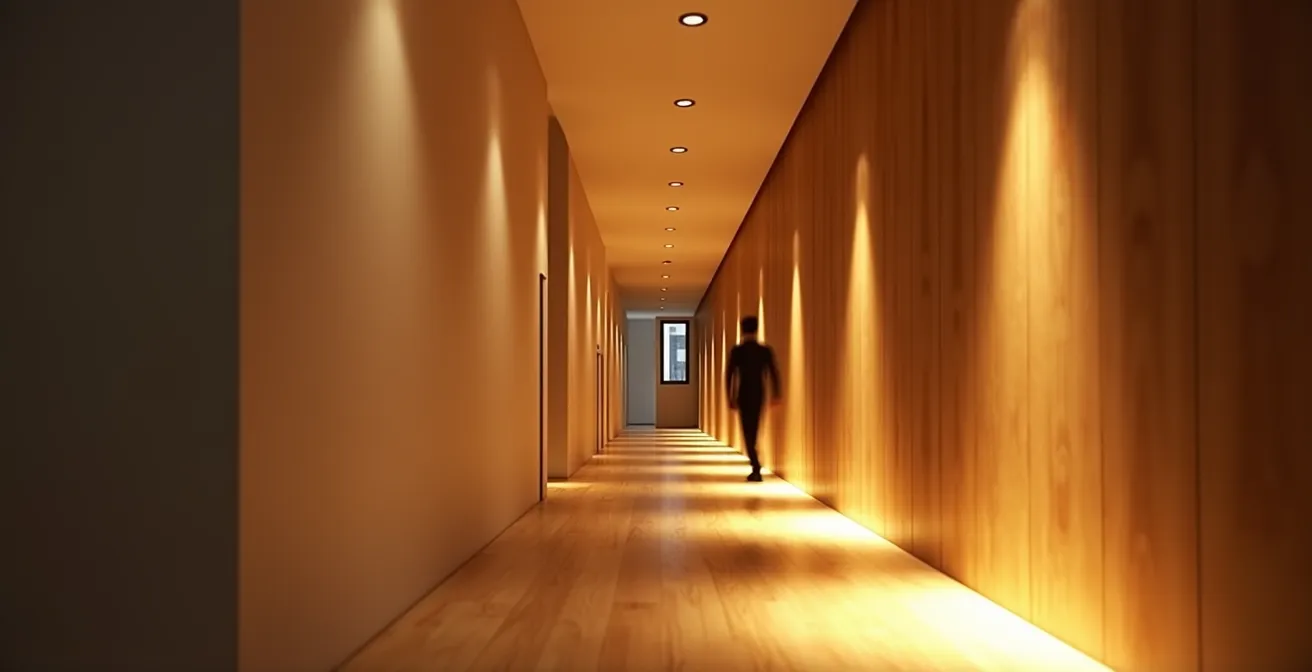
The goal is to create an intelligent system that provides light precisely when and where it’s needed. By installing occupancy or motion sensors, you ensure that lights activate upon entry and, crucially, deactivate automatically after a short, preset period of vacancy (e.g., 60 seconds). This completely removes human error from the equation and guarantees you never pay to light an empty corridor again. The visual below demonstrates how this creates intelligent “follow-me” light zones.
When implementing this, a key decision is whether to use smart bulbs or a smart switch. A smart switch replaces your existing wall switch and controls all the fixtures on that circuit. Smart bulbs are installed individually in each fixture. For a typical hallway with multiple bulbs, a single smart switch is often the most cost-effective and practical solution, as it presents a single point of failure and works intuitively for guests.
The following table breaks down the cost and complexity trade-offs for a typical four-bulb hallway, providing a clear financial and practical comparison to guide your investment decision.
| Feature | Smart Switch (Single) | Smart Bulbs (Multiple) |
|---|---|---|
| Initial Cost (4-bulb hallway) | $25-40 | $60-120 |
| Installation Complexity | Moderate (wiring required) | Simple (screw in) |
| Motion Sensor Integration | Built-in option available | Separate sensor needed |
| Guest-Proof Operation | Works with manual override | Can be disrupted by switch |
| Network Load | Single device | Multiple devices |
| Zone Control | All or nothing | Individual bulb control |
Strategic Light Zoning: Beyond the Hallway
Once you’ve mastered hallway automation, you can apply the same cost-cutting principles to the rest of your home with strategic light zoning. This auditor’s approach involves dividing your home into distinct zones based on usage patterns and creating custom automation rules for each. This moves beyond simple on/off commands to a nuanced system that minimizes every watt of wasted energy. Not all rooms are created equal, and their lighting shouldn’t be either.
First, identify your primary zones:
- Transit Zones: Hallways, stairs, and entryways. These require instant-on lighting with very short auto-off delays (30-90 seconds) to eliminate phantom illumination.
- Task Zones: Kitchen counters, home offices, and workshops. Here, sensors should be configured with longer delays (5-15 minutes) to prevent lights from turning off during periods of low movement, like reading a recipe or typing.
- Ambient Zones: Living rooms and bedrooms. These are less suited for motion-only automation. Instead, focus on scheduled lighting (e.g., dimming automatically after 10 PM) and voice-activated scenes (“Hey Google, turn on movie lights”).
The key to maximizing savings is in the configuration. For instance, a sensor in a laundry room, where you might be present for 10-15 minutes, should have a longer off-delay than one in a pantry, where visits are typically under a minute. This level of granular control ensures you are never over-lighting a space or being inconvenienced by a poorly timed shutoff. By thinking in terms of zones and behaviors rather than just rooms, you transform your lighting from a blunt instrument into a precision tool for cost savings.
Warm White vs Cool White: Does Color Temperature Affect Energy Consumption?
A common question when choosing LEDs is whether the color temperature—measured in Kelvin (K)—affects energy use. Homeowners wonder if a “cool white” (4000K-5000K) bulb is more or less efficient than a “warm white” (2700K-3000K) one. From a purely technical standpoint, the answer is no. For the same lumen output (brightness), technical analysis confirms a negligible energy difference of less than 1% between different color temperatures in modern LEDs. The real savings are not technical; they are behavioral.
The secret lies in human perception. Our eyes perceive cooler, bluer light as brighter and more intense than warmer, yellower light, even at the exact same lumen level. This psychological effect is a powerful tool for an energy auditor. By using cooler-temperature bulbs in task-oriented areas like kitchens or home offices, you can often dim the lights to 80% brightness without any noticeable decrease in functional visibility. This 20% reduction in power consumption is a direct saving, achieved not through hardware efficiency but through smart, perception-based programming.
This concept is the foundation of “Adaptive Lighting” features in advanced smart home systems. These routines automatically adjust both the color temperature and brightness of your lights throughout the day to match natural circadian rhythms. They might provide cool, energizing light in the morning and transition to warm, dim light in the evening to help you relax. Research shows this behavioral programming can naturally reduce energy consumption by up to 20%, as the system intelligently dims the lights when less intensity is needed. The saving comes from what you do with the color, not the color itself.
The “Vampire Power” Mistake of Cheap Smart Bulbs
The promise of a $10 smart bulb is tempting, but it often hides a significant long-term cost: vampire power. This is the electricity consumed by a device when it is turned “off” but remains in standby mode. All smart bulbs require a constant connection to your network (be it WiFi, Zigbee, or Thread) to receive commands. This standby state continuously draws a small amount of power, 24/7. While the draw of a single bulb is minuscule, a house full of them can add up to a noticeable and completely unnecessary expense on your bill.
The technology inside the bulb matters immensely. The most common and cheapest smart bulbs use WiFi. To maintain a stable connection, these smart bulbs consume 0.5 to 2 watts in standby mode. In contrast, bulbs using dedicated low-power mesh protocols like Zigbee or Thread are far more efficient, typically drawing only 0.1 to 0.5 watts. For a home with 20 smart bulbs, choosing WiFi over Zigbee could mean paying for an extra 30 watts of constant power draw—the equivalent of leaving a significant incandescent bulb on all year long.
An energy auditor looks at this cumulative waste and sees a major opportunity for savings. Before investing in a smart lighting system, you must factor in the long-term cost of standby power. Opting for a slightly more expensive Zigbee-based system with a central hub can lead to significant savings over the device’s lifespan compared to a house full of cheap, power-hungry WiFi bulbs. It’s a classic case of paying a little more upfront to save a lot more down the line.
Action Plan: Minimizing Vampire Power in Your Smart Lighting
- Protocol Choice: Prioritize Zigbee or Thread bulbs. Their lower standby consumption of 0.2-0.5W is a direct saving over the higher drain from WiFi-based bulbs.
- Consolidate Control: Group multiple lights on a single smart switch instead of using individual smart bulbs for each. This reduces the number of devices in standby mode from many to just one.
- Calculate the Cost: Understand the real expense. Based on data from experts, even a low 0.2W standby draw costs about $0.02 per month per bulb at average electricity rates. Multiply this by the number of bulbs in your home to see the total hidden cost.
- Verify Certification: Look for the Energy Star logo when purchasing. This certification indicates that the product has been tested and optimized for low standby power consumption.
- Use Smart Power Strips: For clusters of lamps or accent lights not in constant use (e.g., entertainment center backlighting), group them on a smart power strip that you can program to cut power completely during off-hours or vacations.
Building a Cost-Effective Smart Lighting Ecosystem
A truly cost-effective smart lighting system isn’t about buying the most expensive gear; it’s about building a cohesive and efficient ecosystem. The choices you make regarding communication protocols and device types have a direct and lasting impact on your electricity bill and the system’s reliability. From an auditor’s perspective, the goal is to achieve maximum control with minimum energy waste.
The foundational choice is your communication protocol. As we saw with vampire power, this is critical:
- WiFi: Best for a few standalone devices. It’s easy to set up as it connects directly to your router. However, it consumes more power in standby and can clog your home network if you have dozens of devices.
- Zigbee/Z-Wave/Thread: These are low-power mesh networks that require a central hub. While the initial setup involves an extra device (the hub), they are vastly more energy-efficient and reliable. They create their own dedicated network, so they don’t slow down your WiFi, and their range extends as you add more devices. This is the financially prudent choice for a whole-home system.
The next strategic decision is choosing between smart bulbs and smart switches. A hybrid approach is often the most cost-effective. Use smart switches for rooms with multiple overhead lights (kitchens, living rooms, hallways). This is cheaper and more intuitive than managing 4-6 individual smart bulbs. Reserve smart bulbs for specific applications where you need color or brightness control for a single lamp, such as a bedside table or an accent light. This targeted approach gives you the advanced features where you need them without paying for them (in both purchase price and vampire power) where you don’t.
How to Use Dimmers to Extend Bulb Life and Save Energy?
Dimmers are one of the most underutilized tools in a homeowner’s energy-saving arsenal. Most people see them as a way to set a mood, but an energy auditor sees them as a dual-purpose cost-cutting device. Using a dimmer not only reduces immediate energy consumption but also significantly extends the lifespan of your LED bulbs, compounding your savings over time.
The energy-saving mechanism is straightforward: an LED bulb dimmed to 75% brightness does not use 75% of the power. Due to the way their drivers work, the power drop is even more significant. For example, a 12W LED dimmed to 50% brightness might only use 7.2W (60% of full power). A practical example shows that this simple act can result in a saving of $1.26 annually per bulb when dimmed for just four hours a day at average electricity rates. When you apply this across all the dimmable lights in your home, the annual savings become substantial.
The second, often overlooked, benefit is longevity. Heat is the primary enemy of an LED’s electronic components. Dimming a bulb reduces its operating temperature, which in turn lessens the stress on its internal parts. According to the U.S. Department of Energy, proper management and dimming are key factors in why LED bulbs can last 25 times longer than traditional lighting, with lifespans reaching up to 50,000 hours. This means you not only pay less for electricity but also buy replacement bulbs far less frequently, further reducing your total cost of ownership. Creating preset scenes in your smart system—like a “Watch TV” scene at 40% brightness or a “Dinner” scene at 60%—automates these savings and makes them effortless.
Key Takeaways
- Focus on Total Cost of Ownership (TCO): The cheapest bulb to buy is rarely the cheapest to own. Factor in energy use, replacement frequency, and hidden costs like vampire power.
- Eliminate “Phantom” Energy Waste: The biggest savings come from not using electricity. Use motion sensors for transit zones and smart protocols (Zigbee/Thread) to crush vampire power draw.
- Control Is the Ultimate Lever: Strategic use of dimmers, schedules, and color temperature psychology will save far more money than simply swapping to a more efficient bulb.
Conducting Your Own Home Lighting Audit to Achieve 40% Savings
You now have the framework of a professional energy auditor. The final step is to apply this knowledge systematically to your own home. Achieving a 40% reduction in your lighting bill is not about a single magic bullet, but about the cumulative effect of many small, strategic optimizations. A home lighting audit is a simple, five-step process that will give you a concrete action plan to stop wasting money.
First, map your current system. Walk through your home with a notepad and list every single light fixture. Note the type of bulb (CFL, LED), its wattage, and the room’s function (transit, task, or ambient). This inventory is your baseline.
Second, identify waste zones. For each light, ask: “Is this light ever on when the room is empty?” and “Is this light brighter than it needs to be for its task?” Hallways, closets, and guest rooms are often major culprits. This is where you will target your first interventions with sensors and dimmers.
Third, calculate the TCO for replacements. Focus on any remaining CFLs or incandescents. Calculate their high replacement and energy costs over the next five years and compare that to the single upfront cost of a quality LED. This data will justify the investment.
Finally, develop your strategic plan. Based on your audit, decide where a smart switch is more cost-effective than smart bulbs. Choose a low-power protocol like Zigbee for your whole-home system to minimize vampire power. Program scenes and schedules that align with your family’s actual behavior. By systematically replacing guesswork with data and strategy, you turn your home’s lighting into a finely tuned, cost-saving machine.
Start your audit today by mapping out a single room. This first step is the most critical in taking active control of your electricity bill and beginning your journey to a smarter, more cost-efficient home.