
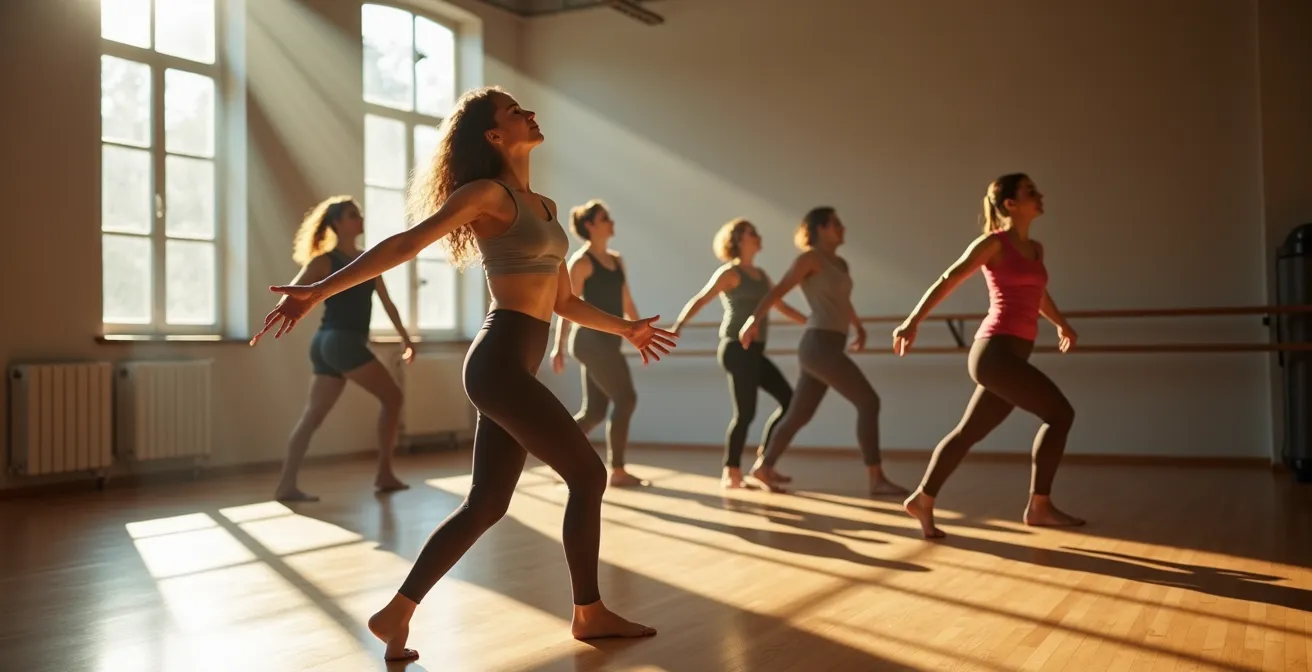
The key to enhancing memory and coordination isn’t just ‘brain training’—it’s integrating the brain and body through the complex challenge of dance.
- Learning choreography builds cognitive reserve more effectively than passive activities like crossword puzzles because it demands multi-modal integration of rhythm, space, and memory.
- Different dance styles offer unique benefits, but all forms engage proprioception and synaptic plasticity, the foundations of motor control and learning.
Recommendation: Choose a dance class not just for the physical exercise, but for the specific cognitive challenge it presents, focusing on learning and memorizing new patterns to maximize brain health benefits.
The concern over losing a step mentally as we do physically is a quiet, persistent worry for many adults. We’re told to keep our minds active with puzzles, sudoku, and crosswords, treating the brain like a muscle to be exercised in isolation. But what if this approach overlooks the most profound connection of all: the one between our mind and our body? What if the secret to a sharper memory and steadier coordination isn’t found in a pen-and-paper puzzle, but in the rhythm of a salsa step or the grace of a ballet movement?
Many adults wonder, “Is it too late for me to learn to dance?” The answer, from a neurological perspective, is a resounding no. In fact, starting now may be one of the most powerful actions you can take for your cognitive health. This isn’t about becoming a professional performer; it’s about engaging in a process that is uniquely suited to challenge and build the brain. While any physical activity is beneficial, dance is distinct. It is a language of movement, a puzzle solved not with the fingers, but with the entire body in space and time.
The true power of dance lies in what I call neuro-scaffolding: the active construction of new neural pathways by forcing different brain regions to work together. Unlike the repetitive, single-domain challenge of a crossword, dance requires the simultaneous integration of auditory processing (music), spatial awareness (your position), procedural memory (the steps), and social cues (a partner or group). This article will explore the science behind why this multi-modal activity is a superior tool for building cognitive reserve, how to choose a style that’s right for your body, and how to harness its benefits for lasting brain health and physical confidence.
This guide delves into the specific mechanisms that make dance a powerhouse for the adult brain. We will navigate from a scientific comparison with traditional brain games to practical advice on choosing a class and practicing effectively, providing a complete roadmap to unlocking these cognitive benefits.
Summary: Unlocking Cognitive Health Through Movement
- Why Learning Choreography Is Better for Your Brain Than Crosswords?
- How to Choose Between Salsa and Ballet for Joint Health?
- Group Class vs Online Video: Which Keeps You Motivated?
- The Warm-Up Mistake That Leads to Ankle Injuries in Beginners
- How to Practice Steps at Home Without a Full Studio?
- The Long-Term Health Risks of Shift Work Disorder
- Why Cycling to Work Reduces Stress Levels Compared to Driving?
- How to Fix Your Sleep Cycle to Boost Overall Health Recovery?
Why Learning Choreography Is Better for Your Brain Than Crosswords?
For decades, the prevailing wisdom for staving off cognitive decline has been “use it or lose it,” with a strong emphasis on mental puzzles. While these activities are not without merit, they often exercise the brain in a limited, siloed fashion. Learning dance choreography, in contrast, is a full-brain workout that engages multiple cognitive systems simultaneously. It is the difference between lifting a single dumbbell and performing a complex, full-body athletic movement. The brain must interpret music, remember sequences of steps, adjust to a partner’s movements, and navigate a physical space, all at once. This is the essence of multi-modal integration.
This integrated challenge actively builds what neuroscientists call cognitive reserve—the brain’s ability to withstand neurological damage. By creating new and redundant neural pathways, you build a more resilient and flexible mind. Passive puzzles often rely on retrieving existing knowledge, whereas learning choreography forces the creation of new procedural memories. The scientific evidence supporting this is compelling. For example, a landmark 21-year study published in the New England Journal of Medicine found that frequent dancing led to a 76% reduced risk of dementia. This was the greatest risk reduction of any activity studied, physical or cognitive, far surpassing the 47% reduction associated with doing crossword puzzles at least four days a week.
The key distinction is the demand for rapid-fire decision-making and adaptation. A crossword puzzle is static; the answer is fixed. In dance, timing, placement, and execution are constantly being adjusted. This process of learning, making mistakes, and self-correcting is a potent driver of synaptic plasticity, the very mechanism through which the brain learns and adapts. It’s not just about recalling a word; it’s about embodying a sequence, a far more complex and enriching task for your neurons.
How to Choose Between Salsa and Ballet for Joint Health?
Once you’re convinced of the cognitive benefits, the practical question becomes: which dance is for me? For adults concerned with joint health, this is not a trivial decision. The choice between a style like Salsa and a discipline like classical Ballet involves very different biomechanical demands. Understanding these differences is key to a sustainable and enjoyable practice that strengthens you without causing injury. Salsa is characterized by fluid hip rotation, bent knees, and quick footwork, with much of the movement centered in the hips and torso. Ballet, even at an adult-beginner level, emphasizes external rotation from the hips (turnout), precise foot articulation, and vertical alignment.
The primary consideration should be your own body’s history and predispositions. If you have sensitive knees or hip issues, the constant rotation in Salsa may require careful attention to technique to avoid torque. Conversely, the demands on the ankles and feet in Ballet, especially with foundational movements like relevé (rising onto the balls of the feet), are significant. The type of flooring also plays a role; social Salsa is often danced on hard, unforgiving floors, while Ballet is almost always taught on sprung floors designed to absorb impact. However, both styles, when taught correctly for adults, can be modified to be safe and highly beneficial for proprioception and joint stability.
The following table, based on an analysis of dancers’ joint health, breaks down the key distinctions to help you make an informed choice.
| Aspect | Salsa | Ballet |
|---|---|---|
| Primary Joint Stress | Knees and hips (rotational) | Ankles and feet (flexion/extension) |
| Floor Type Impact | Often hard floors (social venues) | Usually sprung floors (studios) |
| Movement Speed | Quick rotational movements | Slower, controlled extensions |
| Range of Motion | Natural hip rotation | Extreme turnout and pointe work |
| Recommended for Beginners | Yes, with proper technique | Yes, adult classes with modifications |
Ultimately, the “best” dance is one you will stick with. Try a beginner class in each style. Pay close attention to how your joints feel during and after. More importantly, notice which style of movement and music brings you more joy. An engaged and happy mind is a prerequisite for a consistent practice, which is where the real, long-term benefits for both your joints and your brain are found.
Group Class vs Online Video: Which Keeps You Motivated?
In the digital age, the temptation to learn from the comfort of home via online videos is strong. It offers convenience, privacy, and endless choice. However, when the goal is not just learning steps but long-term engagement for cognitive health, the dynamic of a group class often provides a motivational ecosystem that is difficult to replicate alone. The primary driver is social connection and accountability. Being in a room with peers who share a common goal creates a sense of camaraderie and gentle social pressure that encourages you to show up, even on days when motivation wanes.
This social component is not just a “nice-to-have” feature; it is a critical part of the brain health equation. Social isolation is a significant risk factor for cognitive decline, and group classes directly counteract this. The shared experience of learning, laughing at mistakes, and celebrating small victories creates positive feedback loops that reinforce the habit. As research into older adult wellness consistently shows, combining physical, cognitive, and social stimulation yields the greatest benefits. The Older Adult Care Research Team highlights this synergy in their work on senior health:
Dance classes bring people together who share a common interest in dance, providing an opportunity to meet new people and form social connections.
– Older Adult Care Research Team, Why You Should Dance as an Older Adult for Your Health
Furthermore, a live instructor provides immediate, personalized feedback on your alignment and technique. This is crucial for preventing injury and for mastering the correct motor patterns, which is the foundation of coordination improvement. An online video cannot see if you are putting unsafe pressure on your knee or if your posture is compromising your balance. While online resources can be an excellent supplement for practicing at home, the motivational and corrective power of a group class, especially for beginners, is unparalleled for building a safe and lasting habit.
The Warm-Up Mistake That Leads to Ankle Injuries in Beginners
One of the greatest barriers to a sustained dance practice is injury, and for adult beginners, the ankles are particularly vulnerable. The most common and dangerous mistake is misunderstanding the purpose of a warm-up. Many people equate “warming up” with “static stretching”—holding stretches like a toe touch or a calf stretch for 30 seconds. Performing static stretches on cold muscles is counterproductive and can actually increase the risk of injury. A cold muscle, when stretched, does not lengthen effectively and can be more susceptible to tears or strains when you then ask it to perform the dynamic, explosive movements of dance.
The goal of a warm-up is not to increase flexibility (that is for the cool-down) but to literally increase the temperature of the muscles and increase blood flow. It’s about preparing the neuromuscular system for the work ahead. An effective warm-up must be dynamic, meaning it involves movement. This process awakens the proprioceptive nerves, which are sensory receptors that communicate your body’s position to your brain. For ankle stability, this is non-negotiable. Dynamic movements like ankle circles, pointing and flexing, and gentle rises (relevés) activate the muscles and ligaments around the joint, preparing them to stabilize you during turns, shifts of weight, and landing from small jumps.
Skipping this crucial preparation and jumping straight into choreography, or performing the wrong type of warm-up, leaves the ankle joint unsupported and unprepared. This is how a simple misstep or an awkward turn leads to a sprain or a more serious injury, potentially sidelining you for weeks and killing your hard-won motivation. A proper dynamic warm-up is your insurance policy against injury.
Action Plan: Dynamic Warm-Up Protocol for Ankle Safety
- Start with 3-5 minutes of light cardiovascular activity (e.g., marching in place, gentle jumping jacks) to raise your core body temperature.
- Perform 10-15 ankle circles in each direction on both feet to mobilize the joint through its full range of motion.
- Execute a series of slow and controlled relevé/plié preparations (rises onto the balls of your feet and gentle knee bends) to activate the calf muscles and ankles.
- Practice pointing and flexing your feet 20 times to pump blood into the lower legs and feet.
- Include 30-second single-leg balance holds on each leg to fire up your proprioceptive nerves and engage stabilizer muscles.
How to Practice Steps at Home Without a Full Studio?
A common hurdle for adult learners is the feeling that progress only happens inside the classroom. The time between classes, however, is a critical period for memory consolidation. The good news is you don’t need a mirrored, sprung-floor studio to make significant progress. The most powerful tool for practicing at home is not physical space, but your own mind. The technique of mental rehearsal, or visualization, activates the same neural pathways as physical practice, strengthening procedural memory without moving a muscle.
This is where dancers can borrow a powerful mnemonic tool known as the “Memory Palace.” This technique involves using a familiar location in your mind—like your own living room—and mentally placing specific movements or sequences in different spots. By mentally “walking” through the space, you can rehearse the choreography in the correct order. This is not just daydreaming; it is a structured cognitive exercise that builds robust mental maps of the choreography.
Case Study: The Memory Palace Technique for Dance
Dance memory expert Anthony Metivier demonstrates how dancers can overcome space limitations by using the Memory Palace technique. He instructs dancers to mentally recreate their classroom, projecting body positions and movements onto imaginary walls and furniture. For instance, the first eight-count of a routine might be “placed” on the couch, the next on the bookshelf, and so on. By dividing the space into quadrants and using these familiar reference points, dancers can mentally rehearse complex sequences without physical space. Scientific studies confirm that this form of structured mental rehearsal can significantly improve choreography retention and performance quality, as it activates the same motor cortex regions used in physical execution.
Beyond visualization, you can use simple tools to practice in small spaces. Use painter’s tape on the floor to mark foot positions or pathways. Practice “marking” the choreography, which means performing the movements at 50% energy, focusing on the sequence and timing rather than full physical exertion. This is especially useful for complex footwork. Practicing in socks (on a non-slip surface) can also enhance your proprioceptive feedback, helping you feel the connection between your feet and the floor more acutely. The goal of at-home practice is not perfect execution, but reinforcing the neural patterns learned in class.
The Long-Term Health Risks of Shift Work Disorder
While shift work disorder might seem unrelated to adult dance, it provides a powerful scientific model for understanding a problem that affects many aging adults: circadian rhythm disruption. Shift work disorder is an extreme example of what happens when our internal body clock is chronically out of sync with the external light-dark cycle, leading to sleep disturbances, metabolic issues, and significant cognitive impairment. The resulting brain fog, poor memory, and reduced executive function are not dissimilar to the cognitive complaints that concern many seniors. This disruption reduces the brain’s natural ability to repair and consolidate memories during sleep.
This is where dance enters as a potent therapeutic intervention. It combats the effects of circadian disruption on a deep, neurochemical level. One of the key players in brain health and plasticity is a protein called Brain-Derived Neurotrophic Factor (BDNF). BDNF is like a fertilizer for your brain cells, promoting the survival of existing neurons and encouraging the growth of new ones. Its levels are known to be negatively affected by sleep disruption and stress. Regular, rhythmic aerobic activity—the very definition of dance—has been shown to be one of an effective way to boost BDNF.
For instance, research highlighted in publications like the Neuroscience Biobehavior Review shows that regular aerobic dance activity robustly increases BDNF levels, particularly in the hippocampus, a brain region critical for learning and memory. By engaging in dance, an adult can create a positive neurochemical cascade that directly counteracts the negative effects of a disrupted body clock, whether it’s caused by lifestyle, age, or stress. It provides a scheduled, joyful daytime activity that helps re-anchor the circadian system while simultaneously providing the brain with the very molecules it needs to repair itself and build resilience.
Why Cycling to Work Reduces Stress Levels Compared to Driving?
This question, seemingly about commuting, offers a perfect analogy for understanding two different ways the brain can engage in a complex task—and why certain forms of dance are more cognitively beneficial than others. Driving in traffic is a highly reactive, high-stress activity. It requires constant, split-second decision-making, threat assessment (other cars, pedestrians), and a state of high alert. This constant stimulation of the “fight or flight” system elevates cortisol levels. Cycling, in contrast, can often be a rhythmic, predictable activity that allows the brain to enter a state of “flow,” reducing stress and promoting mental clarity.
This same dichotomy exists within the world of dance. Following a pre-learned, memorized choreography is like cycling on a familiar path. It is a powerful tool for memory consolidation and refining motor skills. However, freestyle social dancing—like Salsa, Swing, or Tango—is cognitively akin to driving in traffic, but in a positive way. It requires the same split-second decision-making as you react to a partner’s lead, navigate a crowded dance floor, and adapt your movements to the music in real-time. This dynamic, unscripted problem-solving is a formidable cognitive workout.
A Stanford study on the cognitive benefits of dance directly explored this difference. Researchers found that freestyle social dancing, with its constant demand for adaptation and rapid choices, was superior in creating new neural pathways compared to simply recalling memorized sequences. This process of improvisation under pressure trains the brain’s executive functions—the high-level cognitive skills used for planning, problem-solving, and managing novel situations. It’s a playful way to build the same mental agility needed to navigate the unpredictable challenges of daily life, effectively reducing real-world stress by improving your ability to handle it.
Key Takeaways
- Dance is a form of ‘neuro-scaffolding’ that builds cognitive reserve more effectively than passive puzzles by integrating multiple brain systems at once.
- Freestyle social dancing enhances real-time decision-making and executive function, while learning set choreography strengthens procedural memory.
- A proper dynamic warm-up is non-negotiable for injury prevention, focusing on movement to prepare muscles and nerves, not static stretching.
How to Fix Your Sleep Cycle to Boost Overall Health Recovery?
A stable sleep cycle is the bedrock of cognitive function and physical recovery. During deep sleep, the brain cleanses itself of metabolic waste and, crucially, consolidates memories—transferring what you learned during the day from short-term to long-term storage. For anyone learning a new skill like dance, quality sleep is not a luxury; it is part of the practice. A disrupted sleep cycle sabotages this process, making it harder to remember choreography and hindering the body’s ability to repair muscle tissue. Fixing your sleep cycle, therefore, directly accelerates your progress in both memory and coordination.
Dance can be a powerful regulator of your sleep cycle, but it must be timed correctly. Vigorous physical activity, like an intense dance class, raises your core body temperature and heart rate. This is excellent for daytime, as it promotes alertness and anchors your circadian rhythm. However, engaging in intense practice within 2-3 hours of bedtime can interfere with your ability to fall asleep. Instead, the evening is the perfect time for a different kind of dance practice: gentle stretching of the muscles worked during the day and, most importantly, the mental rehearsal of choreography. This quiet visualization calms the nervous system while simultaneously reinforcing the day’s learning, priming the brain for effective memory consolidation during the night.
The long-term impact of this synergy between dance and sleep is profound. Sustained, regular activity is key to maintaining motor function over a lifetime. For instance, a 2021 study in Brain Sciences found that people with Parkinson’s disease who participated in a dance class just once a week for three years showed significantly less decline in their motor function compared to those who didn’t. This remarkable result is not just about the one hour of dancing; it’s about the cumulative effect of a regular, joyful activity that regulates sleep, reduces stress, and continuously challenges the brain-body connection, leading to enhanced overall health recovery and resilience.
These principles show that improving memory and coordination is an active, integrated process. The final step is to translate this knowledge into action. To begin building your own cognitive reserve, the next logical step is to find a beginner’s class in your community that aligns with your health goals and, most importantly, brings you joy.