
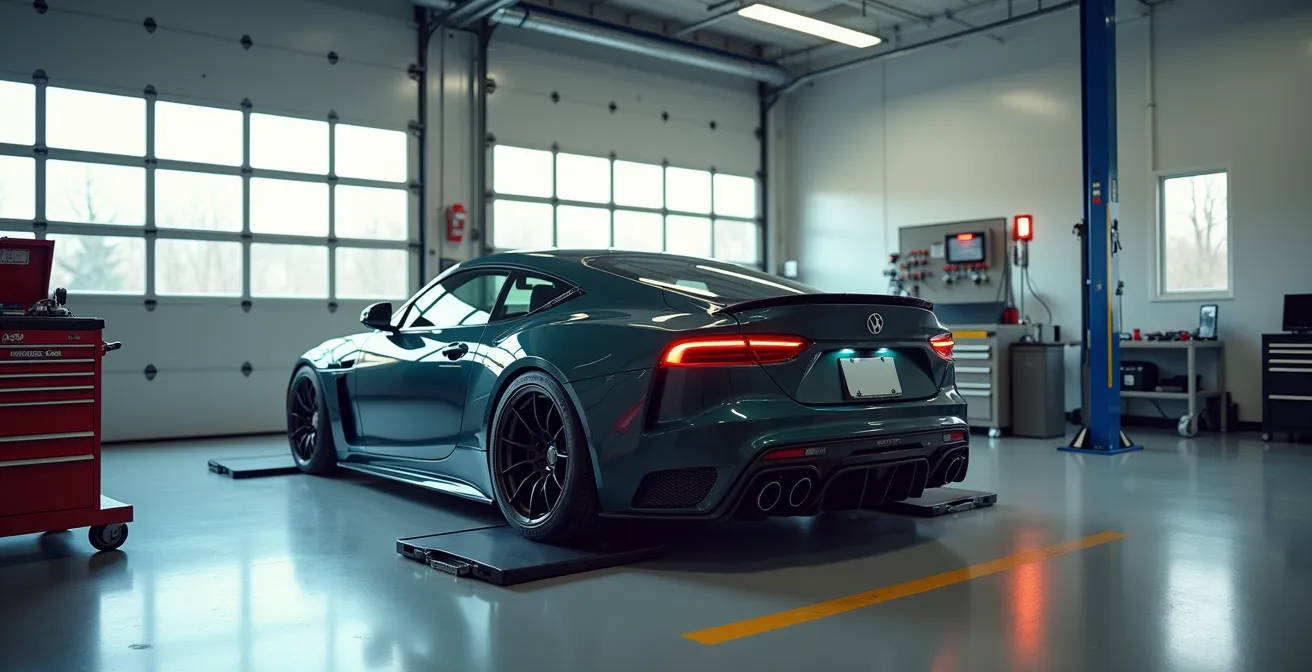
Passing a vehicle inspection with modifications is less about the physical parts and more about mastering the invisible regulatory framework behind them.
- Legal compliance hinges on a verifiable “paper trail” like CARB EO numbers, not just a part’s appearance or sound.
- Your car’s onboard computer (OBD-II) creates a “digital ghost,” logging ECU tunes that can’t be erased by simply flashing back to stock.
- Failing to declare modifications to your insurer correctly can be a more costly mistake than failing the inspection itself.
Recommendation: Shift your focus from hiding mods to documenting them. Build a “compliance portfolio” for your vehicle before you even book your inspection appointment.
The annual dread is a familiar feeling for any car enthusiast. You’ve spent months and a significant amount of money perfecting your vehicle with a new exhaust system or achieving the perfect stance with coilovers. But as the inspection date looms, a cold sweat sets in. The internet is full of conflicting advice: “just swap it back to stock,” “my buddy passed with a straight pipe,” or “as long as it’s not too loud, you’re fine.” This advice misses the fundamental point of modern vehicle inspections.
From my years working on the inspection floor, I can tell you the game has changed. We weren’t just looking for obvious, egregious violations. We were trained to look for the invisible tells: the missing certification stamp on a catalytic converter, the incorrect beam pattern from lowered headlights, and increasingly, the digital footprints left in the car’s own computer. The most common and costly failures I witnessed weren’t from wild engine swaps, but from well-intentioned owners who misunderstood the intricate web of regulations.
But what if the key wasn’t about last-minute part swaps or hoping for a lenient inspector? What if the secret to passing confidently was understanding the system from the inside? It’s not about the parts themselves, but about mastering the regulatory paper trail, the digital ghosts in your ECU, and the precise compliance math that determines a pass or fail. This isn’t just about getting a sticker for another year; it’s about building a street-legal car that is compliant, insurable, and enjoyable without the constant anxiety.
This guide will walk you through the critical checkpoints from an inspector’s perspective. We will decode the jargon, expose the common myths, and give you a clear roadmap to navigate not only the inspection lane but also the equally important conversations with your insurance provider.
Summary: A Tuner’s Guide to Passing Vehicle Inspections
- Why Your Sport Exhaust Is Legal to Sell But Illegal to Use?
- How to Measure Headlight Height After Lowering Your Car?
- TUV vs DOT: Which Certification Actually Matters for Your Country?
- The Visibility Myth That Leads to Window Tint Fines
- How to Reverse Mods Temporarily for Inspection Day?
- How to Declare Modifications to Your Insurer Without Getting Dropped?
- The Blind Spot Error New Cyclists Make in City Traffic
- How to Modify Your Car for Street Use Without Voiding Your Insurance?
Why Your Sport Exhaust Is Legal to Sell But Illegal to Use?
This is the most common point of confusion I’ve seen, and it’s a costly one. A manufacturer can sell a part as “for off-road use only,” which legally absolves them of responsibility for its on-road use. The burden of compliance falls entirely on you, the owner. The fact that a part is available for purchase has zero bearing on its street legality. For an exhaust system, legality isn’t just about decibel levels; it’s about emissions compliance, which is a much higher bar to clear.
The key is the regulatory paper trail. In regions like California, the ultimate proof is a CARB Executive Order (EO) number. This is a specific code assigned to an aftermarket part that has been tested and proven not to increase a vehicle’s emissions. Without this number stamped on the part or on official documentation, an inspector has grounds to fail the vehicle, regardless of how quiet it is. In Europe, a similar system exists with E-Mark certification.
A recent case in New York highlights this enforcement trend. In 2022, legislation was passed that subjects vehicles with non-OEM specification exhausts to fines exceeding $1,000. Critically, the law also holds installation shops liable, creating a system where professional installers are now a first line of defense against illegal parts. An inspector in that state can now fail a car on sight for a non-stock system, even without a decibel meter, because the part lacks the required certification. This is the reality of modern enforcement: no paperwork means no pass.
How to Measure Headlight Height After Lowering Your Car?
Lowering your car with coilovers or new springs is a popular modification, but it directly alters one of the most critical safety systems: your headlights. Factory headlights are precisely aimed. When you lower the chassis, you change that angle, often causing your low beams to dazzle oncoming drivers. This is not a subjective “it looks fine to me” issue; it is a failure based on measurable geometry. Inspectors are trained to spot the incorrect beam cutoff pattern instantly.
You don’t need a fancy optical rig to check this yourself. The process is straightforward and requires a level surface, a wall, and a tape measure. The goal is to ensure the top of your low beam’s cutoff line is at or below the height of the center of your headlamp when measured from 25 feet away. Many modern cars also feature auto-leveling systems that must be recalibrated after a height change. Failing to reset the ECU for this system can cause it to aim incorrectly, leading to an automatic fail, even if the static height seems right.
The image below illustrates the classic “wall test” method. The sharp horizontal cutoff line is the key indicator. If this line is projected too high, it will fail inspection. This is a clear example of “compliance math” in action—it’s a simple measurement that leaves no room for debate.
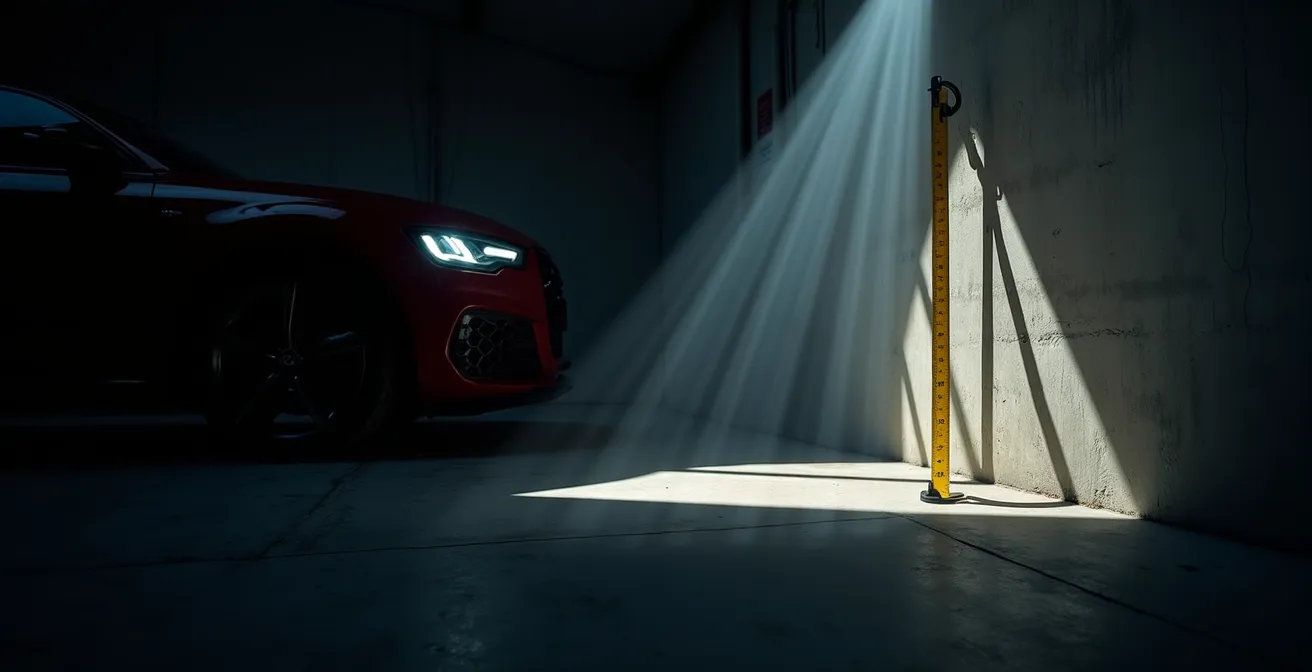
This is a test you must perform post-modification. Showing up to an inspection without having checked and adjusted your headlight aim is one of the easiest ways to get sent home with a rejection sticker. It signals to the inspector that you haven’t considered the safety implications of your modifications.
Your Headlight Height Compliance Checklist
- Park the vehicle on a perfectly level ground 25 feet from a blank, vertical wall.
- Measure the distance from the ground to the absolute center of each headlight lens and document it with photos.
- Mark the headlight centerline height on the wall with a strip of horizontal tape.
- Turn on the low beams and observe the horizontal cutoff line of the beam pattern.
- Adjust the headlight aim using the vertical adjustment screws until the cutoff is at or just below the tape line on the wall, as specified in an official headlight adjustment protocol.
TUV vs DOT: Which Certification Actually Matters for Your Country?
The world of aftermarket parts is flooded with acronyms: TUV, DOT, SAE, E-Mark. Many enthusiasts mistakenly believe these are interchangeable quality badges. This is a critical error in “jurisdictional arbitrage.” A part’s certification is only valid in the jurisdiction that recognizes it. A TÜV-approved part is not automatically street-legal in the United States, just as a DOT-compliant part doesn’t guarantee a pass in Germany.
Think of certifications in tiers. The highest tier (Tier 1) is mandatory, region-specific approval like a CARB EO number in California or an E-Mark in Europe. These are legally required for on-road use. The next tier (Tier 2) includes national standards like DOT (Department of Transportation) or SAE (Society of Automotive Engineers) in the US. These typically indicate that a part meets minimum federal safety standards.
TÜV, while highly respected, falls into a different category for those outside of Germany. As the Turner Motorsport Technical Department explains, “TÜV is a combination of UL (Underwriter’s Laboratories) and the US DOT… any manufacturer claiming to be OEM must submit their products to TÜV for testing.” For an American inspector, a TÜV certificate is merely persuasive evidence of quality, not proof of legal compliance. It shows the part is well-made, but it doesn’t prove it meets local DOT or EPA regulations. You cannot use a TÜV certificate to bypass a CARB EO requirement.
This table breaks down the hierarchy. Understanding it is crucial to avoid buying expensive parts that are worthless for your local inspection.
| Certification Level | Authority | Legal Weight | Geographic Validity |
|---|---|---|---|
| Tier 1: Mandatory | CARB EO (California), E-Mark (Europe) | Legally Required | Country/Region Specific |
| Tier 2: Federal | DOT/SAE (US), ECE (Europe) | National Compliance | Nationwide |
| Tier 3: Quality Indicators | TÜV (Germany), CAPA, NSF | Persuasive Evidence | Quality Assurance Only |
The Visibility Myth That Leads to Window Tint Fines
Window tint is another modification governed by unforgiving math, not by subjective appearance. The most common myth is that you can simply buy film that matches your state’s legal limit and be compliant. For example, if your state’s limit for front windows is 35% Visible Light Transmission (VLT), you might buy 35% VLT film. This is where the “stacking effect” calculation error occurs.
Most factory car windows are not 100% clear. They typically have a slight factory tint, often around 70-80% VLT. When you apply your new film, the final VLT is the product of the two values, not the value of the film alone. For instance, applying a 35% film to a window that is already at 73% VLT results in a final VLT of only 25.5% (0.35 x 0.73 = 0.255). If the state minimum is 28%, you have just made your car illegal. This is a simple calculation that many owners overlook, leading to an easy fine. Some states have even stricter requirements; an analysis shows that some jurisdictions require a minimum of 70% VLT for front side windows.

Inspectors don’t guess. We use handheld, calibrated tint meters that provide an instant and definitive VLT reading, as shown in the image. The number on the meter’s screen is the only evidence that matters. Arguing that “it doesn’t look that dark” is a futile exercise. The meter is objective, and it will expose any miscalculation in your compliance math. Before you tint, you must account for the VLT of your base window glass.
How to Reverse Mods Temporarily for Inspection Day?
Let’s be pragmatic. Sometimes, a modification is simply not legal for street use in your jurisdiction, and the only path to a passing sticker is a temporary return to stock. This is the last resort, but it needs to be a calculated part of your modification strategy, not a frantic, last-minute scramble. The key is to understand the reversibility of each modification before you even install it.
Some mods are easily reversible. An ECU tune can often be flashed back to the stock map in under 30 minutes with the right device. A cold air intake or a cat-back exhaust can typically be swapped for the OEM parts in a couple of hours with basic tools. However, other modifications are a much larger commitment. Reverting coilovers to a stock suspension setup is a half-day job that may require specialized tools like a spring compressor and will almost certainly demand a new wheel alignment, adding cost and complexity.
The wise enthusiast keeps all original parts, labeled and stored, for this very reason. When planning your build, consider the time, cost, and tools required for reversal. This “reversibility scorecard” should influence your purchasing decisions. If a part is a major undertaking to uninstall, you should be far more certain of its street legality before committing.
| Modification | Reversal Time | Cost | Tools Needed | Difficulty |
|---|---|---|---|---|
| Cat-back Exhaust | 2-3 hours | $0 (if kept OEM) | Basic hand tools | 2/5 |
| Coilovers | 4-6 hours | $0-50 (alignment) | Spring compressor | 4/5 |
| ECU Tune | 30 minutes | $0-100 | OBD-II tuner | 1/5 |
| Cold Air Intake | 1 hour | $0 | Basic tools | 1/5 |
How to Declare Modifications to Your Insurer Without Getting Dropped?
Passing the state inspection is only half the battle. The other, often overlooked, regulatory hurdle is your insurance company. A standard auto policy is priced for a standard car. When you add modifications, you change the risk profile and the replacement value of the vehicle. Failing to declare these changes can give the insurer grounds to deny a claim, leaving you with a total financial loss, even if you’ve been paying your premiums faithfully.
The secret is in the “declarative strategy.” You must proactively inform your insurer, but the way you frame the information is critical. Instead of calling and saying “I installed a turbo and lowered my car,” which screams “high risk,” you should present a professional “modification portfolio.” This portfolio frames your changes as improvements to safety, reliability, and handling optimization, not just raw performance. Use terms like “suspension optimization for improved road holding” instead of “lowering kit” and “brake system upgrade for enhanced safety.”
Your portfolio should include professional installation receipts, manufacturer specifications showing safety compliance (like DOT or TÜV certificates), and a log of regular maintenance. This demonstrates that you are a responsible, meticulous owner, not a reckless driver. This approach transforms the conversation from one of risk to one of responsible enhancement. It’s about showing, not just telling, that your modified car is safe and well-maintained. Crucially, as a legal analysis of the Magnuson-Moss Warranty Act points out, coverage can only be denied if the aftermarket part specifically caused the failure for which a claim is made, a point worth remembering.
The Blind Spot Error New Cyclists Make in City Traffic
In traffic, the most dangerous threat is the one you don’t see. For new cyclists, this is often a car in their physical blind spot. For the “new” or inexperienced car tuner, the most dangerous blind spot is digital: the permanent data trail left inside the vehicle’s own computer. Many believe they can install an aggressive ECU tune for a track day, then simply flash the stock map back on before an inspection and be in the clear. This is a fundamental misunderstanding of how modern On-Board Diagnostics (OBD-II) systems work.
Your car’s Engine Control Unit (ECU) is a meticulous record-keeper. It contains a “flash counter” that increments every time the software is modified. An inspector can plug into your OBD-II port and see this counter. A number greater than what’s expected from official dealer updates is an immediate red flag. It’s a “digital ghost” that proves the ECU has been tampered with, even if the current software is stock. In jurisdictions like California, this is now an automatic failure. A 2024 report on inspection data confirms that a vehicle can pass the tailpipe emissions test but still fail because the OBD system reports a “Modified Software” status.
Furthermore, after flashing your ECU or disconnecting the battery, the system’s “readiness monitors” are reset. These are a series of self-tests the car runs on components like the catalytic converter and oxygen sensors. Before an inspector can even begin the test, these monitors must all report a “Ready” status. It typically requires up to one week of combined city and highway driving for these monitors to reset. Showing up for an inspection too soon after reverting your tune will result in a “Not Ready” failure, which is just as definitive as any other.
Key Takeaways
- Paperwork Over Appearance: A part’s legality hinges on verifiable certifications (like CARB EO or E-Mark), not its looks or sound. No papers, no pass.
- Your ECU Has a Memory: Reverting an ECU tune doesn’t erase the evidence. The “digital ghost” of the flash counter can lead to an automatic failure.
- Insurance Is Not Optional: A passing inspection sticker is worthless if your insurance claim is denied. Declaring mods with a “stated value” policy is essential to protect your investment.
How to Modify Your Car for Street Use Without Voiding Your Insurance?
Successfully building a modified car for street use requires a holistic strategy that extends far beyond the inspection lane. The ultimate goal is a vehicle that is not only legally compliant but also fully and properly insured. The two are inextricably linked. An illegal modification that causes an accident can be grounds for your insurer to void your policy entirely, leaving you personally liable for damages.
Insurance companies categorize modifications into risk tiers. Tier 1 mods, like cosmetic changes, different wheels, or a cat-back exhaust, are generally low-risk and may only slightly increase your premium. Tier 2 mods, which must be declared, include coilovers, ECU tunes, and intakes. These can increase premiums by 10-25%. Tier 3 represents major changes like engine swaps or forced induction, which will likely require a specialist insurer, as standard carriers may refuse coverage.
The most critical concept to understand is the difference between an “Actual Cash Value” (ACV) and a “Stated Value” policy. As a specialist insurance advisory notes, a standard ACV policy will only cover the book value of a stock vehicle in a total loss, completely ignoring the thousands you’ve invested. A “Stated Value” or “Agreed Value” policy is essential. It allows you to insure the car for its true, modified worth, based on the documentation and receipts you provide. This is where your modification portfolio becomes your most valuable asset, proving the car’s worth to the insurer.
An ACV policy will only pay for a stock car’s value in a total loss, ignoring your $10k in mods. A ‘Stated Value’ policy allows you to insure the car for its true, modified worth.
– Specialist Insurance Advisory, Modified Vehicle Insurance Guide
By shifting your perspective from simply “passing a test” to “building a compliant and documented vehicle,” you transform the entire process. The path to a street-legal, insurable, and enjoyable modified car begins not with a wrench, but with research and a clear understanding of the regulatory landscape. To put these principles into practice, your next step should be to start building a comprehensive compliance portfolio for your vehicle today.