
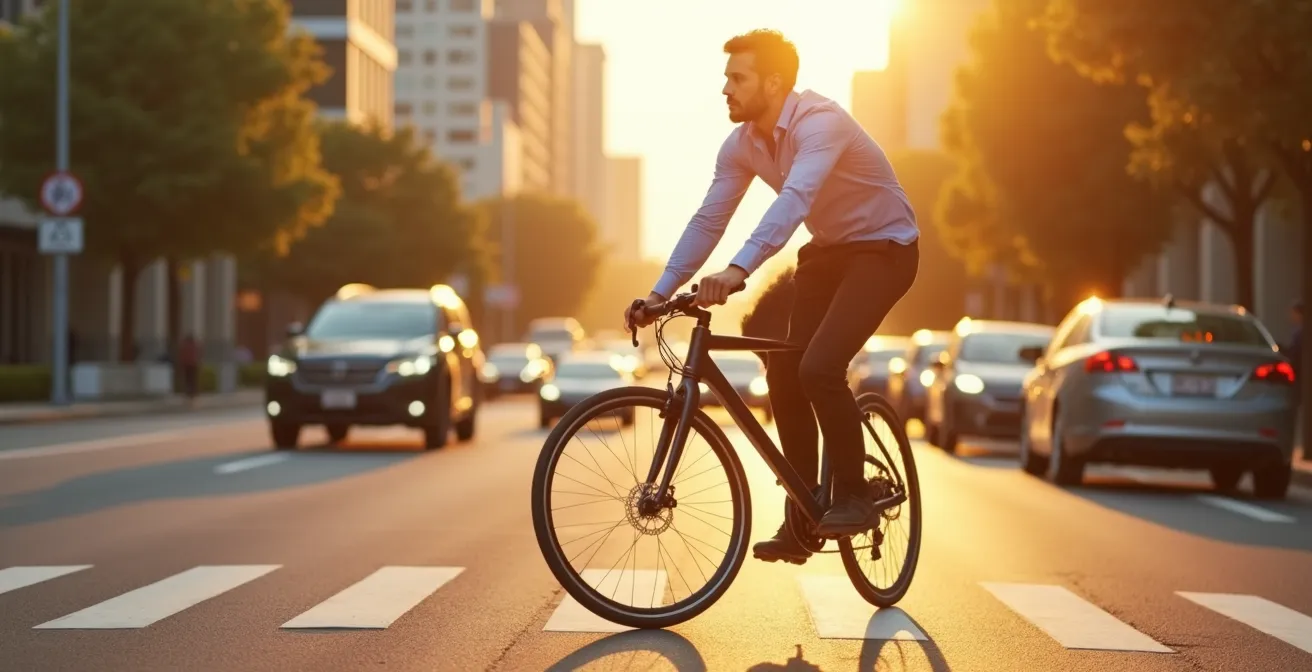
Switching to an e-bike is more than a purchase—it’s a strategic upgrade to your personal mobility system that saves time, money, and stress.
- Success depends on matching your e-bike’s motor and features to your specific route’s challenges, like hills and traffic.
- Understanding the total cost of ownership, including leasing vs. buying, reveals significant long-term financial benefits over a car.
- Proactive safety measures and weather-specific maintenance are crucial for making the transition smooth and sustainable.
Recommendation: Start by analyzing your specific commute’s friction points—hills, distance, and traffic—to build a system that truly works for you.
For many suburban residents, the daily commute is a source of constant frustration. Stuck in traffic, watching the fuel gauge drop, and paying for insurance on a second car that’s often just a commuting tool feels increasingly unsustainable. The idea of switching to an e-bike is appealing, promising savings, a bit of exercise, and a way to bypass gridlock. Yet, the leap feels daunting. Common advice often focuses on generic benefits like being “eco-friendly” or “good for your health,” but fails to address the practical hurdles.
But what if the key to successfully ditching your second car isn’t just about buying a bike? What if it’s about consciously designing a new personal mobility system? This approach shifts the focus from the vehicle itself to the entire commuting experience. It’s about anticipating the friction points—the steep hills, the freezing winter mornings, the financial questions, and the anxiety of city traffic—and solving them before they become deal-breakers. This isn’t just a replacement; it’s a strategic recalibration of your daily life.
This guide is built on that principle. We will walk you through the critical decisions and preparations needed to build a resilient and rewarding e-bike commuting system. From the engineering of your bike to the logistics of your route, you’ll gain the practical knowledge to make the switch with confidence, turning a source of stress into a highlight of your day.
For those who enjoy a visual format, the following video offers a different kind of motivation to kickstart your journey.
To help you navigate this transition, we’ve structured this article to address each key component of your new mobility system. The following sections break down everything you need to know, from choosing the right hardware to mastering the daily logistics.
Summary: Your Roadmap to Car-Free Commuting
- Why Cycling to Work Reduces Stress Levels Compared to Driving?
- How to Choose the Right E-Bike Motor for Hilly Commutes?
- Leasing vs Buying an E-Bike: Which Is Smarter for a 2-Year Plan?
- The Blind Spot Error New Cyclists Make in City Traffic
- How to Extend Your E-Bike Battery Life During Winter Months?
- How to Reinvest Your Commuting Savings for a Better Lifestyle?
- An E-Bike vs. a Second Car During an Economic Slowdown
- When Your E-Bike is Faster Than Your Car: The 5km Rule
Why Cycling to Work Reduces Stress Levels Compared to Driving?
The morning commute by car often begins with tension—traffic jams, aggressive drivers, and the pressure of being on time. This experience floods your system with stress hormones before the workday even starts. Switching to an e-bike fundamentally rewrites this daily script. Instead of being a passive participant in gridlock, you become an active agent in your journey. The physical act of pedaling, even with electric assistance, serves as a powerful form of release. Research confirms this, showing that employees who cycled to work showed significantly lower stress levels within the first 45 minutes compared to those who drove.
This mental health benefit isn’t just about avoiding traffic. Aerobic exercise, even at a low intensity, has profound effects on the brain. As researchers from the University of Illinois found, even a small 5% improvement in cardiorespiratory fitness can lead to a 15% improvement in mental tests and the ability to handle stress. The increased blood flow and oxygen to the brain help regenerate receptors, making you feel more alert and mentally clear upon arrival at work. Your commute transforms from a stressful necessity into a form of active meditation.
To maximize these benefits, you can incorporate simple techniques into your ride. These practices help bridge the gap between home and work, ensuring you arrive calm and focused:
- Practice deep breathing: Cycling naturally encourages regulated breathing, which helps expel the CO2 buildup associated with stress.
- Use the commute as mindfulness time: Focus on the rhythm of your pedaling and the sights and sounds around you, rather than mentally rehearsing your workday.
- Choose scenic routes: If possible, opt for paths through parks or along greenways. Exposure to nature is a proven amplifier of stress-reduction benefits.
- Arrive 10 minutes early: Use the extra time to cool down, grab a coffee, and mentally transition before diving into work tasks.
Ultimately, the reduced stress isn’t a side effect; it’s a core feature of the e-bike commuting system. You reclaim a part of your day that was once a source of anxiety and turn it into a tool for well-being.
How to Choose the Right E-Bike Motor for Hilly Commutes?
The engine of your new mobility system is the e-bike motor. Making the right choice here is the single most important factor for a successful transition, especially if your commute involves hills. A motor that’s underpowered for your terrain will lead to frustration and a “range anxiety” that mimics the stress of a car’s fuel light. The key metric to understand is torque, measured in Newton-meters (Nm). Torque is the rotational force that helps you conquer inclines and accelerate from a stop. The higher the torque, the better the bike’s climbing ability.
For suburban commuters facing varied terrain, a mid-drive motor is typically the superior choice. Unlike hub motors that are located in the wheel, a mid-drive motor is positioned at the bike’s crankset. This allows it to leverage the bike’s gears, just like you do, for optimal efficiency on hills. It provides a more natural, intuitive “amplified pedaling” feel rather than a “pushing” sensation from behind.
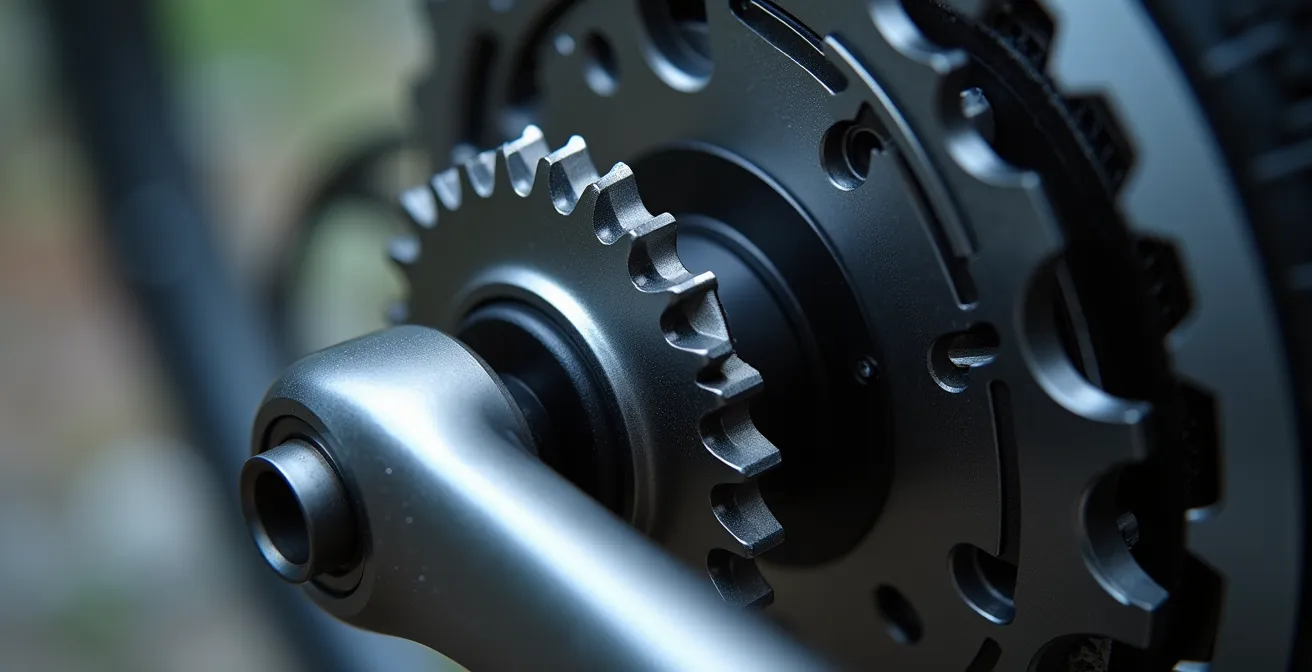
To make an informed decision, you must match the motor’s torque rating to your daily reality. A flat urban route has very different needs from a commute with a 200-foot climb. This table breaks down the common motor types and their ideal use cases.
The following table provides a clear comparison of motor types to help you choose the right one for your specific needs, based on an analysis of e-bike commuting requirements.
| Motor Type | Torque Range | Best For | Feel |
|---|---|---|---|
| Mid-Drive High-Torque | 70-85 Nm | Steep hills, heavy loads | Like diesel car pulling steadily |
| Mid-Drive Standard | 50-70 Nm | Moderate hills, daily commute | Natural pedaling amplified |
| Hub Motor (Geared) | 40-50 Nm | Flat to rolling terrain | Push from behind sensation |
| Hub Motor (Direct) | 30-40 Nm | Flat urban routes | Constant assistance feel |
The best advice is to test ride bikes with different motors on a hill similar to one on your commute. No spec sheet can replace the real-world feeling of a motor effortlessly pulling you up a grade you used to dread.
Leasing vs Buying an E-Bike: Which Is Smarter for a 2-Year Plan?
Once you’ve identified the right type of e-bike, the next friction point is financial. Is it better to buy a bike outright or lease one? For someone testing the waters of a car-replacement strategy, this decision is crucial. Buying offers ownership and the potential for resale value, but it comes with a high upfront cost and the risk of being stuck with rapidly aging technology. Leasing, on the other hand, provides a low-cost entry point and often includes maintenance and insurance, making it a predictable, hassle-free option.
For a two-year timeframe, the financial math can be surprising. While buying seems cheaper in the long run due to resale value, leasing can offer better cash flow and lower risk. A bike that costs $3,000 to buy might only cost a few hundred dollars to start leasing. This is a critical consideration for anyone hesitant to commit a large sum to an unproven commuting system.
This comparative table, based on a cost analysis of commuter e-bikes, breaks down the financial implications over a 24-month period.
| Cost Factor | Buying ($3,000 bike) | Leasing ($100/month) |
|---|---|---|
| Initial Cost | $3,000 | $200 deposit |
| 24-Month Total | $3,000 | $2,400 |
| Insurance | $300/year | Often included |
| Maintenance | $150-300/year | Usually covered |
| Resale Value | ~$1,800 (60%) | N/A |
| Net Cost | $1,800 | $2,400 |
| Technology Risk | High (stuck with old tech) | Low (can upgrade) |
While the net cost of buying appears lower, leasing provides peace of mind. It eliminates surprise repair bills and allows you to upgrade to a bike with newer battery or motor technology after your term is up. The true value of this financial recalibration can be profound, as seen in real-world examples.
Case Study: San Francisco Woman’s 7-Year Car-Free Savings
An excellent example comes from Maureen in San Francisco. After a car accident, she used her insurance payout to buy an e-bike instead of a new car. An analysis of her decision revealed she saved over $50,000 in seven years by eliminating car payments, insurance, gas, and maintenance costs.
For many, leasing for a year or two is the perfect way to validate the e-bike commuting system. If it works, you can then purchase a bike with confidence, armed with real-world knowledge of what you truly need.
The Blind Spot Error New Cyclists Make in City Traffic
One of the most significant mental shifts when moving from a car to an e-bike is understanding your place in traffic. In a car, you are protected by a metal cage; on a bike, your primary safety tool is proactive awareness. The most dangerous mistake new cyclists make is assuming they are visible to drivers. This leads to the “blind spot error,” where a cyclist rides alongside a car, hidden from the driver’s mirrors, just as the car decides to turn right. This is the single most common cause of urban car-bike collisions.
The solution is a principle called “taking the lane.” This counter-intuitive strategy involves positioning yourself in the center of the lane, especially when approaching intersections. By doing so, you make it impossible for a car to pass you on the left and then cut you off with a right turn. You move from being a peripheral object to the primary focus of the driver behind you. This mindset of assuming invisibility is the cornerstone of urban cycling safety. You must ride as if no one can see you, using clear positioning and exaggerated signals to communicate your intentions.
Mastering this requires practice and a deep understanding of driver behavior. The most reliable indicator of a car’s next move isn’t the turn signal, but the direction its front wheels are pointing. Watching the wheels gives you a critical half-second advantage in reacting to sudden maneuvers. To build these habits, it’s helpful to have a clear set of rules to follow on every ride.
Action Plan: Your Urban Cycling Safety Audit
- Watch the wheels, not the driver: Front wheels turning are the most reliable indicator of immediate intention.
- Take the lane before intersections: Position yourself to be un-passable 50 feet before any intersection to prevent right-hooks.
- Use daytime running lights: Special flash patterns are designed to break through driver ‘inattentional blindness’ and register your presence.
- Assume invisibility at all times: Even if you make eye contact, a driver may not have cognitively processed your presence.
- Signal early and obviously: Use exaggerated arm signals starting at least 100 feet before your turn to ensure you are understood.
By transforming your mindset from passive road-sharer to a proactive, defensive rider, you solve one of the biggest friction points of urban commuting: the fear of traffic. Safety isn’t about luck; it’s a system you control.
How to Extend Your E-Bike Battery Life During Winter Months?
For year-round commuters, winter presents a unique challenge: the cold. Just as your car’s engine can struggle on a frosty morning, your e-bike’s lithium-ion battery is highly sensitive to temperature. The chemical reactions that generate power slow down in the cold, leading to a noticeable drop in both performance and range. Studies show that a fully charged battery can experience an efficiency loss of up to 20% when temperatures drop to 50°F (10°C), and even more as it gets colder. This is a critical friction point that can leave you stranded if not properly managed.

The key to winter riding is not to fight the cold, but to work with it. The most important rule is to treat your battery like a living thing: keep it warm. Never leave your battery on the bike overnight in a cold garage. The ideal solution is to bring it inside and store it at room temperature. This single habit can preserve a significant portion of its range.
Furthermore, charging a frozen battery is one of the fastest ways to cause permanent damage to its cells. You must always allow the battery to warm up to room temperature for a few hours before plugging it in. To maximize performance on your commute, you can adopt a simple protocol that keeps the battery in its optimal temperature range for as long as possible.
- Store the battery indoors: Always keep it in a space between 60-75°F (15-24°C) when not in use.
- Warm before charging: If the battery is cold, let it sit inside for 2-3 hours before connecting the charger.
- Install just before riding: Put the warm battery on the bike right before you leave to maximize its starting temperature.
- Start on low assist: Begin your ride on a lower power setting. This allows the battery to warm up gradually through use, which is healthier for the cells.
- Never charge below freezing: Charging a battery below 32°F (0°C) can cause irreversible plating on the anode, permanently reducing capacity.
Managing your battery in the winter is a core skill in your all-season mobility system. A little bit of planning ensures that your e-bike remains a reliable partner, no matter what the thermometer says.
How to Reinvest Your Commuting Savings for a Better Lifestyle?
Replacing a car with an e-bike isn’t just a logistical change; it’s a powerful financial one. The most obvious saving is on fuel, but the real benefit comes from eliminating the hidden costs of car ownership: insurance, depreciation, financing, and maintenance. While an e-bike requires some upkeep, the costs are minimal in comparison. Annual maintenance for an e-bike, including professional tune-ups, typically runs between $100 and $300, a fraction of the cost of a single major car repair.
This creates a significant surplus in your monthly budget. The question then becomes: how do you reinvest this “found money” to enhance your new lifestyle? Thinking about this strategically turns the act of saving into a proactive tool for well-being. Instead of letting the savings disappear into general expenses, you can earmark them for specific goals that reinforce the positive choice you’ve made.
Consider creating a “mobility dividend” fund. The money that once went to a car payment or insurance premium can now be used to:
- Upgrade Your Gear: Invest in high-quality waterproof clothing, heated gloves, or brighter lights to make your commute even more comfortable and safe in all conditions.
- Fund New Experiences: Use the savings to pay for a weekend getaway, a hobby, or dinners out—activities you now have more time and energy for.
- Accelerate Financial Goals: Redirect the funds toward paying down debt, boosting retirement savings, or building an emergency fund, providing a profound sense of financial security.
- Improve Your Health: Invest in a gym membership for cross-training or higher-quality, healthier food.
This financial recalibration is the ultimate return on investment for your new mobility system. The e-bike doesn’t just save you money; it unlocks resources to build a healthier, wealthier, and more enjoyable life.
An E-Bike vs. a Second Car During an Economic Slowdown
During times of economic uncertainty, every financial decision comes under greater scrutiny. The idea of purchasing a second car, with its high initial cost and volatile running expenses, becomes particularly risky. An e-bike, however, presents itself as a financially resilient and intelligent alternative. It insulates you from many of the economic pressures that affect car owners, making it a defensive asset in a downturn.
The primary advantage is the drastically lower exposure to cost volatility. While gas prices can fluctuate wildly, the cost of charging an e-bike is negligible, often amounting to just a few cents per mile. Furthermore, a car is a rapidly depreciating asset, losing a significant chunk of its value the moment you drive it off the lot. An e-bike’s depreciation is far more modest. Insurance, another major car expense, is a fraction of the cost for an e-bike, if required at all.
As former pro cyclist Phil Gaimon powerfully noted when comparing vehicle efficiency, the scale of the difference is immense. He highlights the disproportionate resource use of electric cars compared to their two-wheeled counterparts.
While electric cars are great, a Tesla car battery could power 300 e-bikes
– Phil Gaimon, Worst Retirement Ever YouTube channel
This perspective underscores the e-bike’s role as a low-impact, high-efficiency tool. In an economic slowdown, preserving capital and minimizing monthly liabilities is key. An e-bike is often a cash purchase, avoiding high-interest loans, and its minimal running costs protect your emergency fund from the shock of an unexpected multi-thousand-dollar car repair bill. It represents a move toward financial anti-fragility.
Opting for an e-bike over a second car during a slowdown isn’t a sacrifice; it’s a savvy financial maneuver that enhances your resilience and frees up capital for more important needs.
Key Takeaways
- Success hinges on viewing the switch as designing a complete mobility system, not just buying a product.
- Anticipating and solving friction points—like hills, weather, and safety—before they arise is the most critical step.
- The financial benefits extend far beyond fuel savings, creating a “mobility dividend” that can be reinvested to improve your lifestyle.
When Your E-Bike is Faster Than Your Car: The 5km Rule
One of the most surprising revelations for new e-bike commuters is that they often get to their destination faster than they did by car. This seems counter-intuitive, but it holds true for a huge number of daily trips. The “5-kilometer rule” is a well-documented phenomenon in urban planning: for most urban journeys under 5 kilometers (about 3 miles), the bike is the faster mode of transport from door to door. This is because the biggest time sinks in car travel aren’t the driving itself, but the “last mile” problems: traffic congestion and, most significantly, parking.
While a car may have a higher top speed, its average speed in a city is often shockingly low. An e-bike, however, maintains a consistent average speed. It can utilize bike lanes to bypass gridlock and, most importantly, eliminates the parking hunt. You can typically park it right at the entrance of your destination, saving the 5-10 minutes you might have spent circling a block or walking from a distant parking garage. An analysis of urban travel confirms this, as research shows that most urban rides under 5 kilometers are faster by bike than by car when factoring in these variables.
This time-saving advantage can be amplified by integrating your e-bike into a larger, multi-modal mobility system. For longer commutes, you can ride your e-bike to a train or bus station, take public transport for the long-haul portion, and have your bike ready for the final leg of the journey. This eliminates the stress of tight connections and the expense of station parking. A folding e-bike can even be brought directly onto trains and buses, offering ultimate flexibility.
The journey to replacing your second car begins not at the bike shop, but with a simple analysis of your daily route and its friction points. By designing a mobility system tailored to your specific needs, you can reclaim your commute, improve your finances, and add a dose of stress-free enjoyment to your daily routine. Start planning your system today.