
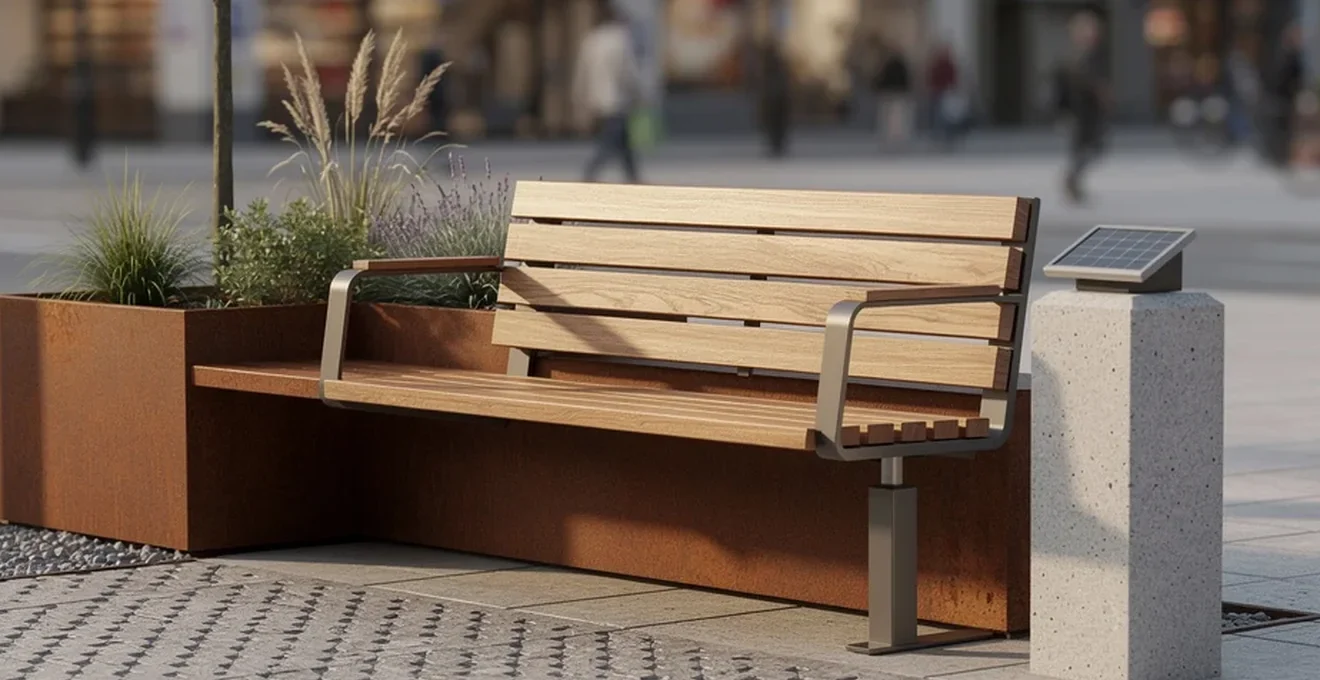
Street furniture is often the last thing added to a public realm scheme, yet it is frequently the first thing people notice and use. Benches, bollards, planters, cycle stands and litter bins determine whether a space feels welcoming, safe and accessible, or whether it becomes cluttered, hostile and hard to maintain. For planners, the challenge lies in balancing durability, accessibility, security and sustainability while keeping long-term costs under control. This article works through the practical considerations that shape good decisions: which materials perform best in high-traffic environments, how to meet accessibility and hostile vehicle mitigation standards, how to integrate furniture with sustainable drainage and biodiversity goals, and how to plan for maintenance from day one. Real-world examples illustrate how these principles translate into successful schemes.
Material selection and durability standards for urban furniture
Material choice is the single biggest factor determining how long street furniture lasts, how much it costs to maintain, and how well it resists vandalism and weather damage. There is no universally “best” material — the right choice depends on location, footfall, budget and design intent.
Corten steel versus galvanised steel in High-Traffic environments
Galvanised and powder-coated steel remains the most common specification for street furniture, typically offering a service life of 15 to 25 years. It performs reliably across a wide range of environments and, when powder-coated, can be finished in bespoke RAL colours to match a wider streetscape palette. In coastal or high-pollution zones, marine-grade powder coatings compliant with ISO 12944-6 for C4 and C5 environments provide enhanced corrosion resistance where standard finishes might degrade more quickly.
Corten (weathering) steel develops a stable, rust-like patina that protects the metal beneath, giving it a distinctive industrial appearance that suits contemporary or heritage-industrial settings. While not covered in the same depth as galvanised steel in standard specifications, it is worth considering where a raw, low-maintenance aesthetic is preferred and where the patina finish fits the design language of the wider scheme.
Hardwood timber species: iroko, oak, and FSC-Certified alternatives
FSC-certified hardwoods offer a natural finish that many planners favour in parks, conservation areas and heritage settings. Timber requires ongoing maintenance — typically oiling or treatment — to preserve its appearance and structural integrity against weathering. Treated softwoods are also used where budget constraints apply, though they generally require more frequent attention than durable hardwoods.
When specifying timber, sustainability credentials matter as much as durability. FSC certification ensures the wood is sourced responsibly, which is increasingly a requirement in public sector procurement and aligns with broader environmental commitments in public realm design.
Recycled plastic composites and their Load-Bearing capacities
Recycled plastic lumber has become a popular alternative to timber, offering low maintenance, splinter-free surfaces and a very long service life. It resists rot, insect damage and warping, making it particularly suitable for locations with limited maintenance budgets or where reactive repairs are difficult to schedule. Because it is manufactured from recycled material, it also supports circular economy objectives increasingly expected in public procurement.
Concrete and precast solutions for Vandal-Resistant installations
Concrete and precast stone are widely used for planters and heavier street furniture elements, particularly where vandal resistance and mass are priorities. Concrete planters filled with soil and planting are a popular choice at town centres, serving a dual purpose: softening the streetscape while potentially contributing to hostile vehicle mitigation (HVM), depending on their specification. Cast iron, meanwhile, offers a heritage aesthetic combined with extreme durability, though its weight can be a practical consideration during installation and any future relocation.
Universal accessibility and inclusive design compliance
Accessibility is not an optional add-on to street furniture design — it is a legal and practical requirement that shapes almost every decision, from bench height to bollard spacing.
BS 8300 and equality act 2010 requirements for street furniture
Street furniture on public land must comply with the Equality Act 2010, alongside guidance such as BS 8300, to ensure it does not create barriers for disabled users. In practice, this means avoiding overhanging elements below 2,100mm that could injure visually impaired pedestrians, ensuring adequate colour contrast, and designing furniture that supports rather than hinders independent movement through public space.
Wheelchair clearance zones around benches and bollards
A minimum clear pedestrian corridor of 1,200mm past any piece of furniture is the baseline standard, but many authorities — including Transport for London through its Streetscape Guidance (2022) and the Department for Transport’s Inclusive Mobility guidance (2021) — recommend 1,500mm to 2,000mm in high-footfall areas or near transport nodes. This wider clearance accommodates wheelchair users, people with buggies and those with visual impairments more comfortably than the statutory minimum.
The same principle applies to bollards: a minimum clear width of 1.5 metres between bollards is recommended to allow wheelchairs and guide dogs to pass safely, and bollards themselves must be detectable by long cane users, with a tapping height of 350–700mm, and offer sufficient visual contrast with their surroundings.
Tactile paving integration with seating and signage elements
Litter bins, bollards and seating must be positioned so they never obstruct tactile paving or designated accessibility zones. Guidance from the Manual for Streets stipulates that bins, in particular, should maintain a minimum clear footway width of 1.5 metres in busy pedestrian areas, near schools and around transport interchanges. Poor placement not only creates a hazard but can also invalidate a pavement licence granted under post-2020 regulations.
Ergonomic bench heights for elderly and Mobility-Impaired users
Bench design has a direct impact on who can use a space comfortably. Compliant seating typically features a seat height of 450–480mm, along with armrests and backrests that allow elderly users or those with mobility issues to rise unaided. This is a deliberate design choice: some benches are specified without arms, which allows people to lie down, so planners should decide consciously which approach suits the intended use of a space rather than defaulting to one style throughout a scheme.
Anti-terrorism and hostile vehicle mitigation infrastructure
In pedestrianised zones, high streets and event spaces, street furniture increasingly performs a security function alongside its everyday amenity role.
PAS 68 and IWA 14-1 certified bollard systems
Where hostile vehicle mitigation (HVM) is a design requirement, bollards and barriers must be tested and certified to recognised impact standards, ensuring they can stop a vehicle travelling at a defined speed and mass. Selection should always match the design language of the wider scheme, so that security infrastructure does not read as an obviously “bolted-on” measure but integrates with the surrounding streetscape palette.
Retrofitting planters as covert security barriers
Concrete, steel or stone planters filled with soil and planting are a popular covert HVM method, particularly in town centres where visible security infrastructure would be unwelcome. However, planners must be cautious here: HVM planters are engineered with reinforced concrete or steel internal structures and are weight-specified to stop vehicles at defined speeds, whereas standard planters may look identical but offer no impact protection at all. Specifications should never be assumed — HVM performance must be verified with the manufacturer before a planter is relied upon for security purposes.
Impact-rated street furniture for pedestrianised zones
Beyond bollards and planters, other street furniture elements in pedestrianised zones may also need to withstand vehicle overmounting or accidental impact, particularly on shared-use streets where vehicle access is permitted for deliveries or emergency services. Bollards, in this context, serve three overlapping functions: enforcing pedestrianisation, protecting the footway from vehicle overmounting, and acting as heritage or aesthetic boundary markers. Where emergency or maintenance vehicle access is required, removable or lockable bollards allow temporary access without compromising security when reinstated.
Sustainable urban drainage and environmental integration
Street furniture increasingly forms part of a wider environmental strategy, rather than sitting apart from it.
Suds-compatible tree pits and permeable paving interfaces
Sustainable urban drainage systems (SuDS) are becoming a standard consideration in public realm schemes, and street furniture must be planned alongside them rather than as an afterthought. Tree pits, permeable paving and planting areas need to be coordinated with the placement of benches, bins and bollards so that drainage infrastructure is not obstructed and furniture is not undermined by water management works beneath the surface.
Biodiverse planters and Pollinator-Friendly landscaping elements
Planters do more than soften hard urban surfaces — they can actively support biodiversity when planted with pollinator-friendly species. This dual environmental and amenity function makes planters one of the more versatile pieces of street furniture available to planners, particularly when combined with their potential HVM role in pedestrianised zones. Incorporating green features such as planters or green roofs near benches and bus stops also contributes to a more environmentally conscious approach to urban planning.
Solar-powered lighting bollards and Off-Grid energy solutions
Energy-efficient lighting, including solar-powered lamps and bollards, reduces public energy consumption while extending lighting into areas without easy access to mains power. This is particularly relevant for cycle parking facilities and pedestrian routes, where LED or solar-powered lighting improves safety and usability during low-light conditions without requiring extensive groundworks.
Maintenance protocols and total cost of ownership
Many public realm investments focus too heavily on initial procurement cost, overlooking the total cost of ownership. This includes the long-term expenses of repairs, replacement parts, repainting and reduced service life caused by vandalism or heavy wear — costs that can dwarf the original purchase price over a product’s lifetime.
Anti-graffiti coatings and Powder-Coated steel finishes
Anti-graffiti coatings and vandal-resistant finishes are now widely available on street furniture ranges and significantly reduce reactive maintenance costs. Powder-coated steel, in particular, combines corrosion resistance with a surface that is easier to clean and restore after graffiti or general wear, compared with untreated metal or unprotected timber.
Modular replacement systems for damaged components
Designing for modularity is one of the most effective ways to control lifecycle costs. Components such as slats, fixings or side panels that can be replaced individually — rather than requiring full unit replacement — extend the useful life of a bench, bin or shelter considerably. This approach, combined with long-term warranties, gives local authorities and facilities managers greater confidence when budgeting for public realm assets over a 15 to 25 year horizon. Lifecycle planning should also account for end-of-life recyclability, particularly where circular economy principles form part of a scheme’s sustainability assessment.
Placemaking strategy and Site-Specific furniture selection
Street furniture cannot be specified in isolation from its context. The right bench for a coastal promenade may be entirely wrong for a conservation-area high street, and the right cycle stand for a rural station may be inadequate for a busy urban interchange.
Conservation area constraints and Heritage-Sensitive designs
In areas of historical or architectural significance, materials and designs must align with conservation objectives, often requiring timber finishes, cast iron or bespoke detailing to preserve visual harmony. Listed Building Consent may be required in conservation areas or near listed buildings, and Historic England guidelines encourage material selection that reflects local character — traditional styling or subtle contemporary lines in rural or conservation zones, contrasted with the powder-coated steel or ductile iron more commonly used in urban and transport environments for its longevity and easier maintenance.
A former car park outside St Denys’ Church in Sleaford, transformed by North Kesteven District Council, illustrates this approach: the redesign introduced flowerbeds, new paving, improved lighting and outdoor seating specifically chosen to enhance the historic surroundings while creating a genuinely usable public space.
High street regeneration case studies: coventry and croydon
High street regeneration projects frequently combine multiple street furniture functions within a single scheme — seating, planting, lighting and pedestrian safety measures all delivered together to revitalise underused or car-dominated spaces. Liverpool’s pedestrian zone transformation offers a clear example of this integrated approach: the city council installed a combination of fixed and removable bollards, tailored to the city’s architectural character and security requirements, to pedestrianise key areas while preventing unauthorised vehicle access. The project was credited with improving safety while also contributing to increased footfall and economic activity in the area, demonstrating how well-planned street furniture can support both public safety and commercial vitality simultaneously.
Cycle parking sheffield stands versus covered cycle hubs
Sheffield stands are widely regarded as the minimum standard for secure cycle parking, as they allow both the frame and wheels to be locked, offering meaningfully better security than simple wheel-bender racks. For higher-risk locations, two-tier racks with locking mechanisms and CCTV coverage provide enhanced security and greater capacity within a limited footprint.
Covered cycle hubs extend this further by protecting bicycles from weather, extending their lifespan and reducing maintenance needs, typically using durable materials such as galvanised steel and UV-stable polycarbonate roofing. The redevelopment at Didcot Parkway Station demonstrates this well: a two-tier cycle shelter using a Hi-Rise parking system maximised capacity within a constrained footprint while matching the station’s aesthetic, contributing to the wider regeneration goals of the site. Whichever format is chosen, cycle parking must maintain a minimum clearance of 1.5 metres around it to avoid obstructing pedestrian pathways, and should ideally integrate lighting, repair stations and clear signage to support broader sustainable transport objectives such as the UK’s Cycling and Walking Investment Strategy.