
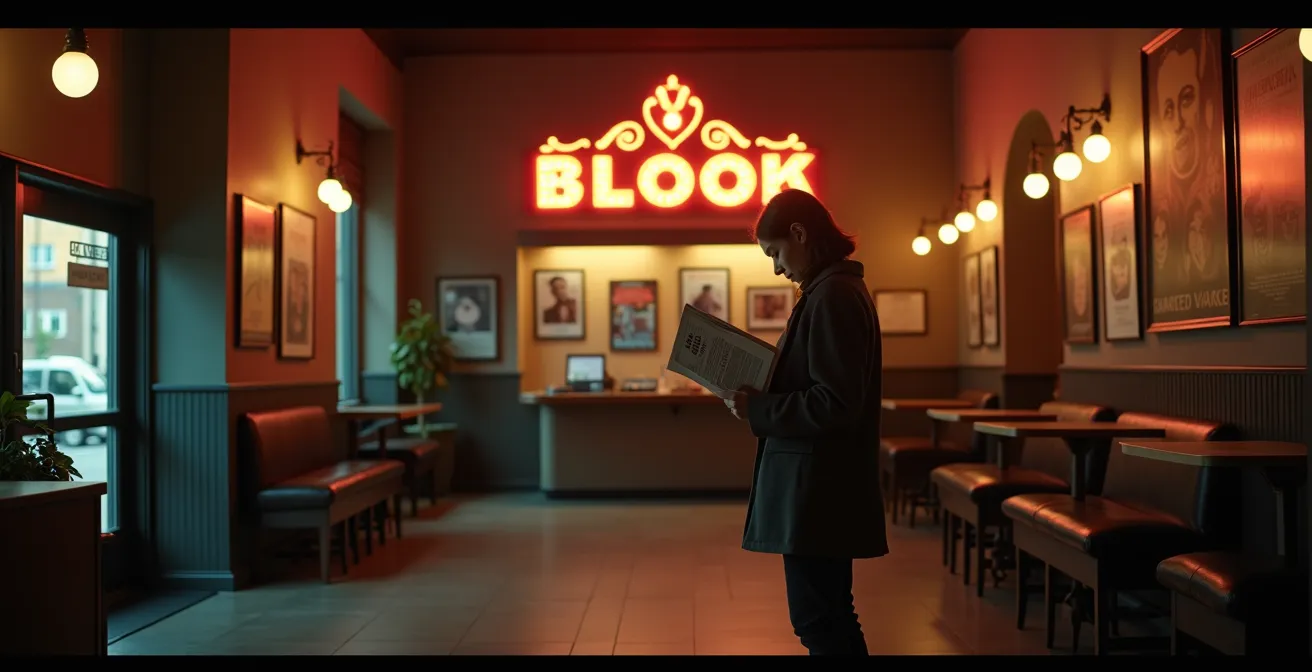
The secret to finding brilliant independent films isn’t a better algorithm; it’s adopting the mindset of a curator.
- Algorithmic recommendations create echo chambers, while human curation opens doors to unexpected and genuinely rewarding cinema.
- Virtual festivals and niche streaming services now offer unprecedented access to global cinema, directly from your home.
Recommendation: Start by following one film festival programmer or critic on a platform like Letterboxd to see the difference in the quality of recommendations.
If you’re a film lover, you know the feeling. You settle onto your couch, ready for a cinematic experience that challenges, moves, or inspires you. But instead, you face the digital abyss: an endless, scrolling grid of algorithmically-suggested blockbusters and “trending” shows that feel more like content than cinema. It’s a paradox of choice that leads to a particular kind of exhaustion—algorithmic fatigue. You’re told what’s popular, but rarely what’s profound.
The common advice is to subscribe to another service or just “watch more trailers.” But this only deepens the problem, feeding the very systems that leave us feeling cinematically malnourished. What if the solution wasn’t about finding a new platform, but adopting a new philosophy? This guide is not another list of streaming services. It is an argument for a more intentional, passionate, and rewarding way to engage with film. It’s about rejecting the passive role of a consumer and embracing the active, joyful role of a curator.
By the end of this article, you will understand how to build your own “digital cinematheque,” a collection of films that speaks to you, not to a demographic profile. We will explore how to follow the real taste-makers, transform your home into a festival venue, and understand the deeper value of choosing a film that demands your attention. This is your first step toward a richer cinematic life.
To guide you on this journey from passive viewer to active curator, this article breaks down the essential strategies and mindsets. Explore the sections below to master the art of discovering films you’ll genuinely love.
Contents: Your Guide to Curated Cinema
- Why Human Curation Beats Netflix Algorithms for Quality Cinema?
- How to Attend Sundance or Cannes Online From Home?
- Subtitles vs Dubbing: Why Purists Are Right About Emotional Impact?
- The Licensing Issue That Hides Great Movies From You
- How to Curate Your Own Film Festival Weekend at Home?
- Why Your Ticket Purchase Generates 3x Value for the Local Economy?
- Reading vs Netflix: Which Actually Recharges Your Brain?
- How to Choose a Theater Season Ticket That You Will Actually Use?
Why Human Curation Beats Netflix Algorithms for Quality Cinema?
The core flaw of a platform like Netflix isn’t a lack of content, but a lack of context. Its algorithm is designed for one thing: to minimize the time between clicks, keeping you on the platform. It operates on correlation, not quality. If you watched a gritty crime thriller, it will suggest ten more, trapping you in a genre feedback loop. This is the very definition of algorithmic fatigue. It prioritizes what is similar over what is exceptional, and in doing so, it actively hides the bold, challenging, and unique voices that define independent cinema.
Human curation, in contrast, is an act of passion and expertise. A curator—be it a festival programmer, a critic, or the mind behind a niche streaming service—connects films based on theme, artistic movement, or pure cinematic power. They build bridges between a classic and a contemporary debut, guiding you toward discoveries you wouldn’t have made on your own. This human touch is proving to be a powerful alternative; research shows that curated film channels have garnered over 2 million subscribers, a testament to a growing hunger for a more considered approach to film discovery. It’s about finding a trusted voice in the digital noise.
This isn’t just a theoretical preference; it’s a practical strategy. By consciously choosing to follow human curators, you are training your own “curatorial sense.” You begin to see the invisible threads connecting different works and filmmakers, enriching your understanding of cinema as an art form. It’s the difference between being fed content and building a relationship with film.
Action Plan: How to Follow Human Film Curators
- Track the Tastemakers: Follow film festival programmers on platforms like Letterboxd or Twitter. They often tag or discuss their official and personal selections, giving you a direct line to emerging talent.
- Subscribe with Intent: Choose one or two curator-driven platforms like Mubi or the Criterion Channel. Their libraries are built on cinematic merit, not mass-market appeal, and often include essays and supplementary material.
- Join the Conversation: Participate in dedicated indie film communities on Reddit (e.g., r/indiefilm, r/truefilm) or Facebook. These forums are hubs for passionate discussion and shared discoveries that go far beyond what’s “trending.”
- Go to the Source: Subscribe directly to the newsletters of film critics whose taste aligns with yours. They often share personal recommendations and “hidden gems” that don’t make it into mainstream publications.
- Build Your Circle: Cultivate a network of film-loving friends with whom you can share and debate discoveries. A trusted recommendation from a friend is the oldest and still most powerful form of curation.
How to Attend Sundance or Cannes Online From Home?
For decades, the world’s most exciting new films premiered behind the velvet rope of exclusive festivals like Sundance, Cannes, and TIFF. Attending was a privilege reserved for industry insiders and the most dedicated cinephiles. Today, that landscape has been radically democratized. The rise of virtual and hybrid festivals means that a coveted festival pass is no longer a physical ticket, but a digital key that unlocks a world of cinema from your living room.
This shift allows you to become a global festival-goer. You can now access curated selections, world premieres, and filmmaker Q&As that were once geographically and financially out of reach. For example, the Toronto International Film Festival (TIFF) pioneered a model offering on-demand viewing of many festival films shortly after their premieres, a strategy now adopted by other major events like Tribeca and SXSW. This creates a direct pipeline from the festival circuit to your personal screen, collapsing the months-long wait for distribution.
The key is to approach it with the same intentionality as attending in person. Plan your “screenings,” take notes, and engage with the online community around the festival. You’re not just watching movies; you’re participating in a global cultural event. The image below captures the essence of this modern festival experience: a curated, comfortable, and deeply personal engagement with cinema’s leading edge.
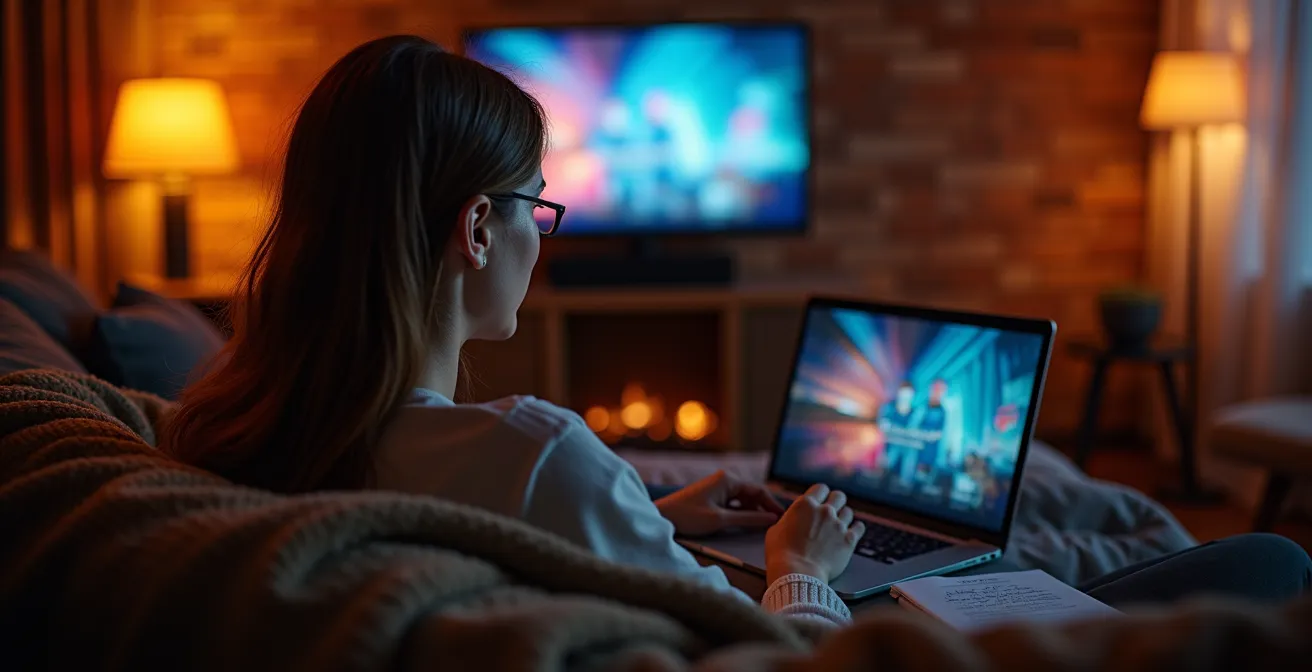
As you can see, the experience is about creating an atmosphere. It’s about dedicating time and space to the art of film, transforming a passive viewing into an active event. This is how you can tap into the excitement and discovery of the festival circuit on your own terms.
To help you navigate this new terrain, the following table breaks down the online access models of several major festivals. As this data shows in a recent comparative analysis, options vary, so planning ahead is crucial.
| Festival | Online Access | Typical Window | Platform |
|---|---|---|---|
| Sundance | Select films | During festival | Festival platform |
| TIFF | Post-festival streaming | 2-4 weeks after | Various platforms |
| Tribeca | Virtual screenings | Festival duration | Tribeca At Home |
| SXSW | Online passes available | Festival week | SXSW platform |
Subtitles vs Dubbing: Why Purists Are Right About Emotional Impact?
The debate between subtitles and dubbing is as old as international film distribution itself. While dubbing offers accessibility, film purists have long argued that it comes at a significant cost to the film’s artistic integrity. This isn’t mere snobbery; it’s a fundamental recognition that an actor’s voice is as crucial a part of their performance as their facial expressions or body language. Tone, cadence, pauses, and the subtle crack in a voice convey emotional information that a different actor in a different language simply cannot replicate.
Independent cinema, in particular, relies on this authenticity. These are not films engineered by committee; they are deeply personal works where every element of the sound design, including the original dialogue, is a deliberate artistic choice. To replace it is to fundamentally alter the work. The goal is to experience a different cultural perspective, and language is the primary vessel for that culture. Analysis of foreign cinema viewership confirms this, showing that films presented with their original audio and subtitles consistently maintain higher engagement rates than their dubbed counterparts. Viewers seek out these films precisely for the authentic emotional delivery that dubbing often flattens.
Choosing subtitles is an act of respect for the filmmaker’s vision and the actors’ craft. It invites a deeper, more active form of viewing. You are not just passively receiving a story; you are engaging with its original texture and nuance. It requires a bit more focus, but the reward is a much richer and more emotionally resonant experience, one that is true to the director’s original intent.
The Licensing Issue That Hides Great Movies From You
Have you ever searched for a celebrated indie classic or a festival-winning foreign film, only to find it’s completely unavailable on any streaming platform? This frustrating experience isn’t an oversight; it’s often the result of a labyrinthine system of film licensing. Unlike a blockbuster with a global distribution deal, an independent film’s journey to your screen is fraught with legal and financial hurdles. Rights are sold territory by territory, with separate, time-limited windows for theatrical, video-on-demand (VOD), and subscription streaming.
This creates a complex and fragmented landscape where a film might be available in Germany but not France, or disappear from a platform overnight because a music license expired. For older or more obscure films, the cost of renewing these rights—especially for music or archival footage—can be prohibitive for platforms, causing these cultural artifacts to vanish from the digital sphere. The film itself becomes a “hidden gem” not by choice, but by the tangled logistics of its distribution.
This is the invisible barrier between you and a world of great cinema. The illustration below offers a metaphor for this reality: a tangled maze of film reels, where clear paths are few and many treasures remain trapped and inaccessible. It’s a system that prioritizes contractual obligation over cultural preservation.

Fortunately, some platforms see this not as a problem, but as a mission. Services like The Criterion Channel and Mubi actively invest in the difficult work of film restoration, untangling rights issues, and re-licensing music to bring these lost films back to audiences. Supporting them is not just about watching movies; it’s about funding the preservation of film history.
How to Curate Your Own Film Festival Weekend at Home?
Once you begin discovering films through human curation and virtual festivals, the next exhilarating step is to become the programmer. Curating your own film festival at home is a deeply rewarding way to engage with cinema, transforming a simple movie night into a thoughtful, thematic event. This isn’t about binge-watching; it’s about intentional programming. The goal is to create a dialogue between films, allowing them to illuminate each other in unexpected ways.
The most successful community curation platforms, like Letterboxd, thrive on this principle. As one case study on user behavior revealed, cinephiles who actively follow curated community lists during festival season report discovering three to five new filmmakers per festival, far more than by following official selections alone. This demonstrates the power of thematic and community-driven programming. You can apply the same logic to your own weekend festival.
To structure your event, think like a professional programmer. Don’t just pick movies you want to see; consider the flow, the energy, and the conversation you want to create. Here is a structure inspired by professional festival programming that you can adapt:
- Opening Night: Start with an accessible, crowd-pleasing indie. Choose a film that sets a welcoming tone and introduces some of the themes or aesthetics you plan to explore.
- Thematic Blocks: Group films together to create a conversation. You could program a block based on a cinematic movement (e.g., French New Wave, Dogme 95), a recurring theme (e.g., urban solitude), or a specific aesthetic (e.g., films known for their long takes).
- Centerpiece Screening: Schedule your most ambitious or challenging film for Saturday evening, when you and your guests have the most energy and focus. This is the heart of your festival.
- Closing Night: End with a film that is resonant and thought-provoking. The ideal closing film sparks discussion and leaves a lasting emotional or intellectual impact.
Why Your Ticket Purchase Generates 3x Value for the Local Economy?
In an age of streaming, choosing to see a film at a local independent cinema can feel like a nostalgic, almost political act. It is, in fact, a powerful economic one. An independent theater is more than just a place to watch movies; it’s a community hub and an economic engine. When you buy a ticket, you’re not just paying for a seat; you’re investing in a local ecosystem.
The impact goes far beyond the box office. Before or after the show, you might grab dinner at a nearby restaurant, have a drink at the local bar, or browse a neighboring bookshop. This “multiplier effect” is significant. In fact, economic research demonstrates that every dollar spent at local indie theaters generates approximately $3 in local economic activity. Your $15 ticket becomes a $45 investment in your community’s vibrancy and a statement that you value shared cultural spaces.
These cinemas are the physical homes for the cinematic conversations we’ve been exploring. They host Q&As with directors, run retrospectives of classic films, and provide a platform for local filmmakers. They are the brick-and-mortar counterparts to the digital curation we seek online. Supporting them is essential for a healthy film culture, both locally and globally. The image below perfectly captures this symbiotic relationship between a cinema and its neighborhood.
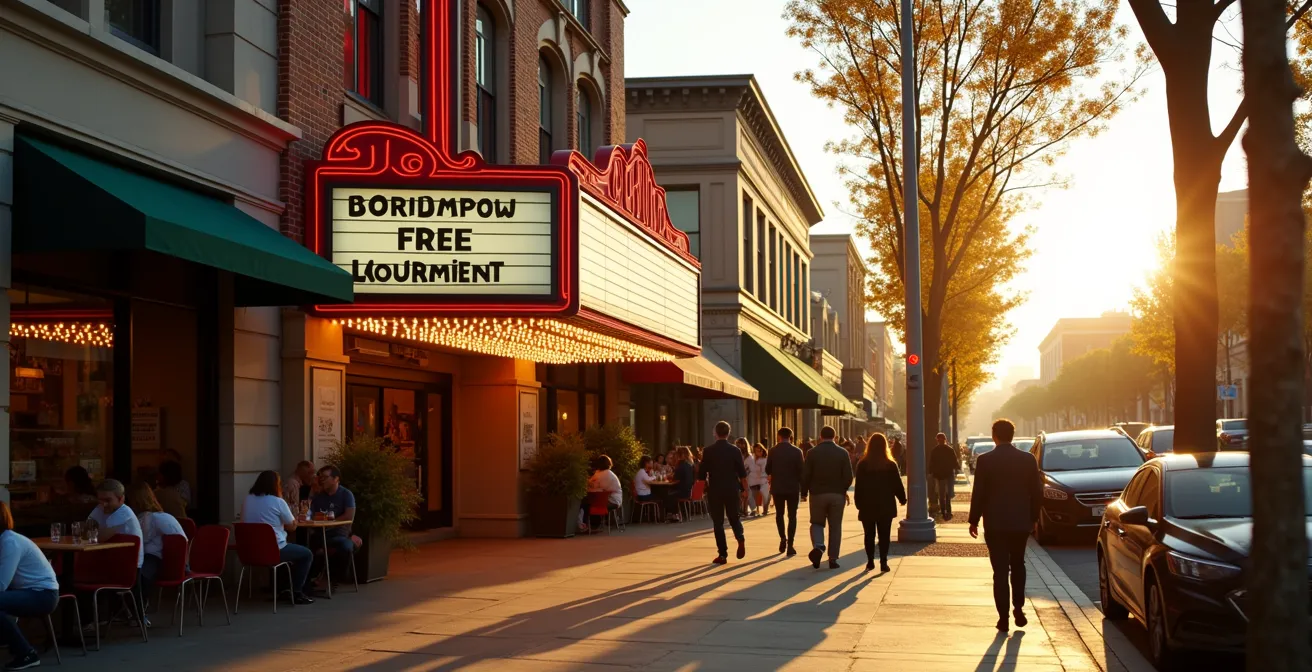
This scene is a reminder that cinema is, at its heart, a communal experience. By choosing the local arthouse, you are casting a vote for a more connected, culturally rich community and ensuring that these vital spaces continue to thrive for years to come.
Key Takeaways
- True film discovery comes from following human curators, not passive algorithms, which leads to a richer and more personal cinematic journey.
- The rise of virtual festivals and niche streaming platforms has democratized access, allowing anyone to engage with global cinema’s cutting edge from home.
- Supporting independent cinema, whether through a curated streaming subscription or a ticket at a local arthouse, is an active investment in artistic diversity and cultural preservation.
Reading vs Netflix: Which Actually Recharges Your Brain?
We often talk about watching a movie to “turn our brains off.” For the standard blockbuster or sitcom, this is largely true. Passive entertainment requires little from us and offers a simple, if fleeting, distraction. However, engaging with a great independent film is a fundamentally different cognitive experience—one that has far more in common with reading a complex novel than with mindlessly streaming content.
This distinction is crucial for understanding what truly recharges us. Passive consumption can leave us feeling drained, while active engagement energizes the mind. As one film studies analysis notes, “Indie films often feature non-linear plots, moral ambiguity, and unresolved endings. This forces the brain to work actively to interpret, form theories, and connect dots.” This is not “turning your brain off”; it is lighting it up. You are not just a spectator; you are a participant in the creation of meaning.
Choosing an indie film is choosing cognitive engagement. It’s a workout for your empathy, your critical thinking, and your ability to hold complexity. Like finishing a great book, you emerge from a challenging film not depleted, but enriched and with a new perspective. So the next time you seek to recharge, consider the *quality* of the entertainment. The easy path of the Netflix algorithm may offer rest, but the more demanding path of a curated film offers genuine restoration.
How to Choose a Theater Season Ticket That You Will Actually Use?
Committing to a theater season ticket or membership is the ultimate expression of support for your local indie cinema. It’s an investment in your own cinematic education and in the cultural life of your community. However, the best intentions can wither if the membership doesn’t align with your actual viewing habits. To ensure your pass gathers experiences instead of dust, a strategic approach is essential.
First, audit the cinema’s past programming. Look at their schedule from the last six to twelve months. How many of those films did you see or want to see? Compare this with your own viewing history on a platform like Letterboxd. If there’s a strong overlap in taste between you and the theater’s programmers, it’s a great sign. Next, do the math. Calculate the break-even point: how many movies do you need to see to make the membership cost-effective compared to buying individual tickets? Be realistic about your schedule.
Then, evaluate the membership structure. Does the theater offer a “flex pass” with a set number of tickets you can use anytime, or does it require commitment to a fixed series on specific dates? Your lifestyle will dictate which is more practical. Finally, look beyond the tickets. Often, the real value of a membership lies in the exclusive perks: member-only preview screenings, discounts on concessions, and invitations to Q&As and special events. These are the benefits that transform you from a customer into part of the cinema’s community.
By making a thoughtful, informed choice, your season ticket becomes more than a transaction. It becomes a passport to a year of cinematic discovery, a commitment to a shared cultural space, and a powerful tool in your journey as an active, engaged film lover.
Now that you have the tools to discover and support the world of independent film, the next logical step is to take action. Start by exploring the programming at your nearest independent cinema and consider becoming a member to deepen your engagement.
Frequently Asked Questions on Discovering Independent Films
Why do some classic indie films disappear from streaming platforms?
Music rights and archival footage licenses expire over time, making it too costly for platforms to renew them, especially for films with limited commercial appeal.
How do regional licensing restrictions work?
Film rights are sold territory by territory with specific time windows for theatrical, VOD, and streaming release, creating a complex puzzle of availability that varies by country.
Which platforms invest in untangling licensing issues?
Criterion Channel and Mubi actively work to restore films and re-license music rights, directly connecting subscriber fees to film preservation efforts.