
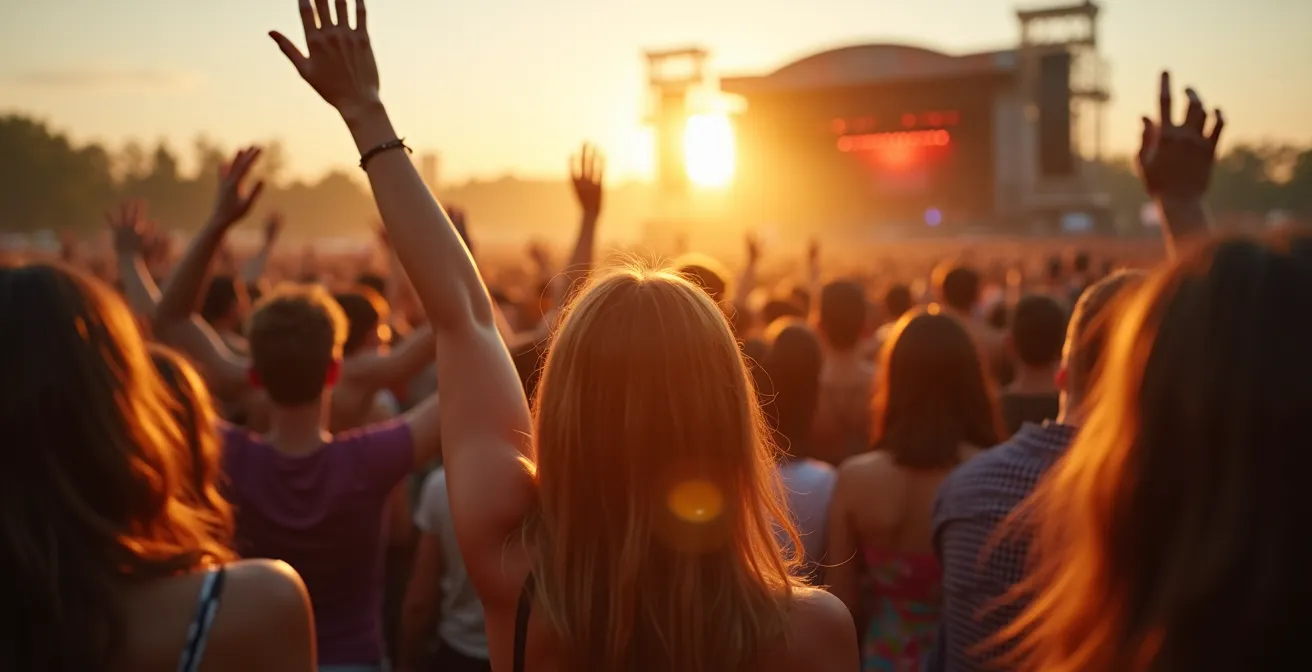
The ringing in your ears after a concert is not a badge of honor; it’s a physiological distress signal indicating you’ve exceeded your safe daily “sound dose.”
- Hearing damage is a function of both volume and duration. At a typical 100 dB concert, irreversible damage can begin in under 15 minutes.
- Effective protection involves using high-fidelity earplugs that reduce volume without distorting sound, unlike standard foam plugs.
Recommendation: Treat your hearing like a finite resource. Actively manage your exposure by choosing the right protection, positioning yourself strategically, and scheduling auditory recovery time after every loud event.
That familiar, high-pitched ringing in your ears after a great concert might feel like a temporary side effect, a small price to pay for an unforgettable night. As an audiologist, I must be clear: this phenomenon, known as Temporary Threshold Shift (TTS), is a critical warning. It is your auditory system screaming that it has been pushed beyond its limits. Many people believe the solution is as simple as “wear earplugs” or “stand further back,” but this advice barely scratches the surface of a complex issue.
The real problem isn’t just loudness; it’s the total acoustic dose your ears absorb over time. Protecting your hearing isn’t about avoiding live music. It’s about becoming an educated manager of your own auditory health. It requires a strategic shift from passive attendance to active, informed participation. This means understanding the precise mechanisms of noise-induced hearing loss (NIHL) and the science behind effective protection and recovery.
But if the key isn’t just blocking sound, what is it? The answer lies in managing your exposure with the precision of a professional. This involves understanding why some earplugs preserve sound quality while others muffle it, recognizing the hidden danger of auditory fatigue from back-to-back events, and even using the venue’s layout to your advantage. This guide will walk you through these expert-level strategies, empowering you to protect your hearing so you can continue to enjoy the power of live music for a lifetime.
To navigate these critical concepts, this article is structured to guide you from understanding the danger to mastering the solutions. Explore the sections below to build your personal hearing protection plan.
Summary: Your Roadmap to Lifelong Concert Enjoyment
- Why 100 Decibels Damages Your Ears in Less Than 15 Minutes?
- How to Choose Earplugs That Lower Volume Without Muffling Sound?
- Custom Molded vs Foam Plugs: Is the $150 Price Difference Worth It?
- The “Auditory Fatigue” Danger of Two Concerts in One Weekend
- How Long to Rest Your Ears After a Loud Event?
- When to Arrive to Enjoy the Pre-Show Atmosphere Stress-Free?
- Where to Place Smart Speakers for Best Hearing in Large Rooms?
- How to Choose a Theater Season Ticket That You Will Actually Use?
Why 100 Decibels Damages Your Ears in Less Than 15 Minutes?
To understand the risk, you must first understand the mechanism of hearing. Your inner ear contains thousands of tiny, delicate hair cells that vibrate in response to sound waves and transmit electrical signals to your brain. Extremely loud noises act like a physical shockwave, bending, damaging, and even breaking these fragile cells. Unlike other cells in your body, once these hair cells are destroyed, they do not regenerate. This damage is permanent and cumulative, leading to noise-induced hearing loss and tinnitus.
The relationship between noise level (measured in decibels, dBA) and safe exposure time is not linear; it’s exponential. For every 3 dB increase in volume, the safe listening time is cut in half. While a normal conversation at 60 dB is perfectly safe, a typical live concert often reaches 100-110 dB. According to occupational safety standards, damage from 100 dBA can begin in just 15 minutes of unprotected exposure. At 110 dBA, that window shrinks to a mere minute. This is the core principle of your sound dose: the combination of intensity and duration determines the damage.
The danger is that this damage is often silent and gradual. You may not notice a significant change after one concert, but the accumulated damage over months or years is what leads to irreversible consequences. Shockingly, a recent UK study revealed that 78% of concert-goers were unaware that such short exposure could cause permanent harm, with many falsely believing they were safe for hours. Understanding this 15-minute threshold is the first and most critical step in taking your hearing health seriously.
How to Choose Earplugs That Lower Volume Without Muffling Sound?
The most common complaint about hearing protection is that it ruins the experience. Standard foam earplugs, while effective at blocking noise, do so unevenly. They disproportionately block high-frequency sounds, which is why music sounds muffled, distorted, and “underwater.” This poor sound quality leads many people to forego protection altogether, exposing themselves to the full, damaging force of the concert. This is a false choice; you do not have to sacrifice audio fidelity for safety.
The solution lies in high-fidelity earplugs, also known as musician’s earplugs. Unlike foam plugs that simply block the ear canal, these advanced devices use a sophisticated acoustic filter. This filter is engineered to provide flat-frequency attenuation. In simple terms, it reduces the volume across the entire sound spectrum—low, mid, and high frequencies—by an equal amount. The result is that the music retains its clarity, richness, and balance. It sounds exactly as the artist and sound engineer intended, just at a safer volume.
Choosing the right earplugs means looking for a specific Noise Reduction Rating (NRR). For most concerts, an NRR of 15 to 25 dB is ideal. This is enough to bring a 100 dB concert down to a much safer 75-85 dB level, drastically extending your safe listening time from minutes to hours. The table below clearly outlines the critical differences between basic foam and high-fidelity options.
This comparison from an analysis by hearing protection specialists demonstrates why investing in high-fidelity technology is essential for any serious music lover.
| Feature | Foam Earplugs | High-Fidelity Earplugs |
|---|---|---|
| Sound Quality | Muffled and distorted | Clear and balanced |
| Frequency Response | Blocks high frequencies more | Even reduction across frequencies |
| Music Clarity | Poor – sounds underwater | Excellent – like turning down volume |
| Price Range | $0.10 – $1 per pair | $15 – $40 per pair |
| Reusability | Single use only | Reusable for years |
Custom Molded vs Foam Plugs: Is the $150 Price Difference Worth It?
For the frequent concert-goer, the next level of hearing protection is custom-molded earplugs. While off-the-shelf high-fidelity plugs offer excellent performance, custom plugs provide the ultimate in comfort, consistency, and long-term value. An audiologist takes an exact impression of your ear canal, creating a plug that fits your unique anatomy perfectly. This perfect seal guarantees a consistent level of sound reduction every time you wear them and eliminates the discomfort or slippage that can occur with universal-fit plugs during a long event.
The initial investment of $150 to $250 can seem steep compared to a $20 pair of universal plugs. However, the long-term economics tell a different story. High-quality custom plugs are built to last. According to industry data, custom-molded earplugs typically last 3 to 5 years with proper care, maintaining their shape and effectiveness. In contrast, disposable foam plugs must be replaced constantly, and even reusable universal plugs can wear out or get lost.
A simple cost analysis reveals the value. One clinic calculated that using disposable foam plugs for 44 events per year would cost a total of $176.80 over four years. In contrast, a single $150 investment in custom plugs covers the same period and beyond. The technology inside these plugs is what you’re paying for: a precision-engineered acoustic filter designed for maximum fidelity, as shown below.

For someone who attends multiple live events per month, the superior comfort, guaranteed protection, and long-term cost-effectiveness make custom-molded earplugs not a luxury, but a wise investment in your health. It’s the difference between a temporary fix and a permanent part of your concert-going gear.
The “Auditory Fatigue” Danger of Two Concerts in One Weekend
Attending a multi-day festival or back-to-back concerts presents a unique and often underestimated threat: auditory fatigue. This is a state where the hair cells in your inner ear become overworked and less responsive due to prolonged exposure to loud noise. While your hearing might seem to recover overnight from one loud event, attending a second one without adequate rest places immense strain on an already taxed system. This significantly increases your risk of permanent damage.
Think of your hearing like a muscle. After an intense workout, it needs time to repair. Subjecting it to another workout too soon leads to injury. Auditory fatigue is the reason why the second day of a festival often “sounds” quieter or less clear, and why the post-event tinnitus can be much more severe and prolonged. This problem is widespread; the World Health Organization (WHO) estimates that between 0.67 and 1.35 billion individuals aged 12-34 years are at risk of hearing loss from unsafe listening practices, with festivals being a major contributor.
Managing auditory fatigue requires a proactive strategy of scheduled auditory rest. It’s not enough to simply wear earplugs; you must consciously reduce your total sound dose over the entire weekend. This means taking deliberate breaks in quieter areas, away from the main stages or speaker towers. Even five to ten minutes of relative quiet every hour can make a significant difference in allowing your auditory system a moment to recover.
To combat the cumulative effect of a loud weekend, you need a clear recovery plan. These steps are not optional suggestions; they are essential protocols for anyone serious about preserving their hearing during multi-day events.
Your Inter-Show Recovery Checklist
- Strategic Breaks: Step away to a designated quiet zone or concession area for at least 5-10 minutes every hour to reduce your cumulative sound dose.
- Monitor Your Body: Pay close attention to early warning signs like a feeling of fullness in the ears, muffled hearing, or the onset of ringing (tinnitus). These are signals to take a longer break immediately.
- Smart Hydration: Limit caffeine and alcohol, as they can increase blood flow and pressure in the inner ear, potentially exacerbating the effects of noise exposure.
- Maintain Distance: Consciously keep a buffer zone of at least 25 feet between yourself and any speaker arrays, even during breaks or between sets.
- Prioritize Sleep: Ensure you get a full night’s sleep between event days. This is the most critical period for your auditory system to naturally repair itself from temporary damage.
How Long to Rest Your Ears After a Loud Event?
The ringing you experience after a concert is a sign of Temporary Threshold Shift (TTS). Your auditory system is over-stimulated, and it needs time to reset. The most critical question then becomes: how much time is enough? The answer depends on the intensity and duration of the exposure, but a well-established guideline provides a crucial benchmark for recovery.
Many audiologists and hearing specialists subscribe to what is known as the “16-Hour Rule.” This principle is based on the physiological time it takes for the delicate hair cells in the cochlea to recover from the metabolic stress of loud noise exposure. As experts at NeuroMed Tinnitus Care explain:
The ’16-Hour Rule’ – ears need at least 16 hours to recover from Temporary Threshold Shift after a typical 2-hour concert.
– NeuroMed Tinnitus Care, Tinnitus Ear Plugs Expert Guide
This means that after a loud event, you should aim for at least 16 hours of relative quiet to allow your ears to fully bounce back. “Relative quiet” doesn’t mean complete silence. Instead, it refers to an environment where the ambient sound is at a safe level. According to hearing health experts, sounds at or below 70 dBA are considered safe and will not impede your auditory system’s recovery process. This is the level of a normal conversation or background music in a quiet cafe.
Ignoring this recovery period is one of the fastest ways to turn temporary damage into a permanent problem. If you expose your ears to another loud environment—like a second concert, a noisy bar, or even just loud music through headphones—before the 16 hours are up, you interrupt the healing process. This cumulative stress is what leads to permanent tinnitus and hearing loss. Prioritizing this quiet recovery period is just as important as wearing protection during the event itself.
When to Arrive to Enjoy the Pre-Show Atmosphere Stress-Free?
For the strategic concert-goer, arriving early is not about soaking up the pre-show atmosphere or getting a better spot in the crowd. It is a critical window of opportunity for acoustic reconnaissance. Using this time to scout the venue is one of the most effective ways to manage your sound dose for the entire evening, long before the main act even takes the stage. Your goal is to identify both the dangers and the safe havens within the space.
The opening acts are not a “warm-up” for your ears; they are part of your total sound dose for the night. This is a lesson even professional musicians often learn the hard way, with many reporting they use hearing protection more diligently after experiencing hearing disorders from repeated exposure during their own and others’ performances. Arriving early allows you to assess the volume of the opening acts and ensure your hearing protection is adequate and comfortable for the hours ahead.
Use the pre-show time to methodically assess the venue’s acoustic landscape. This isn’t about being paranoid; it’s about being prepared. By creating a mental map of the venue’s sound, you empower yourself to make smart decisions throughout the show, moving between areas to moderate your exposure without sacrificing your enjoyment of the music. A pre-show checklist should include:
- Speaker Location: Immediately identify the location of all main speaker arrays and subwoofers. Make a mental note to always stay at least 25-50 feet away from them.
- Quiet Zones: Locate the areas that are naturally quieter. These are often near concession stands, restrooms, or side hallways. These will be your go-to spots for auditory breaks.
- Reflective Surfaces: Take note of large, hard surfaces like concrete walls or glass panels. These surfaces reflect sound, creating “hot spots” where the volume can be significantly louder. Avoid standing near them.
- The FOH Position: Find the sound engineer’s mixing desk (Front of House, or FOH). This is typically the acoustic “sweet spot” where the sound is most balanced and at an optimal (though still loud) level. Positioning yourself near here is often the best choice for audio quality and safety.
Where to Place Smart Speakers for Best Hearing in Large Rooms?
While this question often relates to home audio, its underlying principle is directly applicable to your safety in a large concert venue. The core idea is not about placing speakers, but about placing yourself relative to the speakers. The physics of sound in a large room (an arena, a concert hall) is complex, creating a landscape of acoustic peaks and valleys. Your location within this landscape dramatically impacts the sound pressure level reaching your eardrum.
The worst possible location is directly in front of or beside the main speaker stacks. Here, you are exposed to raw, untamed sound pressure that has not had a chance to properly disperse. Conversely, standing too far back or off to the side can result in muffled sound with poor definition. The optimal location, as any sound engineer will tell you, is in the “sweet spot” where the audio has been mixed to be heard best: the Front of House (FOH) position.
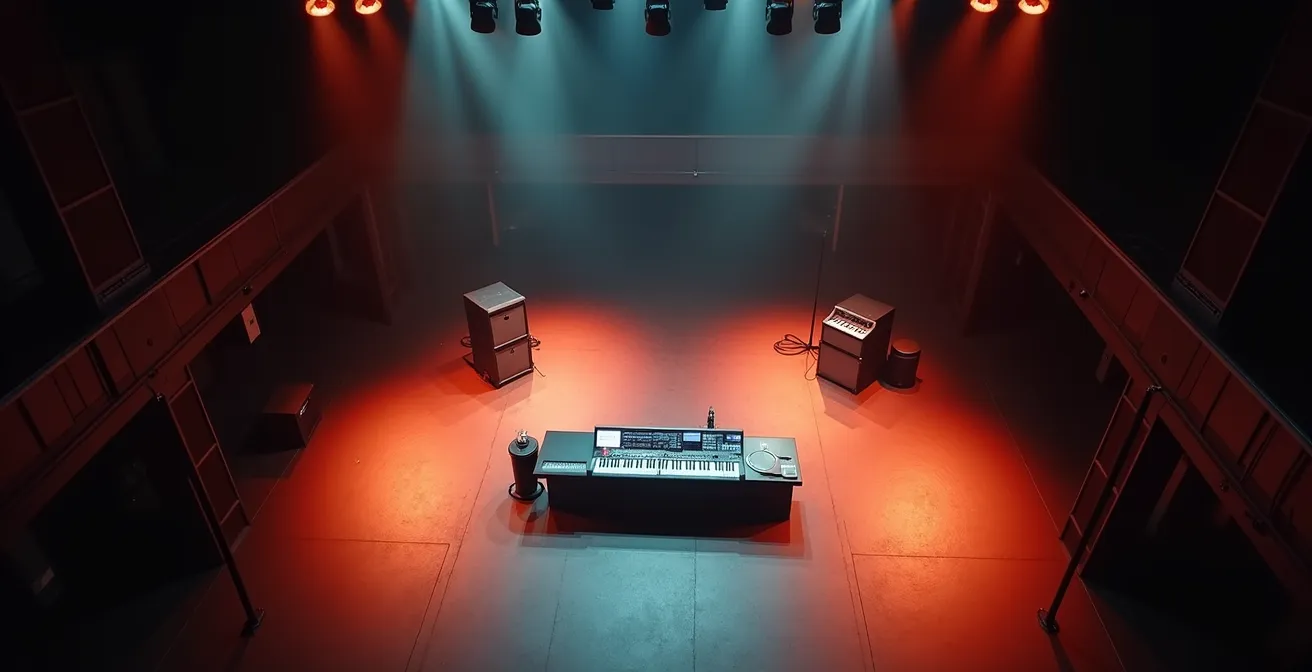
As the aerial view above illustrates, the FOH mixing desk is strategically placed where the sound from all speakers converges in the most balanced way. Positioning yourself in this vicinity ensures you hear the music with the most clarity and balance, as intended by the engineer. This is not only better for the musical experience but also safer, as it’s a zone free from the extreme SPL (Sound Pressure Level) peaks found near the stage or against reflective walls.
Furthermore, your own anatomy plays a role. The human ear canal naturally amplifies sounds in the 2,000-4,000 Hz range—the very frequencies where human speech and musical clarity reside. Research shows that the ear canal provides about 10 dB of gain to the eardrum at around 3,300 Hz. This means that even if the venue’s sound is 100 dB, your eardrum may be experiencing 110 dB in that critical frequency range, making your position relative to the sound source even more important.
Key Takeaways
- Your “sound dose” is determined by volume and time. At 100 dB, permanent hearing damage can start in under 15 minutes.
- Choose high-fidelity earplugs with flat-frequency filters. They reduce volume without muffling sound, preserving the music’s quality.
- After any loud event, your ears need at least 16 hours of relative quiet (below 70 dB) to recover from auditory fatigue and prevent long-term damage.
How to Choose a Theater Season Ticket That You Will Actually Use?
This question, when viewed through the lens of an audiologist, is not about choosing plays or musicals. It’s a metaphor for making a long-term, sustainable commitment to your hearing health. A “season ticket” represents a habit, a practice that you will actually stick with for every single show, year after year. The best hearing protection plan is not the most expensive or complex one; it’s the one you will use consistently without fail.
Choosing a plan you will actually use means finding the perfect balance between protection, comfort, and convenience. For one person, that might be a $20 pair of high-fidelity universal earplugs kept permanently on their keychain. For a more frequent attendee, it might be a $200 set of custom-molded plugs that feel so comfortable they forget they’re even wearing them. The specific choice is less important than the commitment it represents.
This commitment is a conscious decision to value your future hearing over a fleeting moment of unprotected sound. It’s acknowledging that live music is a profound gift, one that deserves to be enjoyed for an entire lifetime, not just for a few years before it’s marred by tinnitus or hearing loss. This perspective is perfectly encapsulated by hearing health advocates like Dr. De Wet Swanepoel:
Music is a gift to be enjoyed for a lifetime. The message is to enjoy your music but safely.
– Dr. De Wet Swanepoel, University of Pretoria
Ultimately, “choosing the ticket you will use” means integrating hearing protection into your concert-going ritual until it becomes as automatic as grabbing your phone and keys. It’s about making safety a non-negotiable part of the experience, ensuring that every concert you attend enriches your life without taking anything away from it.
The strategies outlined here are not about diminishing your enjoyment of live music; they are about preserving it. The next time you prepare for a concert, don’t just go—go with a plan. Your hearing is one of the most precious senses you have, and it is entirely your responsibility to protect it. Make these practices your new habit, starting today.