

The key to affordable Corporate Social Responsibility (CSR) for an SME is to stop seeing it as a cost and start treating it as an operational efficiency strategy.
- Focus on direct reductions in waste and energy, which generate immediate, measurable savings.
- Use these savings to fund employee well-being initiatives, creating a self-perpetuating “green dividend.”
Recommendation: Start with a simple waste or energy audit this week. The data you uncover is the foundation for your entire low-cost CSR program.
As a small business owner, the term “Corporate Social Responsibility” likely conjures images of massive corporations planting a million trees or donating huge sums to charity—initiatives that seem completely out of reach. You want to do the right thing, for the planet and for your community, but the fear of high costs and complex programs creates a barrier. The common advice often revolves around grand gestures that feel more like expensive marketing than genuine impact, leaving you feeling that sustainability is a luxury you can’t afford.
This perception is the single biggest obstacle for SMEs. Many believe CSR is a separate, costly department. They might dabble in basic recycling or a one-off donation, but these isolated actions rarely move the needle on cost, culture, or customer perception. They are seen as expenses, not investments, and often fall by the wayside when budgets get tight. This approach completely misses the point of modern, effective CSR.
But what if the entire framework was flipped on its head? What if, instead of being a cost center, CSR became your most powerful tool for boosting operational efficiency? The truth is, sustainable practices are not about spending more; they’re about wasting less. This guide will demonstrate that the most impactful CSR isn’t about the size of your budget, but the cleverness of your strategy. We will explore a pragmatic system where small, targeted actions to reduce waste and energy don’t just cut costs—they create a ‘green dividend’ that can be reinvested into what matters most: your people and your purpose.
This article provides a roadmap to transform your business from the inside out. We will move from the strategic ‘why’—understanding how these values attract top talent—to the practical ‘how’ of conducting waste audits, avoiding greenwashing, and reinvesting your savings. By the end, you will have a portfolio of low-cost, high-impact strategies that turn sustainability into a competitive advantage.
Summary: A Pragmatic Roadmap to CSR for Small Businesses
- Why Top Talent Prefers Working for B-Corp Certified Companies?
- How to Conduct a Waste Audit in Your Office in One Afternoon?
- Carbon Offsets vs Direct Reduction: Which Is Less Greenwashing?
- The Marketing Mistake That Makes Your Green Claims Look Fake
- How to Reinvest Energy Savings into Employee Well-being?
- How to Unsubscribe and Delete Old Emails to Save Server Space?
- How to Use Dimmers to Extend Bulb Life and Save Energy?
- How to Transition Your Team to a 4-Day Workweek Without Losing Revenue?
Why Top Talent Prefers Working for B-Corp Certified Companies?
In today’s competitive job market, salary and benefits are just the baseline. The most skilled and motivated professionals are increasingly seeking employers whose values align with their own. They aren’t just looking for a job; they’re looking for a purpose. This is where companies with strong, authentic CSR programs—epitomized by certifications like B Corp—gain a significant edge. Being a B Corp signals a verified commitment to high standards of social and environmental performance, accountability, and transparency. It tells a potential hire that this is a business that walks the talk.
This isn’t just a feeling; it’s backed by data. A recent analysis revealed that Certified B Corporations in the UK are outperforming their peers in attracting and retaining staff. For instance, new data from B Lab UK reveals that certified companies saw a significant increase in employee headcount while the national average showed a decrease. This trend is driven by a phenomenon known as “conscious quitting,” where employees leave roles that conflict with their personal values. The Net Zero Employee Barometer found that over 35% of employees reported quitting a previous job due to such misalignment.
Case Study: Ignition Law’s Talent Magnet
Ignition Law, a values-led UK law firm, provides a powerful example. By embarking on their B Corp certification journey, they successfully attracted and retained a diverse, talented team in a high-attrition industry. They found that a staggering 70% of applicants had actively researched the firm’s purpose and explicitly cited the B Corp certification as a key factor during interviews. This demonstrates that a public commitment to purpose acts as a powerful filter, attracting candidates who are already aligned with the company’s mission and are more likely to be engaged and loyal long-term.
You don’t need to be B Corp certified from day one to leverage this principle. The key is to build and communicate an authentic CSR action portfolio. Start by involving employees in decisions, partnering with local community organizations, and transparently sharing your progress—wins and challenges alike. These actions build a culture of purpose that becomes your most powerful recruitment tool, attracting individuals who want to contribute to something more than just the bottom line. This creates a virtuous cycle of engagement and performance.
How to Conduct a Waste Audit in Your Office in One Afternoon?
One of the fastest, cheapest, and most impactful ways to kickstart your CSR journey is by looking in your own bins. A waste audit is a simple diagnostic tool that demystifies your company’s consumption patterns and uncovers immediate opportunities for cost savings and environmental wins. Many businesses are shocked to learn what they’re throwing away—and how much it’s costing them. In fact, research shows that up to 70% of the typical business’s landfill waste could be recycled instead. An audit transforms this abstract statistic into a concrete action plan.
The process is far less daunting than it sounds and can be completed in a single afternoon with a small, dedicated team. It’s a hands-on activity that directly engages employees in your sustainability mission, making them part of the solution from the very beginning. The goal isn’t just to sort trash; it’s to gather data that will inform smarter purchasing decisions, improve recycling systems, and reveal “quick wins” that build momentum for your entire CSR program.
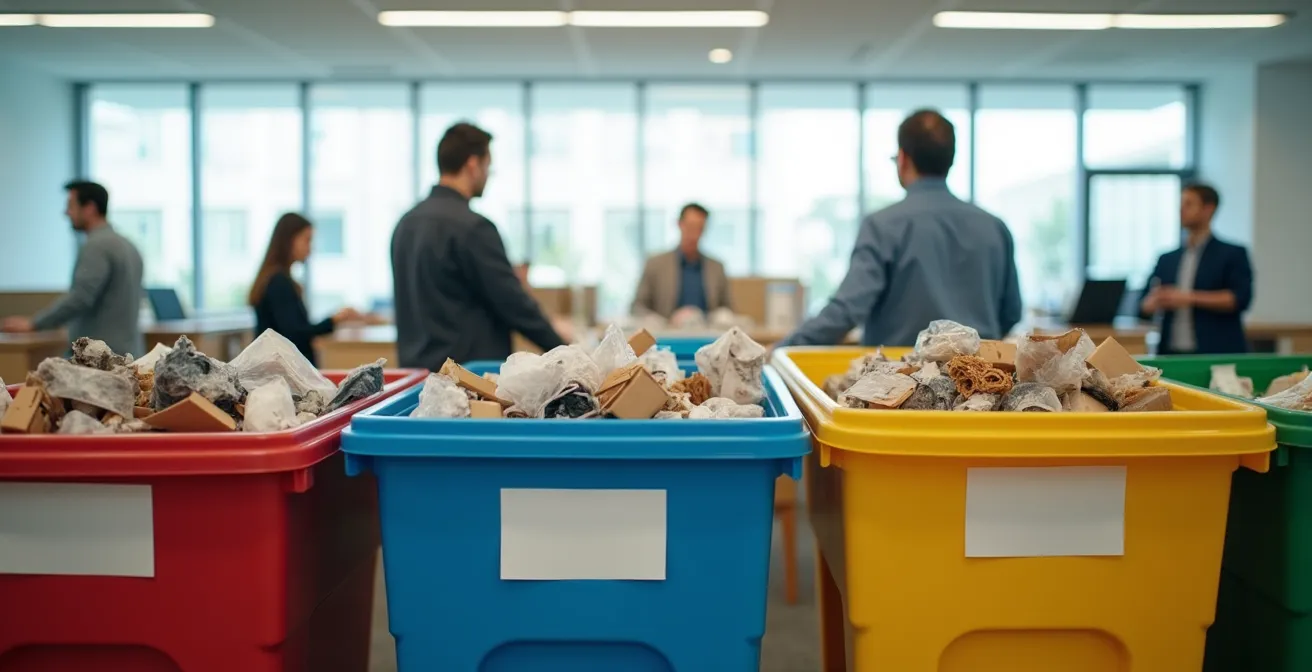
As the image above illustrates, the process involves systematically sorting collected waste into clear categories. This visual evidence is powerful. Seeing a mountain of single-use coffee cups or recyclable paper in the general waste bin makes the problem tangible and undeniable. From this simple exercise, you can calculate the volume of each waste stream, identify contamination issues in your recycling, and estimate the potential financial savings from diverting materials from landfill.
Your 5-Step Waste Audit Action Plan
- Points of contact: Gather all waste from every bin (offices, kitchen, restrooms) just before the regular pickup to get a full picture.
- Collecte: Arm your team with gloves, clear bags, and a scale. Sort all materials into distinct categories like paper, cardboard, plastic types, glass, organic waste, and non-recyclables.
- Coherence: Weigh each category and calculate its percentage of the total waste. Compare this data to your disposal costs to see where your money is going.
- Mémorabilité/émotion: Identify the top one or two “problem items” that appear in the wrong bins or make up the largest volume of landfill waste. This is your first target.
- Plan d’intégration: Create a simple action plan. Could you switch to a reusable alternative for the top problem item? Do you need better signage on bins? Schedule a brief training session with staff.
The results of your waste audit become the first chapter of your authentic sustainability story. It provides the “before” picture and a set of clear, data-driven goals. This is the foundation of an operational efficiency loop: the money saved from reduced disposal fees can be reinvested into other green initiatives or employee rewards.
Carbon Offsets vs Direct Reduction: Which Is Less Greenwashing?
As your business becomes more aware of its environmental footprint, you’ll encounter two main strategies for managing carbon emissions: direct reduction and carbon offsetting. Carbon offsetting involves purchasing “credits” from projects that reduce emissions elsewhere (like a reforestation project) to compensate for your own. Direct reduction, on the other hand, involves making changes within your own operations to lower your energy consumption and waste output. For a small business, the choice between these two paths is critical for both budget and credibility.
While carbon offsets can seem like a quick and easy solution, they carry a significant risk of being perceived as “greenwashing”—a marketing-first approach that masks a lack of genuine internal change. Stakeholders, including savvy customers and employees, are increasingly skeptical of companies that simply buy their way to “carbon neutral” status without first doing the hard work of cleaning up their own house. For an SME, authenticity is paramount. Therefore, focusing on direct reduction is almost always the more credible, cost-effective, and marketable strategy.
Direct reduction initiatives, such as improving insulation, redesigning packaging to use less material, or optimizing delivery routes, have a dual benefit. They tangibly lower your environmental impact and, crucially, they reduce your operational costs. This creates a powerful and easy-to-understand story: “We changed our process, which saved X amount of cardboard and Y in expenses.” This is far more compelling than the abstract concept of an offset credit from a project halfway across the world.
The following table, based on real-world SME strategies, highlights the clear advantages of focusing your efforts locally and internally first. A third option, “hyper-local insetting,” involves funding a local environmental project, which combines high credibility with excellent community engagement.
| Approach | Direct Reduction | Carbon Offsets | Hyper-Local Insetting |
|---|---|---|---|
| Initial Cost | Low to Medium | Low | Very Low |
| Credibility for SMEs | High | Low-Medium | High |
| Marketing Value | Strong local story | Risk of greenwashing perception | Excellent community engagement |
| ROI Timeline | 3-12 months | Immediate but no savings | 6-18 months |
Case Study: Spicers of Hythe’s 20% Cardboard Reduction
The UK-based company Spicers of Hythe achieved an impressive 20% year-on-year reduction in cardboard usage through thoughtful packaging redesigns. This direct action not only shrank their environmental footprint but also directly lowered material and shipping costs. It’s a perfect example of how sustainability and smart budget management are two sides of the same coin, creating a win-win scenario that resonates with customers and strengthens the bottom line.
The pragmatic approach for any SME is clear: prioritize direct reduction first. Use the data from your waste and energy audits to identify the biggest opportunities for efficiency. Once you have exhausted these internal options, you can then consider hyper-local insetting to engage your community. This strategy builds a foundation of authenticity that makes your green claims impossible to dismiss as greenwashing.
The Marketing Mistake That Makes Your Green Claims Look Fake
The biggest marketing mistake an SME can make in its CSR journey is a mismatch between the scale of its claims and the reality of its actions. This often manifests as the use of vague, grandiose terms like “eco-friendly,” “green,” or “sustainable” without any specific proof to back them up. In an era of heightened consumer skepticism, such generic language is a red flag for greenwashing. Authenticity isn’t built on buzzwords; it’s built on transparent, measurable proof.
To avoid this trap, you must shift your communication strategy from making broad claims to sharing a specific, honest journey. Instead of saying your product is “eco-friendly,” state that you “reduced packaging waste by 30% by switching to a new material.” This data-driven approach is not only more credible but also more engaging. It tells a story of continuous improvement, not of un-provable perfection. Sharing challenges and setbacks alongside your wins can further enhance your credibility, showing that you are on a genuine journey of learning and adaptation.

The focus should be on radical transparency. As shown in the image, the most powerful green marketing involves proudly showcasing your real metrics and progress. Connect your environmental initiatives back to your core business values and, importantly, to the benefits for your employees and community. This narrative approach transforms a simple sustainability metric into a powerful story about your company’s purpose. As Chris Turner, Executive Director of B Lab UK, notes, purpose and profit are not mutually exclusive.
Companies do not have to choose between purpose and profit. This data shows that a new generation of UK businesses are proving purpose and profit can go hand in hand.
– Chris Turner, B Lab UK Executive Director
This principle of “show, don’t tell” is the antidote to greenwashing. Your marketing should reflect the reality of your operations. If you’ve just started, talk about your first step—the waste audit. If you’ve achieved a significant reduction, celebrate that specific number. This honesty builds trust that no vague “eco-friendly” label ever could. Your sustainability report can be a simple, regularly updated blog post or a section on your website, not a glossy, expensive publication. The key is the content, not the container.
How to Reinvest Energy Savings into Employee Well-being?
Here lies the heart of the operational efficiency loop: turning cost savings from green initiatives into tangible benefits for your team. This is where CSR transitions from a series of environmental actions into a powerful tool for building a positive and engaged company culture. By creating a “green dividend,” you create a direct link between sustainable practices and employee rewards, making everyone a stakeholder in the company’s success. This is a game-changer for retention and morale.
The impact of such programs is profound. A well-designed CSR strategy isn’t just a “nice-to-have”; it’s a core driver of human resources metrics. For example, according to a Project ROI study, strong CSR programs can increase employee engagement by up to 7.5% and, remarkably, reduce employee turnover by as much as 50%. For an SME, cutting turnover in half represents a massive saving in recruitment and training costs, far outweighing the initial investment in sustainability efforts.
The key is to make the reinvestment process transparent and, ideally, employee-directed. After tracking the savings from initiatives like installing LED lighting, reducing waste, or going paperless, you can allocate that budget to a dedicated well-being fund. The magic happens when you empower your employees to decide how that “green dividend” is spent. This fosters a deep sense of ownership and proves that their efforts to be more efficient have a direct, positive outcome on their work life.
Case Study: Employee-Directed Green Dividend Programs
One of the most cost-effective and engaging ways to implement this is through Employee Volunteer Programs (EVPs) funded by operational savings. Companies that implement EVPs report that employees experience significant personal growth and a heightened sense of purpose and job satisfaction. A small business can allocate its energy savings to fund paid time for employees to volunteer at a local charity of their choice. An even more powerful model is to let the team vote on how the ‘green dividend’ is used, whether it’s for new ergonomic office chairs, a subscription to a wellness app, or a series of team-building volunteer days. This creates a self-perpetuating cycle where sustainability directly fuels a better, more fulfilling work environment.
By reinvesting savings in this way, you close the loop. Environmental responsibility is no longer an abstract corporate goal; it’s a system that actively improves the daily lives of your employees. This builds unparalleled loyalty and transforms your workforce into passionate advocates for your brand and its values.
How to Unsubscribe and Delete Old Emails to Save Server Space?
In our quest for sustainability, we often focus on physical waste, but our digital footprint has a real and growing environmental cost. Every email stored on a server, every file in the cloud, consumes electricity 24/7. This “digital clutter” contributes to the massive energy demand of data centers worldwide. For a small business, implementing a policy of digital sobriety is a no-cost CSR initiative that reduces your environmental impact while also improving data security and organizational efficiency.
The principle is simple: store only what you need. A significant portion of the data an average company holds is redundant, obsolete, or trivial. Old promotional emails, outdated project files, and endless notification threads take up valuable server space and energy. The problem is compounded by the explosive growth of electronic waste from the hardware needed to store this data. While recycling is part of the solution, the most effective strategy is to reduce the demand in the first place.
Implementing a digital cleanup policy can start today. Encourage your team to take 15 minutes each week to unsubscribe from newsletters they no longer read and delete old, unnecessary emails. You can use free bulk-unsubscription tools to accelerate this process. The next step is to create a simple, automated email retention policy. For instance, you can set rules in your email client to automatically delete items in the “sent” or “deleted” folders after 90 days, or archive emails older than two years.
This isn’t just about saving the planet; it’s about good data hygiene. A lean digital storage system is easier to manage, faster to search, and more secure. Educating your team on the impact—for example, that storing 1GB of data can consume around 32 kWh annually—helps frame this not as a chore, but as a meaningful contribution to the company’s efficiency and sustainability goals. By establishing clear policies for what to keep and for how long, you create a more streamlined and responsible digital workplace.
How to Use Dimmers to Extend Bulb Life and Save Energy?
Improving energy efficiency is a cornerstone of any low-cost CSR strategy, and lighting is one of the easiest areas to find significant savings. While upgrading to LED bulbs is a well-known first step, a more nuanced and often overlooked tactic is the installation of dimmer switches. Dimmers provide a powerful one-two punch: they can dramatically reduce energy consumption and significantly extend the lifespan of your bulbs, delivering savings on both your electricity bill and your replacement costs.
The principle is straightforward. A light bulb running at 90% of its full power uses about 10% less energy but can see its lifespan double. This effect becomes even more pronounced at lower light levels. By giving employees control over their immediate lighting environment, you not only save energy but also improve comfort and well-being. Dimmers allow for “light tuning”—adjusting brightness based on the task at hand, the time of day, or the amount of available natural light. This is a simple, behavioral-driven approach to energy conservation that requires minimal investment.

Installing dimmers is a relatively low-cost upgrade, often costing just $20-50 per switch. When combined with other low-cost strategies like “daylight harvesting” (making maximum use of natural light by arranging desks near windows) and “light zoning” (turning off lights in unoccupied areas), the cumulative savings can be substantial. The table below compares the effectiveness of various lighting strategies for a small office, highlighting that a blend of behavioral changes and minor technical upgrades yields the best return on investment.
| Strategy | Investment Required | Annual Savings Potential | Implementation Difficulty |
|---|---|---|---|
| Behavioral Changes (light zoning) | $0 | 15-20% | Easy |
| Daylight Harvesting Rules | $0-50 (for reminder stickers) | 10-15% | Easy |
| Installing Dimmers | $20-50 per switch | 20-25% | Medium |
| LED Conversion | $5-15 per bulb | 50-75% | Easy |
| Motion Sensors | $30-100 per sensor | 30-40% | Medium |
By implementing dimmers, you empower your team to become active participants in the company’s energy conservation efforts. It’s a visible and interactive change that serves as a constant reminder of your commitment to sustainability. The savings generated can then be funneled directly into your “green dividend” fund, making the connection between efficiency and employee reward crystal clear.
Key takeaways
- Effective CSR is not a cost but a system for driving operational efficiency and employee engagement.
- Start with measurable, internal actions like waste and energy audits to generate savings that fund bigger initiatives.
- Authenticity is everything; use specific data in your marketing and avoid vague “green” claims to build trust.
How to Transition Your Team to a 4-Day Workweek Without Losing Revenue?
The 4-day workweek represents one of the most advanced and holistic expressions of a modern CSR strategy. It moves beyond simple environmental or community initiatives to fundamentally redesign the relationship between work, well-being, and productivity. While it may seem like a radical step, for an SME that has already embraced a culture of efficiency, it is the logical conclusion. It’s the ultimate “green dividend”—a reward funded not by increased spending, but by a relentless focus on eliminating wasted time and energy.
The premise of a successful transition is the “100-80-100” model: 100% of the pay, for 80% of the hours, in exchange for 100% of the productivity. This is not about cramming five days of work into four; it’s about fundamentally re-engineering your processes to eliminate the inefficiencies that fill a traditional 40-hour week. This requires a company-wide “efficiency sprint” to identify and remove time-wasting meetings, redundant administrative tasks, and inefficient workflows. What you are left with is a leaner, more focused operation where outcomes, not hours, are the measure of success.
From a CSR perspective, the benefits are multi-faceted. Environmentally, having one less commuting day per week per employee results in a measurable reduction in your company’s collective carbon footprint. Operationally, a closed office one day a week leads to significant energy savings. Most importantly, it is a powerful statement about your commitment to employee well-being, giving your team the gift of time. This has a profound impact on talent attraction and retention in a world where work-life balance is a top priority.
To begin, you don’t need to commit forever. Start with a 3-month trial, perhaps during a slower season, and establish clear Key Performance Indicators (KPIs) to track productivity, revenue, and employee satisfaction. Document the energy savings and the reduction in commuting emissions. This data becomes a powerful part of your sustainability story, proving that prioritizing people and the planet can go hand-in-hand with a healthy bottom line. This is the pinnacle of the operational efficiency loop, where system-wide improvements unlock the ultimate employee benefit.
By adopting this pragmatic, efficiency-first mindset, any small business can build a powerful and authentic CSR program. Start today by choosing one small, measurable action from this guide—conduct a waste audit, install a dimmer switch, or start a digital cleanup. The journey to becoming a purpose-driven company begins not with a big budget, but with a single, smart step.