
In summary:
- Stop being a tour guide who explains facts; become a co-detective who asks curious questions.
- Turn the visit into a mission-based scavenger hunt that goes beyond simple “I Spy.”
- Treat your child’s attention span like a budget; leave before it’s “spent” to avoid meltdowns.
- Reframe the gift shop from a point of conflict to a strategic part of the experience.
The scene is painfully familiar. You’re standing in a beautiful museum gallery, surrounded by centuries of art and history. You’re hoping for a spark of wonder in your child’s eyes, but instead, you hear the dreaded whine: “I’m boooored. Can we go now?” You’ve tried all the standard advice: pack snacks, promise ice cream, and limit the visit to an hour. Yet, you still find yourself dragging a complaining child from room to room, feeling more like a warden than a parent sharing a joyful experience.
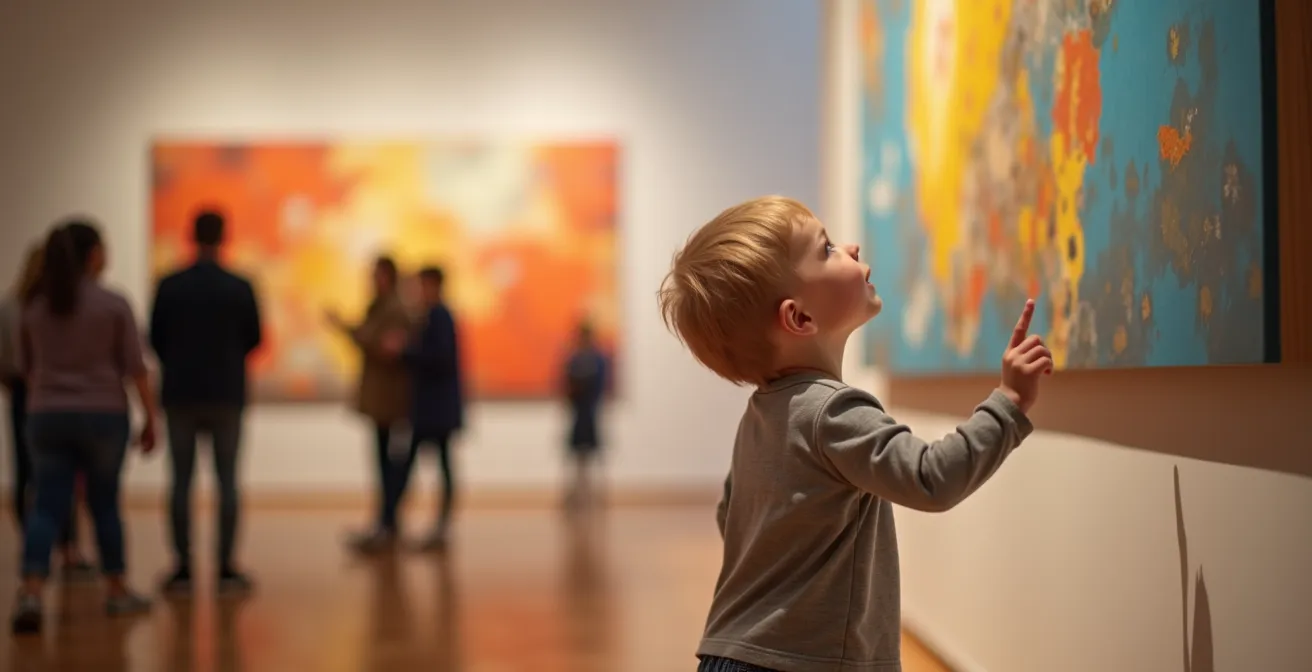
What if the problem isn’t your child’s attention span or the museum itself? What if the secret to a genuinely fun visit lies in a simple but profound shift in your own role? The common approach is to become a teacher, pointing out facts and explaining what’s important. But for a child, this can feel like a lecture, another chore to endure. The real magic happens when you stop explaining and start exploring together.
This guide is about transforming you from a tour guide into a co-detective. We’ll move beyond the platitudes and dive into playful, pedagogical strategies that empower your child to lead the discovery. You’ll learn how to unlock the stories hidden in plain sight, turning a passive walk into an active adventure. We will explore how to ask better questions, create compelling games, navigate the dreaded “one more room” mistake, and even use the gift shop to your advantage. Let’s rediscover the museum through their eyes.
To help you navigate this new approach, this article breaks down the key strategies into practical, easy-to-implement steps. Discover how to change your conversations, gamify your visit, and manage energy levels for a meltdown-free day.
Summary: A Parent’s Guide to Fun Museum Adventures
- Why Asking “What Do You See?” Is Better Than Explaining Facts?
- How to Create a DIY Scavenger Hunt for Any Art Museum?
- Audio Guide vs Docent Tour: Which Holds a Child’s Attention?
- The “One More Room” Mistake That Leads to Meltdowns
- When to Visit the Gift Shop to Avoid Tantrums?
- Why Is It So Emotional to Start Parenting Your Own Parents?
- The Signs of Parental Burnout You Should Never Ignore
- How to Use Family Heirlooms to Unlock Your Genealogy?
Why Asking “What Do You See?” Is Better Than Explaining Facts?
The single most powerful shift you can make is to stop telling and start asking. When we feed a child facts—”This painting is from 1888 by Vincent van Gogh”—we place them in a passive role. Their only job is to receive information. But when you ask an open-ended question like, “What’s going on in this picture?”, you hand them the detective’s magnifying glass. You invite them to be an active participant, an expert on their own observations. This method, known as Visual Thinking Strategies (VTS), isn’t just about keeping kids busy; it’s a powerful educational tool.
VTS was developed through over 30 years of research by cognitive psychologist Abigail Housen and museum educator Philip Yenawine. Their work is grounded in the idea that looking at art is a developmental skill that grows with practice. By facilitating a discussion with a few key questions, you encourage children to look closer, back up their ideas with evidence, and listen to the perspectives of others. The goal is not to find the “right” answer but to engage in a collaborative process of discovery. This simple change transforms a one-way lecture into a two-way conversation, making your child feel heard, valued, and intellectually capable.
This approach has profound benefits that extend far beyond the museum walls. A key VTS implementation study has documented a strong relationship between the program and students’ academic achievement in math, science, and language arts. By asking “What do you see that makes you say that?”, you are teaching the foundational skill of evidence-based reasoning. You are showing them how to build an argument from visual information, a skill critical for all forms of learning. So next time you’re in front of a masterpiece, resist the urge to read the plaque aloud. Take a breath, look with your child, and simply ask what they see.
Action Plan: Audit Your Museum Conversation Style
- Points of contact: Notice when you tend to explain vs. ask. Is it in front of famous art? When your child seems bored?
- Collecte: For your next visit, try using only the three core VTS questions: “What’s going on here?”, “What do you see that makes you say that?”, and “What more can we find?”.
- Coherence: Does this questioning style align with your goal of fostering curiosity? Compare it to the results of fact-based explanations.
- Mémorabilité/émotion: Note which artworks spark longer conversations. Are they the “famous” ones or the ones with quirky, story-rich details?
- Plan d’intégration: Make asking open-ended questions your default strategy, using facts only as a “bonus” if your child asks for more information.
How to Create a DIY Scavenger Hunt for Any Art Museum?
Once you’ve embraced the co-detective mindset, the next step is to give your family a mission. A well-designed scavenger hunt can transform a meandering, aimless walk into a focused and exciting quest. Forget generic “I Spy” with colors. The most engaging hunts are thematic, encouraging kids to look for concepts, emotions, and stories rather than just objects. The best part? You can create one for any museum on the back of an envelope just minutes before you enter.
The key is to create “missions” instead of a checklist. Instead of “Find a boat,” try “Find a vessel for a secret journey.” Instead of “Find a dog,” try “Find a loyal sidekick for a hero or villain.” These prompts ignite the imagination and encourage visual storytelling. You’re not just identifying items; you’re casting characters and building narratives. This works for all ages. For younger children, a sensory hunt can be magical. For older kids, you can introduce more complex challenges related to artistic techniques or historical context.
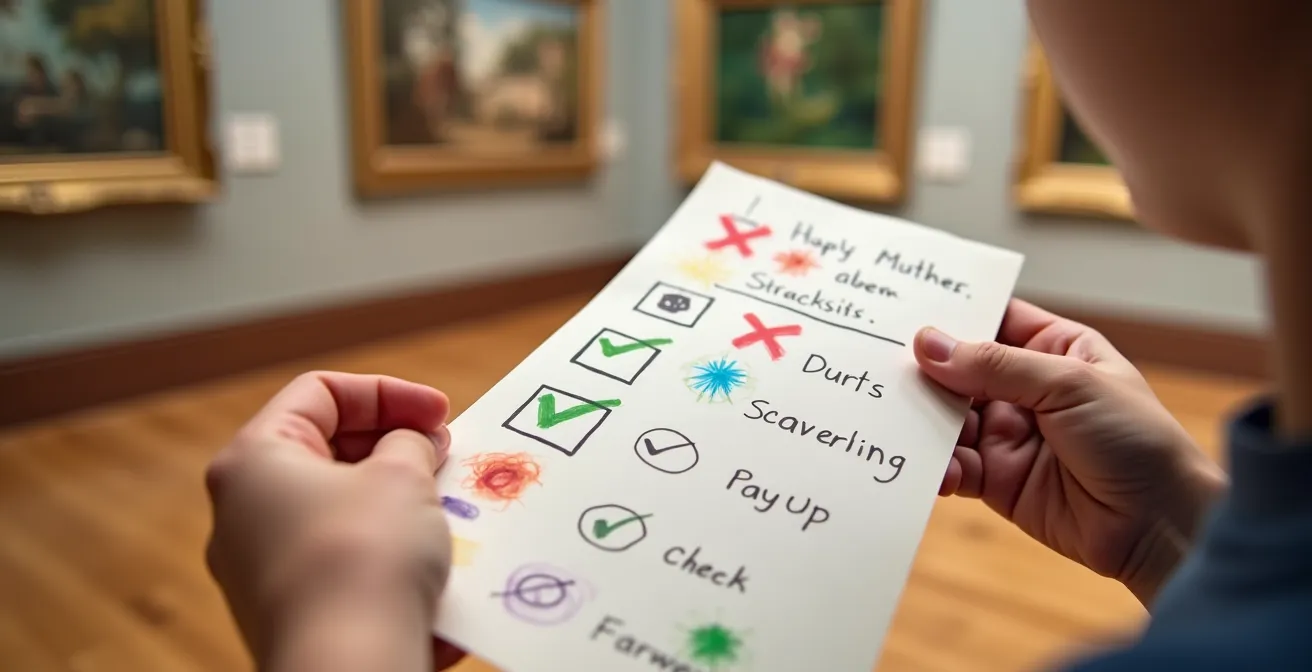
As you can see, the hunt itself becomes a creative artifact. To get started, brainstorm a few missions based on the type of museum you’re visiting. Here are a few ideas to spark your creativity:
- Detective Missions: “Find three clues to a secret treasure: a key, a map, and a suspicious character.” This encourages kids to scan paintings for small, overlooked details.
- Sensory Hunts: “Find a painting that looks rough to touch,” “Find a sculpture that looks cold,” or “Find a scene where you can almost hear a loud noise.”
- Emotion Bingo: Create a simple grid and have them find characters expressing joy, anger, surprise, sadness, or concentration. You can expand this to roles like “a hero,” “a villain,” “a trickster.”
- Technique Challenges (for older kids): “Find a painting with dramatic shadows (chiaroscuro),” “Find a portrait where the person isn’t looking at you,” or “Find a sculpture that seems to be in motion.”
Audio Guide vs Docent Tour: Which Holds a Child’s Attention?
When you want to outsource the “guide” role, museums offer two main options: the pre-recorded audio guide or the live docent-led tour. Choosing the right one depends less on the museum and more on your child’s personality. There’s no single “best” option, but understanding the pros and cons of each can help you pick the format that’s most likely to engage your young explorer rather than overwhelm them.
An audio guide offers maximum control. The child can choose which pieces to learn about, listen to a segment multiple times, or skip ahead at will. This autonomy is ideal for introverted children who prefer to explore at their own pace or for those who are easily overstimulated by group dynamics. It allows them to have a personal, private experience with the art. A docent tour, on the other hand, is a social, interactive experience. It’s often better for extroverted children who thrive on group energy and enjoy asking questions. A great docent is a master storyteller who can read the room and tailor their presentation to the audience’s reactions.
However, there’s a third option that aligns perfectly with our co-detective philosophy: the “Parent-as-Docent.” This doesn’t mean you need a degree in art history. It simply means doing a tiny bit of pre-research on 3-4 specific pieces you think your child will love and then building a mini-tour around them. This method combines the personalization of an audio guide with the interactive bonding of a docent tour. The following table, inspired by an analysis of family museum strategies, breaks down the choices.
| Factor | Audio Guide | Docent Tour | Parent-as-Docent |
|---|---|---|---|
| Best for | Introverted/easily overwhelmed children | Extroverted/interactive learners | Personalized experience seekers |
| Control Level | High – child sets pace | Low – group pace | Maximum – fully customized |
| Engagement Style | Individual exploration | Group interaction | One-on-one bonding |
| Preparation Needed | Minimal | Booking required | Parent pre-research needed |
The “One More Room” Mistake That Leads to Meltdowns
As family travel blog Suitcases and Sandcastles wisely puts it: “Visiting a museum should be a pleasure, not an endurance test. It’s no fun for anyone dragging a tired, bored child around a museum.” The most common trap parents fall into is the “one more room” mistake. You feel the pressure to “get your money’s worth” and see everything, but you push past the point of fascination and into the red zone of fatigue. This is where meltdowns happen. Understanding and respecting the concept of “museum fatigue” is your best defense against tantrums.
Museum fatigue is a documented phenomenon. Research shows that a visitor’s ability to engage with exhibits drops sharply after a certain point. For instance, research at the Florida Museum of Natural History found that visitors show high interest for about 30 minutes, with a significant decrease afterward. For children, this window can be even shorter. It’s not just about tired feet; it’s about cognitive and sensory overload. The constant presentation of new stimuli, the decision-making of what to look at, and the ambient noise all contribute to an exhausted brain.
For some children, this goes beyond simple tiredness and into the realm of sensory overload. According to the Child Mind Institute, children can be either hyposensitive (seeking more input by touching things) or hypersensitive. A hypersensitive child is easily overwhelmed by sensory input, and a crowded, echoing museum gallery can be a direct trigger for a meltdown. Your role is to be the manager of your family’s Attention Span Budget. Your goal should be to leave the museum while everyone is still happy and wanting more, not when they are exhausted and miserable. Ending on a high note ensures they will remember the visit as a fun adventure, making them eager to return.
When to Visit the Gift Shop to Avoid Tantrums?
Ah, the gift shop. For many parents, it’s a minefield of “Can I have this?” and the inevitable tantrum when the answer is no. But what if we reframed the gift shop from an obstacle to a strategic tool? The key is to control the timing and the narrative. Visiting the gift shop at the very end, when your child is already tired and overstimulated, is often a recipe for disaster. Instead, consider integrating it into the visit in a more thoughtful way.
One of the most common pieces of advice is to set expectations *before* you enter. This is crucial. But you can go further by turning the gift shop into part of the educational mission rather than a transactional reward. By giving your child a small, pre-defined budget, you’re not just controlling spending; you’re creating a powerful learning experience about financial literacy. They have to make choices, weigh options, and manage their own resources. This shifts their role from a passive “wanter” to an active “shopper.”
Instead of seeing it as the final hurdle, try incorporating it into the museum experience itself. These strategies can help turn a potential point of conflict into a moment of connection and learning:
- The Mid-Visit Postcard Break: This is a brilliant tactic. About halfway through your visit, when energy starts to dip, take a deliberate break to visit the shop with a single mission: to buy one postcard of a favorite piece seen so far. It’s a small, contained treat that also reinforces the art.
- The Budget Learning Experience: Give your child a specific amount of cash ($5 or $10) and explain that it’s theirs to manage for a souvenir. This empowers them to make choices and understand value.
- The Mission-Based Purchase: Connect the purchase directly to your scavenger hunt. “Our mission is to find a souvenir that a brave knight would use.” This keeps the imaginative play going.
- The Photo-as-Souvenir Mindset: Equip your child with a camera (or your phone) and dub them the “official expedition photographer.” The real souvenir becomes the collection of images they create, which you can later print and frame at home.
Why Is It So Emotional to Start Parenting Your Own Parents?
This question seems out of place in a guide about kids in museums, but the core emotion it touches upon—the friction of a shifting power dynamic—is surprisingly relevant. The frustration and emotional complexity of guiding an aging parent who resists your help can feel eerily similar to guiding a resistant child through a gallery. In both scenarios, your well-intentioned efforts to share something valuable are met with a firm “I don’t want to,” and it can be deeply frustrating.
The root of the emotion is often a perceived loss of autonomy. An aging parent may resent feeling controlled, just as a child bristles at being told what to look at, what to think, and where to go next. When we lecture a child about a painting’s importance, we are unintentionally mirroring that dynamic. We are saying, “I know what’s best, and your role is to listen.” This immediately creates a power struggle. The child’s “I’m bored” is not always about the art; it’s often a declaration of independence, a way of saying, “You can’t make me enjoy this.”
Recognizing this emotional parallel can foster empathy. The feeling of being infantilized is unpleasant for anyone, whether they are 8 or 80. By shifting from a “parenting” or “teaching” mode to a curiosity-led exploration with your child, you dissolve this power struggle. You are no longer imposing your will; you are inviting them into a partnership. You are respecting their autonomy and signaling that their perspective is just as valid as yours. This not only makes the museum visit more pleasant but also strengthens the foundation of your relationship, which is built on mutual respect, not top-down authority.
The Signs of Parental Burnout You Should Never Ignore
Parental burnout is a state of intense exhaustion that leads to emotional distancing from your children and a sense of parental ineffectiveness. While it’s a serious and broad issue, a specific, acute version of it can strike during a family outing: “Museum Day Burnout.” It’s that moment when your patience snaps, your voice gets sharp, and you start thinking, “Why did I even bother?” This isn’t just being tired; it’s the result of immense self-imposed pressure to be the “perfect parent” crafting a “perfectly enriching day.”
The signs of Museum Day Burnout are clear. It starts with an internal monologue of high expectations: “We *have* to see the Impressionists,” “He *needs* to appreciate this,” “This trip has to be educational *and* fun.” This performance pressure turns a joyful outing into a high-stakes test that you feel you’re failing. The symptoms escalate from there: you become less responsive to your child’s needs, interpreting their fatigue as misbehavior. You feel a growing resentment about the effort you’ve put in. The final stage is often an emotional outburst or a grim, silent march back to the car, with everyone feeling defeated.
The antidote to this specific form of burnout is to radically lower the stakes. Let go of the need for the day to be “perfect.” Embrace the co-detective role, which inherently removes the pressure of being the all-knowing teacher. Think of the visit in terms of your Attention Span Budget—not just your child’s, but yours as well. Your goal is not to conquer the museum; it is to share a few moments of genuine connection and discovery. If that means you only see three paintings and spend 20 minutes discussing the weirdest one, that’s a huge success. Giving yourself permission to have an “imperfect” but happy visit is the ultimate act of self-care in this context.
Key takeaways
- The best way to engage a child is to ask curious questions (“What do you see?”), not to state facts.
- Turn the visit into a mission by creating a DIY scavenger hunt for emotions, stories, or sensory details.
- Manage your family’s “attention budget” and always leave while you’re still having fun, not when exhaustion hits.
How to Use Family Heirlooms to Unlock Your Genealogy?
At first glance, this question about genealogy and family heirlooms seems disconnected from a day at the art museum. But what is a museum if not a collection of humanity’s family heirlooms? Every portrait, every piece of pottery, every ancient artifact is a tangible link to our collective ancestors. By reframing the museum’s collection in this way, you can unlock a powerful new method for engaging your child: treating art as a key to unlocking the stories of our shared past.
Instead of looking at a 17th-century portrait as a boring picture of a stranger, frame it as a photograph of a very, very distant relative. Ask your child questions you would ask about an old family photo: “What do you think her name was? What was her secret wish? If she could talk, what story would she tell us?” You are using the object not as an end in itself, but as a portal to a person’s life. This is the essence of visual storytelling, and it transforms your child from a passive viewer into a historical empath and biographer.
This “genealogy of humanity” approach works for objects, too. Standing in front of a Roman vase, you can ask, “Who do you think owned this? What did they use it for every day? Was it a special occasion gift? Imagine the family that sat around a table where this vase held flowers.” You are connecting an inanimate object to the living, breathing people who made and used it. You are teaching your child that history is not just a collection of dates and facts, but a tapestry of individual human stories. By treating the museum’s treasures like precious family heirlooms, you give them a personal relevance and an emotional weight that a simple description could never achieve.
Now that you’re armed with these new strategies, the next step is to put them into practice. Start small. On your next museum visit, commit to trying just one of these ideas. Leave the pressure for a “perfect” educational day at home and focus instead on becoming your child’s partner in discovery. You might be amazed at the stories you uncover together.