
In summary:
- Adopt a “chef’s mindset” that prioritizes workflow efficiency over brute-force chopping.
- Master “batch-to-branch” cooking: turn one base ingredient into three distinct meals to avoid food boredom.
- Strategically use seasonal and frozen produce to maximize flavor, nutrients, and budget.
- Organize your kitchen process and storage to reduce mental load and eliminate food waste.
- Build a flexible system, not a rigid plan, that can adapt to unexpected disruptions.
The Sunday evening dread sets in. You know you *should* prep meals for the week, but the thought of another marathon chopping session and a fridge full of identical, boring containers makes ordering takeout seem so much easier. Many guides suggest the same old solutions: cook one giant pot of chili or dedicate hours to dicing vegetables. While well-intentioned, this approach often leads to food fatigue by Wednesday and doesn’t address the real challenge: the mental and physical drain of the process.
But what if the secret to successful meal prep wasn’t about working harder, but thinking smarter? What if you could adopt the mindset of a professional chef, focusing on workflow, versatility, and efficiency? The true key to reclaiming your weeknights isn’t a rigid, prescriptive plan; it’s building a flexible, intelligent system. It’s about understanding the “why” behind the “what” – from maximizing flavor with seasonal ingredients to orchestrating your kitchen tasks like a symphony.
This guide will walk you through that very system. We will deconstruct the process step-by-step, showing you how to transform your Sunday prep from a dreaded chore into a powerful, streamlined ritual. You’ll learn how to make your ingredients work for you, how to organize your time and space for maximum efficiency, and ultimately, how to free yourself from the daily “what’s for dinner?” decision fatigue.
To help you navigate these strategies, this article is organized into a clear, actionable sequence. Explore the topics that matter most to you or follow along from the beginning to build your complete meal prep system from the ground up.
Summary: Master Your Sunday Meal Prep System
- Why Eating Seasonally Saves Money and Tastes Better?
- How to Cook Three Different Meals from One Batch of Roasted Veggies?
- Fresh vs Frozen Vegetables: Which Is Actually Healthier in Winter?
- The Storage Mistake That Rots Your Berries in 2 Days
- How to Order Your Prep Steps to Save 45 Minutes in the Kitchen?
- How to Use a Kanban Board to Manage Family Chores Effectively?
- How to Conduct a Waste Audit in Your Office in One Afternoon?
- Managing the Mental Load: Strategies for Parents Working Full-Time
Why Eating Seasonally Saves Money and Tastes Better?
The first strategic decision a chef makes isn’t about the recipe; it’s about the ingredients. Embracing seasonal produce is the foundation of a smarter meal prep system. When fruits and vegetables are in season, they are at their absolute peak in flavor and nutritional value. A summer tomato, ripened on the vine, has a sweetness and depth that its bland, winter counterpart simply cannot match. This isn’t just a matter of taste—it’s a matter of abundance.
When produce is plentiful, its price drops significantly. This simple law of supply and demand is a powerful tool for your budget. For example, seasonal pricing data shows that tomatoes are often 40-60% cheaper in late summer than in the dead of winter. By aligning your meal plan with the seasons, you’re not just getting better-tasting food; you’re actively cutting your grocery bill without sacrificing quality.
Think of it as a framework for creativity. Instead of deciding you want to make a specific dish and then hunting for out-of-season ingredients, let the season guide you. A simple base of proteins and grains can be transformed throughout the year: add grilled corn and tomatoes in the summer, roasted butternut squash in the fall, and a crisp cabbage slaw in the winter. This approach ensures variety and novelty in your diet while keeping costs low and flavors high, making it the most efficient starting point for any meal prep strategy.
How to Cook Three Different Meals from One Batch of Roasted Veggies?
The single biggest killer of meal prep enthusiasm is boredom. Eating the same meal for three days straight is a surefire way to find yourself reaching for a delivery app. The chef’s solution to this is the “batch-to-branch” method: cook a large, neutral base of an ingredient and then transform it into several distinct dishes. A big tray of roasted vegetables is the perfect canvas for this technique.
The key is versatility. By roasting root vegetables, broccoli, and bell peppers with just olive oil, salt, and pepper, you create a delicious but simple base. From there, you can branch out into completely different flavor profiles. This approach saves immense time on Sunday while guaranteeing a varied and exciting week of meals. The visual below demonstrates how one simple batch can become three entirely different culinary experiences.
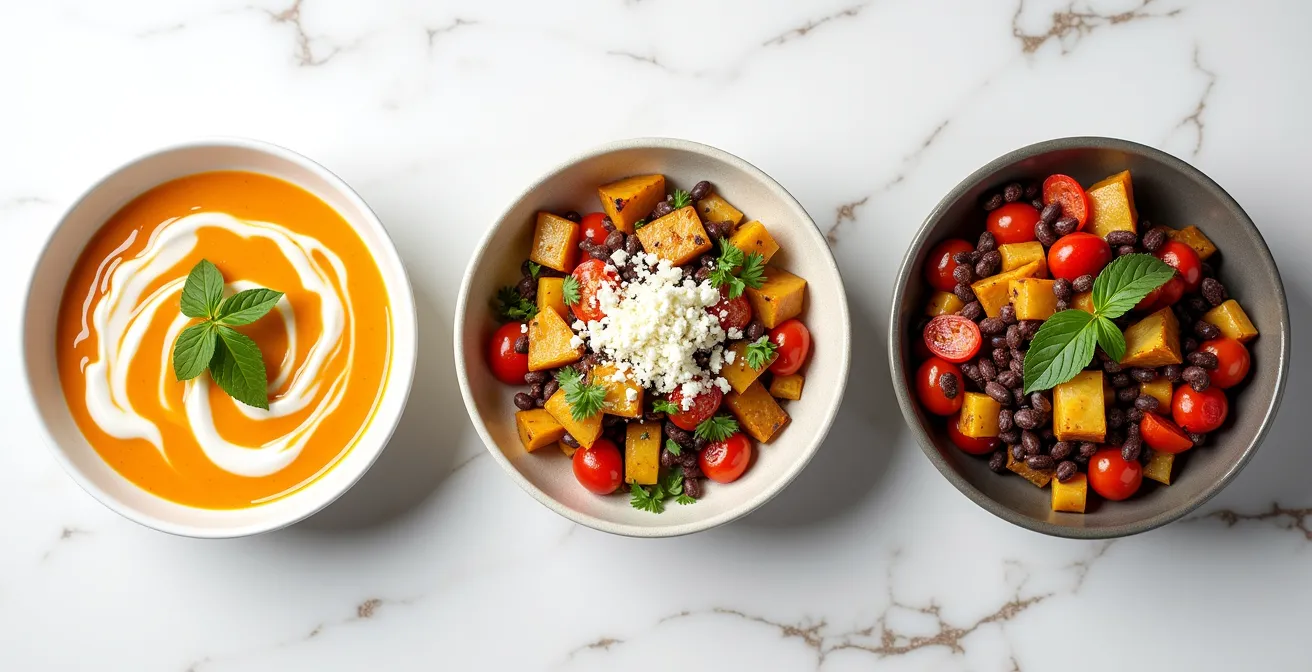
As you can see, the transformation is dramatic. To achieve this, you simply divide your initial batch and add a few key ingredients to each portion. Here’s a simple process to follow:
- Slightly undercook your base batch: Roast at 400°F for 15-20 minutes. This prevents them from getting mushy when you reheat them in different preparations.
- Divide and conquer: Immediately separate the roasted vegetables into three portions.
- Transform Portion 1 into a Curry: Add a splash of coconut milk, a spoonful of curry paste, and some chickpeas. Simmer for a few minutes and serve with rice.
- Create Mediterranean Bowls with Portion 2: Toss the veggies with crumbled feta cheese, a squeeze of fresh lemon juice, olives, and cooked quinoa.
- Assemble Taco Bowls with Portion 3: Mix the vegetables with black beans, a dash of cumin and chili powder, and a squeeze of lime. Serve with salsa and a dollop of Greek yogurt.
Fresh vs Frozen Vegetables: Which Is Actually Healthier in Winter?
There’s a common belief that “fresh is always best,” but a savvy meal prepper knows this isn’t the whole story, especially during winter. When produce is shipped long distances out of season, it can lose a significant portion of its nutrients by the time it reaches your kitchen. This is where frozen vegetables become a strategic advantage. They are typically picked at peak ripeness and flash-frozen within hours, a process that locks in their nutritional value. In fact, nutritional research demonstrates that flash-frozen vegetables retain 90-95% of their nutrients, often making them more nutrient-dense than their “fresh” out-of-season counterparts.
Beyond nutrition, frozen vegetables are champions of convenience and cost-effectiveness. They come pre-washed and pre-chopped, saving you valuable active prep time on a busy Sunday. While the upfront cost per pound can sometimes seem higher, they eliminate waste from peeling and trimming, and you use only what you need, storing the rest for later. This is especially true for items that require significant prep work, like butternut squash or bell peppers.
The choice between fresh and frozen isn’t a moral one; it’s a tactical one based on the season, your budget, and the intended use. A crisp salad requires fresh spinach, but a stir-fry or soup benefits immensely from the convenience and cost-savings of frozen. The following table breaks down the trade-offs for a few common vegetables.
| Vegetable Type | Prep Time Saved (Frozen) | Cost per Pound | Best Use Case |
|---|---|---|---|
| Butternut Squash | 20 minutes | Frozen: $2.50 / Fresh: $1.99 | Frozen for soups, fresh for roasting |
| Spinach | 5 minutes | Frozen: $1.99 / Fresh: $3.99 | Frozen for cooking, fresh for salads |
| Bell Peppers | 10 minutes | Frozen: $2.99 / Fresh: $4.99 | Frozen for stir-fries, fresh for raw eating |
The Storage Mistake That Rots Your Berries in 2 Days
You’ve spent time and money selecting beautiful, fresh produce, only to find your berries molding and your greens wilting within 48 hours. The most common culprit isn’t the quality of the food; it’s a simple storage mistake: excess moisture. When delicate items like berries, herbs, and leafy greens are trapped in a sealed container, the moisture they release creates a perfect breeding ground for mold and decay. Proper airflow and moisture management are non-negotiable for extending the life of your prep.
The solution is to think like a food scientist. Instead of just tossing everything into random containers, you need to create the right micro-environment for each item. For leafy greens and berries, this means using containers that promote air circulation or adding a paper towel to absorb excess condensation. Specialized produce keepers often have elevated grids at the bottom to keep the food from sitting in a pool of water, a key factor in preventing premature rot. Organizing your fridge into zones also plays a crucial role.
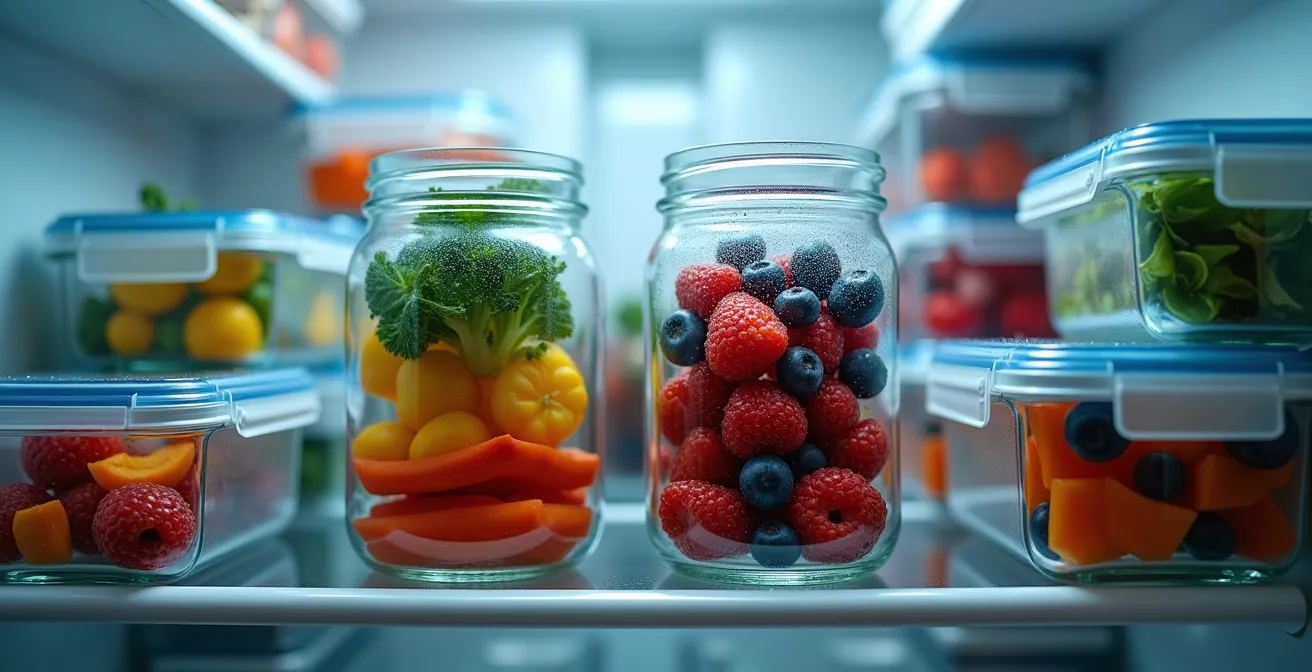
As the image shows, a well-organized fridge isn’t just about aesthetics; it’s a system for preservation. To protect your hard work, implement these strategic storage rules:
- Isolate Ethylene Producers: Keep vegetables in crisper drawers away from ethylene-producing fruits like apples and bananas, which accelerate ripening and spoilage.
- Absorb Excess Moisture: Place a folded paper towel in containers with washed leafy greens to wick away condensation.
- Use the Right Container: Store dressings and sauces in door compartments where temperatures fluctuate most. Use clear glass Mason jars for soups and layered salads for better visibility.
- Prioritize Safety: Always place containers with raw meat or poultry on the bottom shelf to prevent any drips from contaminating other foods.
How to Order Your Prep Steps to Save 45 Minutes in the Kitchen?
The difference between a frantic, 3-hour kitchen frenzy and a calm, efficient 90-minute session lies in one word: workflow. A professional chef never just starts cooking; they orchestrate a series of tasks, maximizing every minute. The key is to distinguish between “active time” (when you are actively chopping, mixing, or sautéing) and “passive time” (when the oven is preheating or something is roasting or simmering). Your goal is to fill every moment of passive time with an active task.
Instead of chopping vegetables and then waiting for the oven to preheat, you should start the oven first. While it heats up, you cook your grains. During the 30-40 minutes that your proteins and vegetables are roasting (passive time), you can wash and chop raw veggies for salads, whip up a dressing, or wash the dishes. This continuous flow eliminates dead time and dramatically shortens your total time in the kitchen. In fact, meal prep efficiency studies show that just two hours of structured prep on a Sunday can save you approximately 45 minutes every single day of the following week.
This systematic approach turns a chaotic process into a calm, predictable sequence. By ordering your steps logically, you build momentum and reduce the feeling of being overwhelmed. The “one-sink method,” where you keep a sink of hot, soapy water ready for continuous cleaning, is another pro-tip that prevents a mountain of dishes from piling up at the end.
Your Kitchen Workflow Audit: The Passive vs. Active Time Method
- Initiate Passive Tasks First: Start by preheating your oven and getting water boiling for grains or pasta. (First 5 minutes)
- Utilize Preheat Time for Active Prep: While the oven heats and grains cook, wash and chop all your vegetables for both roasting and raw salads. (20 minutes of active work during passive time)
- Maximize Roasting Time: Get proteins and vegetables roasting in the oven. This frees you up for a significant block of passive cooking time. (45-60 minutes)
- Perform Parallel Tasks: During the roasting period, assemble salads, make dressings, portion out snacks, and utilize the “one-sink method” with hot soapy water for continuous cleaning.
- Implement a Cooling and Packing System: Once cooked, cool all foods to room temperature on baking sheets or racks (within 2 hours for food safety) before packing and refrigerating to prevent condensation.
How to Use a Kanban Board to Manage Family Chores Effectively?
While the title mentions family chores, the underlying tool—the Kanban board—is a powerful strategy for any busy professional looking to reduce the mental load of meal prep. At its core, a Kanban board is a simple visual system for managing workflow. It helps you see what needs to be done, what’s in progress, and what’s complete. For meal prep, this can be a game-changer, transforming a jumble of mental notes and lists into a clear, organized process.
You don’t need a fancy app; a simple whiteboard or even sticky notes on your fridge will do. Create columns that mirror your meal prep process. A great example comes from a family that implemented a “Meal Prep Flow” board with columns for: ‘To Plan’ (meal ideas), ‘To Shop’ (grocery list), ‘To Prep’ (tasks for Sunday), ‘To Portion’ (packing the meals), and ‘Ready to Eat’ (the finished product).
By moving a “task card” (e.g., “Chicken and Veggies”) across the board, you externalize the entire plan from your brain onto a visual medium. This has two huge benefits. First, it eliminates the need to constantly remember what’s next, freeing up mental energy. Second, it makes the process feel more manageable and provides a satisfying sense of accomplishment as you physically move tasks to the ‘Ready to Eat’ column. It turns an abstract goal into a concrete, step-by-step project, which is a powerful way to combat procrastination and overwhelm.
How to Conduct a Waste Audit in Your Office in One Afternoon?
Let’s adapt this concept from the office to where it matters most for meal prep: your kitchen. A household food waste audit is a chef’s secret weapon for creating a hyper-efficient system. It’s a simple process of tracking what you throw away to gather data and make smarter decisions. Are you consistently tossing half a bag of spinach? Do the prepped turkey meatballs always go uneaten? This information is gold.
Conducting this audit doesn’t have to be complicated. For one week, simply keep a running list on your fridge of every food item you throw away. At the end of the week, look for patterns. This audit provides direct feedback on your planning, purchasing, and consumption habits. It’s the most effective way to stop wasting money and the effort you put into prep. Studies confirm the power of this approach; waste reduction studies indicate that consistent meal planning can reduce household food waste by up to 30%.
Once you identify your patterns, you can take targeted action. Here is a simple framework to turn your audit findings into savings:
- Document Your Patterns: Keep a simple log of what you threw away last week. Be honest and specific.
- Create an ‘Eat Me First’ Zone: Designate a shelf or box in your fridge for items that are close to their expiration date.
- Plan a “Use-It-Up” Meal: Dedicate one meal per week specifically to using ingredients from your ‘Eat Me First’ box.
- Track Uneaten Prepped Items: If you consistently don’t eat a certain prepped meal, stop making it or reduce the batch size.
- Adjust Portion Sizes: If you’re throwing away leftovers from your prepped meals, your portions are too large. Adjust them based on your actual consumption.
Key takeaways
- Strategic thinking is more important than hard labor; adopt a “chef’s mindset” focused on workflow and efficiency.
- Combat food boredom by using the “batch-to-branch” method, turning one base component into multiple distinct meals.
- A successful meal prep is a flexible system, not a rigid plan, with built-in strategies for handling disruptions.
Managing the Mental Load: Strategies for Parents Working Full-Time
While this is framed for parents, the core challenge—managing an overwhelming mental load—is universal for busy professionals. The constant, low-level stress of deciding “what’s for dinner?” every single day is a significant drain on your cognitive resources. A well-designed meal prep system is your single most effective strategy for eliminating this decision fatigue and reclaiming your mental energy for more important things.
One of the most powerful advanced strategies is the “Capsule Menu.” This involves creating a rotating 2-week menu with 5-7 core proteins that you can batch-cook on Sundays. By establishing theme nights (e.g., Meatless Monday, Taco Tuesday), the decision of what to eat is already made for you. You simply “assemble” the meal for that night using your pre-cooked protein and pre-chopped veggies, adding theme-specific seasonings and sides. This system combines the efficiency of batch cooking with the variety needed to keep meals interesting, drastically reducing daily mental effort.
But what happens when life gets in the way of your perfect Sunday plan? A truly robust system accounts for disruptions. This is where “If-Then” planning comes in. Instead of letting an unexpected event derail your entire week, you have a pre-decided backup plan:
- IF you’re too tired for a full prep, THEN you’ll do a 30-minute “mini-prep” (just wash greens and boil eggs).
- IF unexpected Sunday plans arise, THEN you’ll shift your prep session to Saturday morning.
- IF you’re missing a key ingredient, THEN you’ll pivot to your designated freezer meal backup plan.
By shifting your perspective from a chore to a strategic system, you transform your Sundays and, by extension, your entire week. Start building your own flexible meal prep system this Sunday and reclaim your weeknights from decision fatigue and the endless cycle of takeout.