
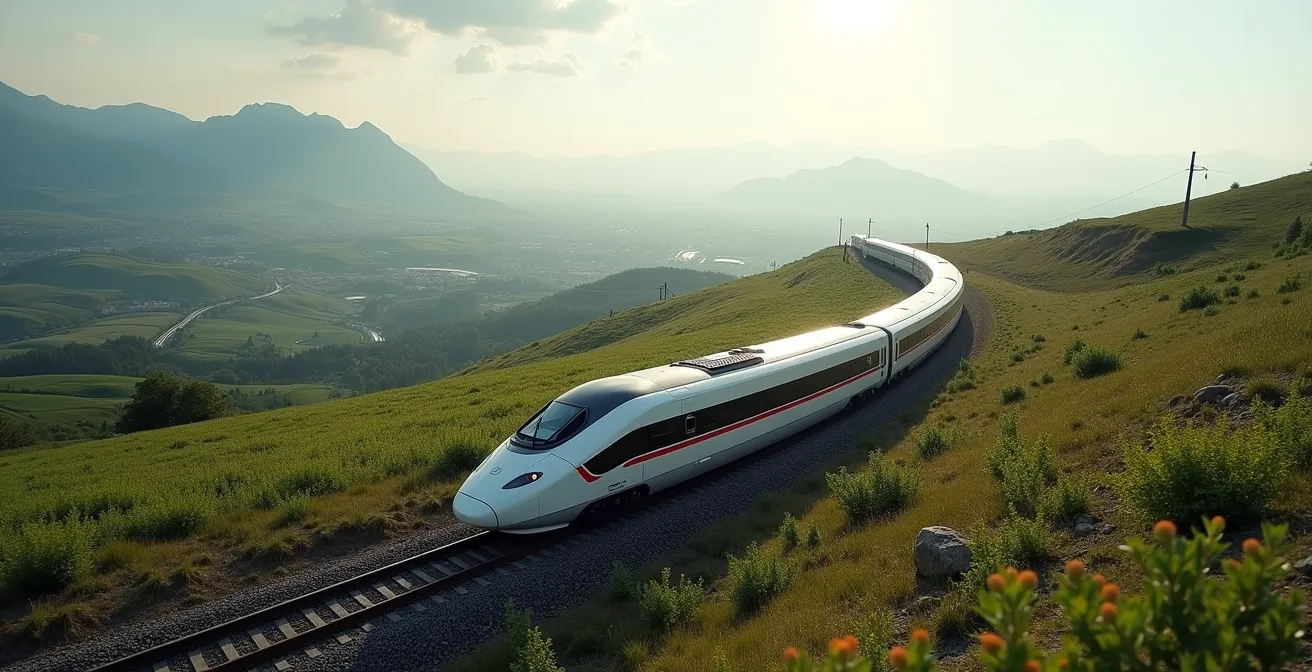
The “one-hour flight” is a myth; a strategic cross-Europe train journey is often faster, cheaper, and removes the stress points of air travel.
- Calculating the “Total Journey Time” reveals that city-center train stations consistently beat airports on door-to-door speed for many routes.
- Rail travel offers “Luggage Freedom,” eliminating surprise baggage fees, weight restrictions, and the risk of lost bags common with budget airlines.
Recommendation: Shift your planning focus from flight duration to total travel time and master a few key rail tactics like split-ticketing to unlock a more efficient and enjoyable way to explore Europe.
The romance of European rail travel is undeniable, but for the modern traveler, practicality often trumps poetry. We’re told that to maximize our precious vacation time, we must endure the budget airline ballet: the pre-dawn taxi, the sprawling security lines, and the nickel-and-dime fees that turn a “cheap” ticket into a costly affair. The plane, we assume, is simply faster. It’s the default choice for anyone trying to hop from Paris to Amsterdam or Berlin to Vienna in a single day.
This common wisdom, however, overlooks a crucial metric: the Total Journey Time. It focuses solely on the time spent in the air, conveniently ignoring the hours buffering either side of the flight. We’ve been conditioned to accept the stress of airports as a necessary evil for the sake of speed. But what if that trade-off is based on a false premise? What if the true key to efficient European travel isn’t a faster plane, but a smarter train journey?
This guide moves beyond the scenic platitudes and dives into the logistics. We will deconstruct the myth of the “one-hour flight” and prove, with concrete strategies and examples, that the train is not just a more pleasant or sustainable alternative, but a logistically superior one. We’ll explore how to leverage night trains as mobile hotels, master the art of fare hacking to slash costs, and manage connections like a pro, transforming your European adventure from a series of stressful sprints into a seamless, efficient, and genuinely enjoyable experience.
In the following sections, we will break down the essential strategies that empower you to plan a cross-continental journey by rail that outpaces its airborne competition. This article provides a logistical roadmap for the savvy traveler ready to reclaim their time and sanity.
Summary: A Strategic Guide to Outsmarting Air Travel in Europe
- Why the “1-Hour Flight” Actually Takes 5 Hours Door-to-Door?
- How to Sleep Comfortably on a Night Train to Save Hotel Costs?
- Train vs Plane Luggage: Why Rail Wins for Heavy Packers?
- The Layover Mistake That Can Strand You in a Foreign Station
- How to Use Split-Ticketing to Save 40% on Rail Fares?
- Why Cycling to the Station Reduces Stress Levels Compared to Driving to the Airport?
- Why Exploring the Station’s Neighborhood Reduces Travel Fatigue?
- How to Plan a “Slow-Paced” European Tour That Feels Like True Exploration?
Why the “1-Hour Flight” Actually Takes 5 Hours Door-to-Door?
The biggest illusion in modern travel is the “one-hour flight.” Airlines sell us on the time spent in the air, but the reality on the ground tells a very different story. To accurately compare train vs. plane, you must calculate the Total Journey Time from your starting point’s door to your destination’s door. When you factor in the travel to out-of-town airports, the mandatory 2-3 hour pre-flight buffer, security screenings, boarding, deplaning, and baggage claim, the time skyrockets.
A high-speed train, in contrast, offers a streamlined experience. You can arrive at a central city station 20-30 minutes before departure, walk directly to your platform, and settle in. Upon arrival, you are already in the heart of your destination, ready to explore. This efficiency isn’t just theoretical. A real-world comparison reveals the hidden time cost of flying. For example, a journey from Paris to Amsterdam highlights this disparity. The flight itself is short, but the entire process takes significantly longer than the direct train.
Consider a practical case: traveling from central Paris to central Amsterdam. The direct train takes around 3.5 hours, station to station. The flight is advertised as 1.5 hours, but as a detailed analysis shows, adding the 30-minute journey to CDG airport, the mandatory 2-hour early arrival, and the transfer from Schiphol airport makes the total flight journey at least 4 hours and 15 minutes. The train isn’t just more comfortable; it’s faster. This principle holds true for countless routes across Europe, such as London-Paris, Brussels-Frankfurt, and Madrid-Barcelona.
By shifting your perspective from “flight time” to “Total Journey Time,” you begin to see the train not as the slow option, but as the savvy traveler’s shortcut.
How to Sleep Comfortably on a Night Train to Save Hotel Costs?
One of the most powerful tools in the strategic rail traveler’s arsenal is the night train. It’s more than just transportation; it’s a mobile hotel that works while you sleep, covering vast distances and saving you the cost of a night’s accommodation. Instead of losing a travel day to a 6-hour journey, you can board a train in the evening in one capital and wake up refreshed and ready to explore another, having effectively traveled for “free” in terms of usable daytime.
The key to a successful overnight journey is comfort. Modern European night trains, like ÖBB’s Nightjet, have revitalized the experience, moving far beyond basic seats. For a truly restorative rest, booking a couchette (a shared bunk-style compartment) or, even better, a private sleeper cabin is essential. These cabins often come with comfortable beds, fresh linens, a washbasin, and sometimes even a private shower and toilet. It’s the difference between merely surviving the night and arriving genuinely rested.
To maximize your comfort, pack a small “night kit” with essentials like an eye mask, earplugs, and a water bottle. Dress in comfortable layers. Once onboard, you can change into something more suitable for sleeping, store your main luggage securely, and relax. The gentle motion of the train is often more conducive to sleep than the dry, pressurized air of a plane cabin.

As the image shows, a private sleeper provides an intimate and secure space to unwind. You have your own window to the passing night, your belongings are safe, and you’re not contending with strangers for armrests. It transforms the journey from a logistical necessity into a peaceful, memorable part of your adventure.
By embracing the night train, you’re not just moving from A to B; you’re optimizing your two most valuable resources: time and money.
Train vs Plane Luggage: Why Rail Wins for Heavy Packers?
The era of budget air travel has introduced a significant hidden cost: luggage fees. The low-cost carrier model relies on a low base fare, which often includes nothing more than a small personal item. Every additional bag, from a standard carry-on to a checked suitcase, incurs a hefty fee that can easily double the total price of your ticket. This creates stress before you even leave home, forcing you to meticulously weigh your bags and worry about costly surprises at the check-in desk.
Rail travel, in stark contrast, offers what can be called “Luggage Freedom.” Most European train operators allow passengers to bring two large suitcases and a piece of hand luggage at no extra charge. There are no check-in queues, no baggage drop-off, and, most importantly, no weight restrictions or surprise fees. You simply carry your bags onto the train and store them on the ample racks provided above your seat or at the end of the carriage. This simple advantage completely changes the travel equation, especially for longer trips, families, or travelers with sports equipment.
Your belongings stay with you, eliminating the risk of lost or delayed luggage—a common and highly stressful occurrence with air travel. You also have immediate access to your things throughout the journey, a small but significant convenience. This freedom from luggage-related anxiety and fees is one of the most underrated benefits of choosing the train.
The financial impact becomes starkly clear when comparing the total cost for a family. A budget airline’s low initial price can quickly balloon with added fees, often making the train’s seemingly higher upfront ticket price the more economical choice in the end, as a cost comparison for a family of four illustrates.
| Transport Mode | Base Ticket | First Bag | Second Bag | Oversize/Sports | Total for Family of 4 |
|---|---|---|---|---|---|
| Budget Airline | €35 | +€25 | +€35 | +€50 | €580 |
| Train | €145 | Included | Included | Included | €580 |
When you factor in the financial and mental cost of luggage, the train emerges as the clear winner for anyone who wants to pack without penalty.
The Layover Mistake That Can Strand You in a Foreign Station
For complex, multi-leg European journeys, the layover is a point of major anxiety. A short delay on your first train could cause you to miss your connection, potentially leaving you stranded and out-of-pocket for a new, expensive last-minute ticket. However, not all connections are created equal. The critical mistake many travelers make is failing to understand the difference between a “protected” and an “unprotected” connection.
An unprotected connection is what you get when you book two separate tickets on your own (e.g., one ticket from Paris to Cologne, and another from Cologne to Berlin). If your first train is late and you miss the second, it’s your responsibility. You have to buy a new ticket. A protected connection, by contrast, is a single journey booked through a rail operator or a reputable agent (like Trainline or Deutsche Bahn). With this single ticket, the rail carriers are responsible for getting you to your final destination. If a delay causes you to miss a connection, they will put you on the next available train at no extra cost.
This transforms the layover from a gamble into a managed process. As the renowned rail expert Mark Smith of The Man in Seat 61 explains, the central issue isn’t the walking time between platforms, but risk management. He emphasizes that while the chances of a high-speed train being significantly late are small, the consequences of a missed unprotected connection can be disastrous. Opting for a single, through-ticket is the single most important strategy for a stress-free, multi-leg rail journey.
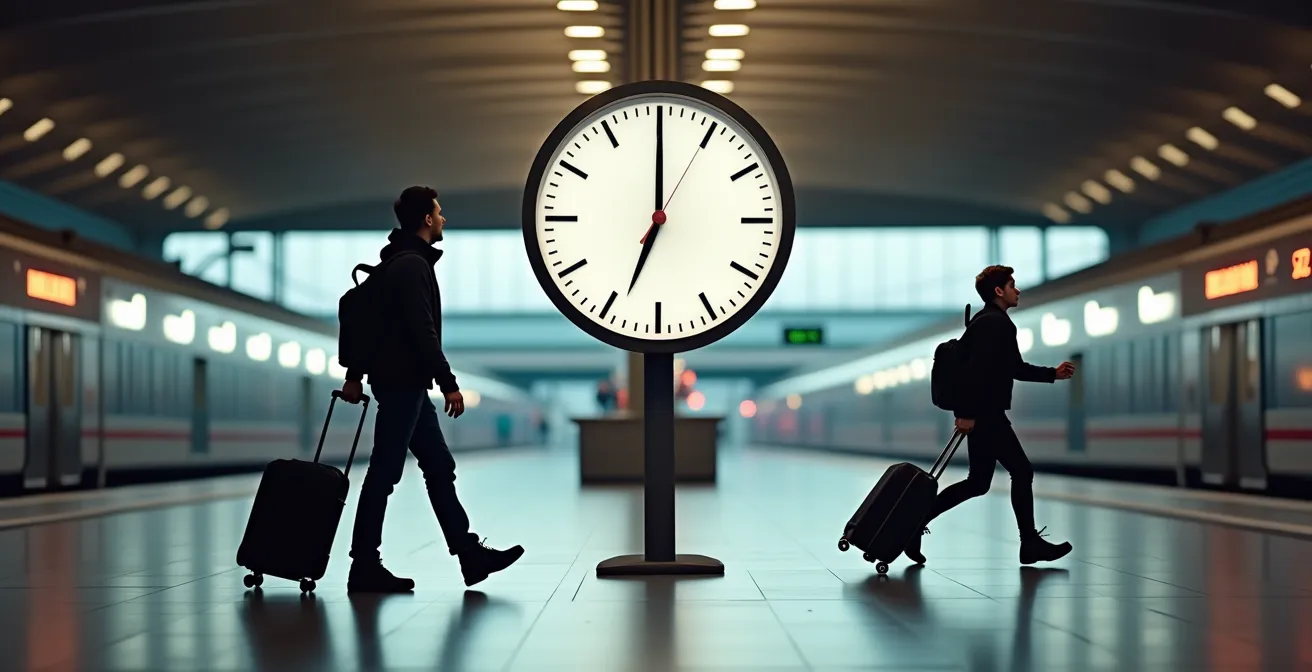
Navigating a bustling station hub feels entirely different when you know your onward journey is guaranteed. You can take your time, grab a coffee, and walk to your next platform calmly, rather than sprinting through the crowds with the stress of a potential missed connection weighing on you.
Always prioritize booking a single, through-ticket for your entire journey. It’s the ultimate insurance policy for your time, money, and peace of mind.
How to Use Split-Ticketing to Save 40% on Rail Fares?
While a single through-ticket is best for managing connection risk, there’s an advanced “fare hacking” technique for savvy travelers looking to maximize savings on direct point-to-point routes: split-ticketing. This strategy involves breaking a single, expensive journey into two or more cheaper tickets. Due to the complex and often protectionist pricing structures of different national rail companies, it can be significantly cheaper to buy separate tickets for different legs of the exact same journey on the exact same train.
This isn’t about taking different trains; it’s about exploiting pricing anomalies. For instance, a ticket from Berlin to Vienna might be sold by Germany’s DB, Austria’s ÖBB, and the Czech Republic’s ČD, as the train passes through all three countries. A cross-border pricing anomaly example shows that the Czech operator (ČD) might offer very cheap fares for journeys starting or ending in the Czech Republic, but not for transit journeys. So, buying a Berlin-Prague ticket and a Prague-Vienna ticket for the same train can be much cheaper than one Berlin-Vienna ticket. Since you’re on the same train, there’s zero connection risk.
Mastering this requires a bit of detective work, but the savings can be substantial, often reaching 40% or more. The general principle is to identify major stations along your route and check the prices for separate legs. This is particularly effective for cross-border journeys where different national carriers have different pricing models. While this technique adds a layer of complexity, it can be a powerful tool for budget-conscious adventurers.
Your Action Plan: A Guide to Split-Ticketing Strategy
- Establish a Baseline: First, track down the standard price for the direct journey you want to make. Without this benchmark, you won’t know if you’re actually saving money.
- Identify Calling Points: Use a journey planner like the National Rail (UK) or Deutsche Bahn (EU) site. Search for your desired train and look for the detailed view showing all the stations it calls at.
- Experiment with Splits: Pick a major station along the route and search for separate tickets to and from that station for each leg. If that doesn’t yield savings, try another major station on the line.
- Verify the Stops: This is a critical rule. The train you are physically on MUST stop at all the stations for which you hold tickets. You cannot buy a ticket from A to B and B to C if the train goes directly from A to C without stopping at B.
- Check Domestic Fares: For international trips, remember that national carriers like Germany’s DB often offer cheaper “domestic” advance fares than they do for the full international route.
While it requires a bit more planning, split-ticketing empowers you to beat the system and travel further for less.
Why Cycling to the Station Reduces Stress Levels Compared to Driving to the Airport?
The stress of a journey often begins before you even leave your city. The experience of getting to an out-of-town airport is fundamentally different from getting to a central train station, and this “first mile” sets the tone for your entire trip. Driving to an airport is a battle against unpredictable traffic, the hunt for expensive long-term parking, and the long walk or shuttle ride from the car park to the terminal. It’s an anxiety-inducing start.
Now, contrast this with the start of a train journey. Because stations are centrally located, they are far more accessible by sustainable and low-stress transport modes. For the adventurous traveler, cycling to the station is a perfect example. A leisurely bike ride through familiar city streets is a calm and predictable experience. There’s no traffic to get stuck in, no parking to worry about (most major stations have ample bike racks), and the physical activity itself is a proven stress-reducer.
This isn’t just a quaint idea; it’s a logistical advantage. The predictability of a 20-minute cycle ride across town is far higher than a 45-minute drive that could easily become 90 minutes due to an unexpected traffic jam. You arrive at the station feeling energized and in control, not frazzled from a stressful drive. This same principle applies to using public transport—buses, trams, and metros all provide a more predictable and less stressful path to a central station than a car journey to a peripheral airport.
By choosing a better “first mile,” you’re not just being greener; you’re actively designing a less stressful and more enjoyable travel experience from the moment you close your front door.
Why Exploring the Station’s Neighborhood Reduces Travel Fatigue?
Travel fatigue isn’t just about the time spent in transit; it’s also about the “dead time” and logistical hurdles at your destination. When you land at an airport, your journey is far from over. You face a long, often confusing, and costly transfer into the city center. This final leg—on a crowded airport express train or in an expensive taxi—is a frustrating limbo between the end of your travel and the beginning of your exploration. It drains your energy and delays the gratification of arrival.
This is where the train’s city-center advantage truly shines. When you step off your train, you are not in a sterile transit hub miles from anywhere; you are immediately immersed in the destination. Grand European stations like Milano Centrale or London’s St. Pancras are architectural marvels in their own right, located in the heart of vibrant neighborhoods. Instead of a tedious transfer, your “last mile” is a short, exciting walk to your hotel or straight into a local café.
This immediate immersion is a powerful antidote to travel fatigue. You can drop your bags and start exploring within minutes of arrival. The energy of the city is instantly accessible. This ability to seamlessly transition from traveler to explorer eliminates the mental and physical drain of the airport-to-city transfer. It means your vacation starts the second your train stops, not an hour and a half later.
Choosing the train is choosing to spend more of your precious time actually experiencing your destination, not just trying to get to it.
Key Takeaways
- The “1-hour flight” is a logistical illusion; always calculate the full door-to-door “Total Journey Time” to see the train’s true speed advantage.
- Leverage night trains as “mobile hotels” to save a full day of travel and the cost of a night’s accommodation.
- Embrace “Luggage Freedom” on trains to avoid the excessive fees, weight limits, and stress of flying with baggage.
How to Plan a “Slow-Paced” European Tour That Feels Like True Exploration?
We’ve deconstructed the myths of air travel and armed you with the logistical strategies to make European rail a faster, cheaper, and more efficient choice. We’ve talked about Total Journey Time, Luggage Freedom, and Connection Risk Management. But the ultimate benefit of embracing the train goes beyond pure logistics. It enables a fundamental shift in your travel philosophy—from a frantic, box-ticking race to a more deliberate and rewarding form of exploration.
Planning a “slow-paced” tour doesn’t mean moving slowly; it means traveling smartly. It’s about applying the mindset of a ‘staycation’—focused on immersion and enjoyment—to a grand continental tour. By eliminating the high-stress, time-wasting elements of airports, you free up mental and physical energy to actually connect with the places you visit. The journey itself, with its changing landscapes and central arrivals, becomes an integral and enjoyable part of the adventure, not just a necessary evil between destinations.
This approach encourages you to see Europe not as a series of disconnected points on a map, but as a continuous, interconnected tapestry. You begin to appreciate the subtle shifts in culture, architecture, and landscape as you glide from one country to another. The result is a journey that feels less like a commute and more like true travel, leaving you with a deeper and more meaningful connection to the continent.
Start planning your next European adventure not by searching for the cheapest flight, but by mapping out a smart, seamless, and genuinely faster journey by rail.