
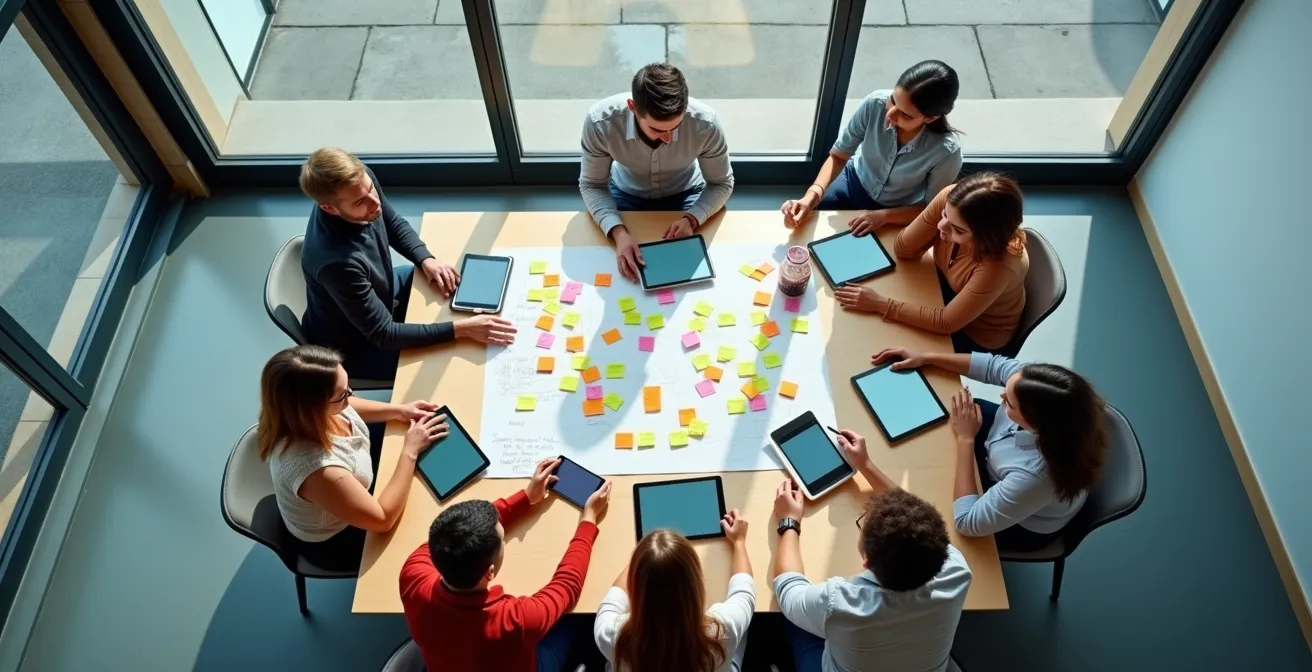
True cross-functional collaboration isn’t achieved with better agendas, but by systematically dismantling the psychological barriers that keep teams in silos.
- Most group brainstorming actively hinders creativity; silent, individual ideation is far more effective at surfacing diverse ideas.
- A “we are a family” culture often stifles the necessary dissent for innovation; a “pro sports team” model focused on performance and accountability is more productive.
Recommendation: As a facilitator, focus on creating psychological safety and structuring dissent as a core part of the workshop process, not an obstacle to be avoided.
You’ve seen the scenario play out time and again. You gather a room of intelligent, capable people from marketing, engineering, sales, and product. The whiteboard fills with colorful sticky notes, the coffee flows, and there’s a buzz of activity. Yet, a week later, nothing has fundamentally changed. The departmental walls remain as high as ever, and the brilliant solutions conceived in the workshop dissolve into the friction of daily business. This is the core frustration for any project manager trying to foster genuine collaboration: the workshop that feels productive but solves nothing.
The common advice is to set a clear agenda, invite the right people, and use a few icebreakers. While not wrong, this advice barely scratches the surface. It treats the workshop as a simple procedural checklist. But what if the real problem isn’t the procedure, but the psychology? The hidden currents of groupthink, the fear of challenging a senior colleague’s idea, and the lack of genuine psychological safety are the invisible forces that sabotage cross-functional work before it even begins. The most well-crafted agenda is useless if participants are afraid to speak their minds.
This guide takes a different approach. It’s built on the principle that your role as a facilitator is not just to manage time, but to engineer a specific social environment. It’s about moving beyond surface-level techniques to intentionally design a space that systematically dismantles the cognitive biases and power dynamics inherent in siloed organizations. We will deconstruct the common failure points, from the illusion of consensus to the trap of “family” culture, and provide methodical, evidence-based frameworks to build workshops that don’t just generate ideas, but catalyze real, lasting change.
This article will provide you with a methodical roadmap to transform your workshops from performative meetings into powerful engines of problem-solving. Below is a summary of the key areas we will deconstruct and rebuild.
Summary: A Methodical Guide to Workshops That Break Silos
- Why Homogeneous Teams Make Faster Decisions But More Mistakes?
- How to Use “Silent Brainstorming” to Include Introverts in Meetings?
- Design Thinking vs Agile: Which Framework Fits Creative Problem Solving?
- The “Groupthink” Trap That Kills Innovation in Consensus Cultures
- How to Structure the Agenda to Move from Ideation to Action?
- Why “We Are a Family” Is Often a Red Flag for Exploitation?
- Why the “Yes, And” Rule Improves Team Brainstorming?
- How to Rebuild Team Trust After a Layoff or Restructuring?
Why Homogeneous Teams Make Faster Decisions But More Mistakes?
It’s a tempting illusion for any project manager under pressure: fill a room with people who think alike, and you’ll get to a decision quickly. Homogeneous teams—groups of people from similar backgrounds, functions, or schools of thought—share a common language and set of assumptions. This creates a low-friction environment where consensus is reached with deceptive speed. However, this speed comes at a steep price: a higher probability of catastrophic error. The lack of cognitive diversity creates massive blind spots, as the team collectively fails to challenge its own core assumptions.
This isn’t just theory; it’s a recurring pattern in major failures. The very structure of a homogeneous group makes it susceptible to functional fixedness, where existing solutions are repeatedly applied to new problems. This is the danger you face when a workshop is dominated by a single department. The group’s shared perspective becomes an echo chamber, reinforcing existing biases instead of challenging them. In fact, sobering research reveals that up to 75% of cross-functional teams are dysfunctional, often because they fail to overcome these ingrained, department-level perspectives.
As a facilitator, your primary goal is to introduce productive cognitive friction. You must intentionally assemble a group with diverse expertise—engineering, marketing, finance, customer support—and create a structure where their conflicting viewpoints can be aired safely. The initial discomfort and slower pace are not signs of failure; they are the signs that deep-seated assumptions are finally being questioned. The goal isn’t just to get people in a room, but to get their different worlds to collide in a controlled, constructive way.
How to Use “Silent Brainstorming” to Include Introverts in Meetings?
The traditional, open-floor brainstorming session is one of the most common yet least effective workshop activities. It disproportionately favors extroverted, fast-thinking individuals and those in positions of authority. Quieter, more reflective team members—often the ones with deep, well-considered insights—are frequently drowned out or don’t get a chance to formulate their thoughts amidst the noise. The result is a narrow set of ideas dominated by the loudest voices, not the best ones.
As author Susan Cain highlights in a powerful critique, the science is clear on this point. She explained in an interview with Scientific American:
Forty years of research shows that brainstorming in groups is a terrible way to produce creative ideas. The organizational psychologist Adrian Furnham puts it pretty bluntly: The ‘evidence from science suggests that business people must be insane to use brainstorming groups. If you have talented and motivated people, they should be encouraged to work alone when creativity or efficiency is the highest priority.’
– Susan Cain, Scientific American
The solution is a methodical technique known as “silent brainstorming” or “brainwriting.” Instead of people shouting out ideas, you give everyone a set amount of time (e.g., 5-10 minutes) to write down their ideas individually and in silence on sticky notes. This simple structural change has profound effects: it equalizes participation, eliminates the fear of immediate judgment, and allows introverts the cognitive space they need to contribute fully. It ensures that the idea pool is based on the collective intelligence of the entire group, not just the most assertive members.

After the silent generation phase, the ideas are posted on a wall and then clustered and discussed by the group. This separates the act of idea generation from idea evaluation, which is critical for psychological safety. The focus shifts from “who said what” to “what is the merit of this idea?” As a facilitator, implementing this one technique can dramatically increase the quality and diversity of your workshop’s output.
Design Thinking vs Agile: Which Framework Fits Creative Problem Solving?
As a project manager, choosing the right overarching framework for your workshop is critical. Two dominant methodologies, Design Thinking and Agile, are often mentioned, but they are designed to solve very different types of problems. Misapplying a framework can lead to immense frustration—like using a delivery-focused tool for an exploration-focused problem. Understanding their core purpose is key to designing an effective session.
Design Thinking is a framework for exploring and defining ambiguous problems. Its strength lies in the early phases: empathizing with users, defining the core challenge, and ideating a wide range of potential solutions. It excels when you’re not yet sure what the right problem is to solve. Agile, on the other hand, is a framework for delivering solutions to well-defined problems. Its strength lies in iterative development, rapid feedback loops, and adapting to changing requirements during execution. It assumes you already have a clear, prioritized backlog of what to build.
For a cross-functional workshop aimed at breaking silos and tackling a complex business challenge, a hybrid approach is often most effective. You can use Design Thinking principles for the first half of the workshop to ensure the team is aligned on the *problem* and has explored a breadth of creative solutions. Then, you can transition to Agile-inspired principles to prioritize those solutions and create a concrete, actionable backlog for the first “sprint.” This is often called a “Sprint Zero.”
The following table, based on common teachings in cross-functional facilitation, breaks down these differences and highlights the power of a hybrid model.
| Aspect | Design Thinking | Agile | Hybrid ‘Sprint Zero’ |
|---|---|---|---|
| Focus | Problem exploration | Solution delivery | Problem to action |
| Workshop Phase | Empathize, Define, Ideate | Sprint planning | Both integrated |
| Output | Insights & concepts | Working increments | Prioritized backlog |
| Timeline | Variable | Fixed sprints | Workshop to sprint |
This integrated approach provides the structure to move a team from a vague sense of a problem to a concrete plan of action, all within a single, high-impact workshop. It leverages the best of both worlds: deep problem exploration followed by disciplined execution planning.
The “Groupthink” Trap That Kills Innovation in Consensus Cultures
Groupthink is the silent killer of innovation. It’s a psychological phenomenon where the desire for harmony or conformity in a group results in an irrational or dysfunctional decision-making outcome. In a workshop setting, it manifests as a reluctance to voice dissenting opinions for fear of disrupting the group’s positive momentum or being seen as “not a team player.” This pressure for consensus leads teams to ignore red flags, rationalize away risks, and prematurely settle on a suboptimal solution.
This isn’t a minor issue; it has severe consequences. Academic research on group dynamics has long shown that groupthink significantly increases the chances of low-quality and even unethical decision-making. When individuals self-censor, the collective intelligence of the group plummets. The first idea presented by a senior leader is often accepted without real scrutiny, not because it’s the best, but because challenging it feels too risky. As a facilitator, your most important job is to create an environment where dissent is not only safe but expected.
This requires moving beyond simply asking “Does anyone disagree?” to implementing formal processes for structured dissent. One of the most effective techniques is assigning a “devil’s advocate” role. This person’s job is to actively argue against the emerging consensus, probing for weaknesses and unexamined assumptions. By making dissent a formal role, you depersonalize the conflict; the person isn’t being difficult, they are fulfilling their assigned duty. This gives the entire group permission to consider alternatives without threatening social cohesion.
To help you spot the warning signs in your own workshops, use the following diagnostic tool. If you find yourself ticking several of these boxes, you are likely falling into the groupthink trap.
Groupthink Diagnostic Checklist for Facilitators
- Are we rationalizing away warnings or contradictory evidence?
- Is there an illusion of unanimity where individuals tend to refrain from expressing doubts and judgments?
- Are we applying direct or indirect pressure on team members who disagree?
- Do we have excessive confidence in our group’s inherent morality?
- Are individual members self-censoring, especially if they fear being shunned or derided?
How to Structure the Agenda to Move from Ideation to Action?
A common workshop failure is a great ideation session that never translates into a concrete plan. The energy is high during the creative phase, but it dissipates when it’s time to make hard decisions and commit to next steps. A well-structured agenda is not just a list of topics; it’s a carefully choreographed journey that manages the group’s energy and guides them from divergent thinking (exploring possibilities) to convergent thinking (making choices).
The first step, as noted by experts in cross-functional workshop design, is to set the stage properly. This includes a warm welcome, an icebreaker that connects to the work, and the co-creation of ground rules. One crucial, often-missed step is “Shared Language Calibration”: dedicating 15 minutes at the start to define ambiguous terms like “done,” “success,” or “customer-centric.” This prevents teams from discovering hours later that they were operating with different definitions.

The core of the agenda should follow a natural rhythm of energy management. Schedule high-energy, divergent activities like brainstorming early in the day when minds are fresh. After a break, when energy levels dip slightly, move to more analytical, convergent activities like clustering ideas, prioritizing using methods like dot-voting, and debating the merits of the top concepts. This ensures you use the peak creative energy for generation and the more focused, post-break energy for synthesis.
The final, non-negotiable block of your agenda must be “Commitment & Accountability.” This is where you transform discussion into action. In this session, every key initiative or next step identified must be assigned a specific owner, a clear due date, and a concise “definition of done.” This moves the outcome from a vague “we should look into this” to a concrete “Sarah will deliver a one-page summary of the competitive landscape by next Friday.” Capturing these commitments and sharing them immediately after the workshop is what separates a talk-fest from a true problem-solving session.
Why “We Are a Family” Is Often a Red Flag for Exploitation?
The phrase “we are a family here” is often presented as a sign of a caring, supportive workplace. However, in the context of a cross-functional workshop, it can be a significant red flag. Family dynamics are built on unconditional loyalty and a strong aversion to conflict. Challenging a “parent” (a senior leader) or a “sibling” (a colleague) is often seen not as a constructive act, but as a personal betrayal. This dynamic is toxic for innovation.
True problem-solving requires open debate, the ability to challenge ideas regardless of who they came from, and a high degree of psychological safety. As one expert on organizational dynamics puts it:
In ‘family’ cultures, challenging ideas is seen as personal disloyalty, making honest debate and true cross-functional problem-solving impossible due to a lack of psychological safety.
– Workshop Culture Expert, Analysis of organizational dynamics
When this “family” mindset pervades a workshop, participants self-censor to maintain harmony. The goal shifts from finding the best solution to ensuring everyone feels good. This leads directly to groupthink and prevents the healthy, cognitive friction that is necessary to vet ideas thoroughly. The fear of “rocking the boat” or “disappointing the family” becomes a powerful suppressor of truth and creativity.
A much more productive and healthier model for a cross-functional team is that of a professional sports team. On a sports team, everyone shares a common goal: to win. Members have clear, distinct roles and are held accountable for their performance. Debate about strategy is constant, rigorous, and expected—it’s not taken personally. Team members trust each other to perform their roles to a high standard, but loyalty is conditional on performance and commitment to the team’s success. This model fosters respect and a shared drive for excellence, creating a far more effective environment for a problem-solving workshop than the conflict-avoidant “family” metaphor.
Why the “Yes, And” Rule Improves Team Brainstorming?
The phrase “Yes, but…” is one of the most common and destructive phrases in a collaborative setting. It masquerades as agreement while functioning as a shutdown. It dismisses the core of a colleague’s idea and immediately pivots to a criticism or an obstacle. This seemingly small linguistic habit has a powerful negative effect, creating a defensive atmosphere where people become hesitant to share nascent, imperfect ideas for fear of them being immediately shot down.
The solution comes from the world of improvisational theater: the “Yes, and…” rule. This simple shift in language forces a fundamental change in behavior. By starting your response with “Yes, and…”, you are required to first accept the validity of your colleague’s contribution (“Yes”) and then build upon it (“and…”). It transforms a critical mindset into a creative one. Instead of pointing out flaws, you are challenged to add value and move the idea forward.
This isn’t just about being polite; it has a neurological basis. Hearing “Yes, but…” can trigger a threat response, releasing cortisol and shutting down creative thinking. In contrast, the collaborative nature of “Yes, and…” promotes a sense of safety and reward, which can foster the release of dopamine, enhancing creativity and open-mindedness. You’re not ignoring potential problems; you’re just reframing them as new elements to incorporate rather than reasons to stop.
As a facilitator, you can introduce this as a ground rule for brainstorming sessions. To make it practical, provide the team with a “phrasebook” of alternatives:
- Instead of “No, that won’t work”: Try “That’s an interesting starting point. How might we solve for the budget constraint?”
- Instead of “Yes, but we tried that”: Try “Let’s build on that. What would need to be true for that to work this time?”
- To raise a concern: “I love where you’re going with this. Let me add another dimension to consider, which is our timeline.”
By enforcing this discipline, you can fundamentally change the energy of a room from critical and closed to expansive and generative, unlocking ideas that would otherwise have been dismissed too early.
Key Takeaways
- Effective workshops are designed environments that prioritize psychological safety over procedural checklists.
- Counter-intuitive techniques like silent brainstorming and structured dissent are more effective than traditional group activities.
- The facilitator’s main role is to manage group dynamics and energy, guiding the team from divergent exploration to convergent commitment.
How to Rebuild Team Trust After a Layoff or Restructuring?
Facilitating a workshop after a layoff or major restructuring is one of the most challenging tasks you can face. The air is thick with anxiety, uncertainty, and a profound loss of trust. Running a “business as usual” workshop in this context is not only ineffective but can be perceived as tone-deaf and disrespectful. Before any productive problem-solving can occur, you must first address the emotional fallout and begin the methodical process of rebuilding psychological safety.
Your first step as a facilitator is to make the workshop a symbolic fresh start. It must be explicitly framed as an opportunity to co-create the “new normal” rather than a continuation of the old. This begins by directly and safely addressing the elephant in the room. A structured “Hopes & Fears” exercise is an invaluable tool here. Anonymously, on sticky notes, have participants write down their biggest hopes for the team moving forward and their biggest fears or anxieties about the recent changes. Discussing these themes as a group creates a shared emotional baseline and validates the team’s unspoken concerns.
The central deliverable of this type of workshop should not be a product roadmap, but a new social contract. This can take the form of a “New Team Charter” or “Rules of Engagement.” This is not a top-down document; it must be co-created by the team during the session. The charter should explicitly define how members will communicate, handle disagreements, support each other, and hold one another accountable in the new structure. This process of collaboratively defining their own rules is a powerful act of agency that helps restore a sense of control and predictability.
Only after this foundational work of emotional processing and social contract creation is complete can the team move on to more task-oriented problem-solving. Attempting to jump straight to business goals without rebuilding the human foundation of trust is a recipe for a disengaged, cynical, and ultimately unproductive session. The workshop becomes a critical ritual for healing and redefining the team itself.
Frequently Asked Questions on Cross-Functional Workshops
How do we address the elephant in the room about layoffs?
Start by clarifying the change initiative the workshop is meant to address. Define the stakeholders, their new roles, and their expectations. Frame the workshop’s purpose within the overall change strategy, showing how their contribution will help shape the path forward, rather than ignoring the past.
What’s the best first activity for a restructured team?
Use a structured ‘Hopes & Fears’ exercise. This allows team members to anonymously express their anxieties and optimism about the restructuring. Discussing the anonymized themes as a group validates their feelings and clears the air before productive work can begin.
What should be the main deliverable?
The primary goal should be to co-create a ‘New Team Charter’ or ‘Rules of Engagement.’ This document, built by the team during the workshop, serves as a tangible social contract that defines how the reorganized team will work together, handle conflict, and communicate, thereby rebuilding trust and predictability.