
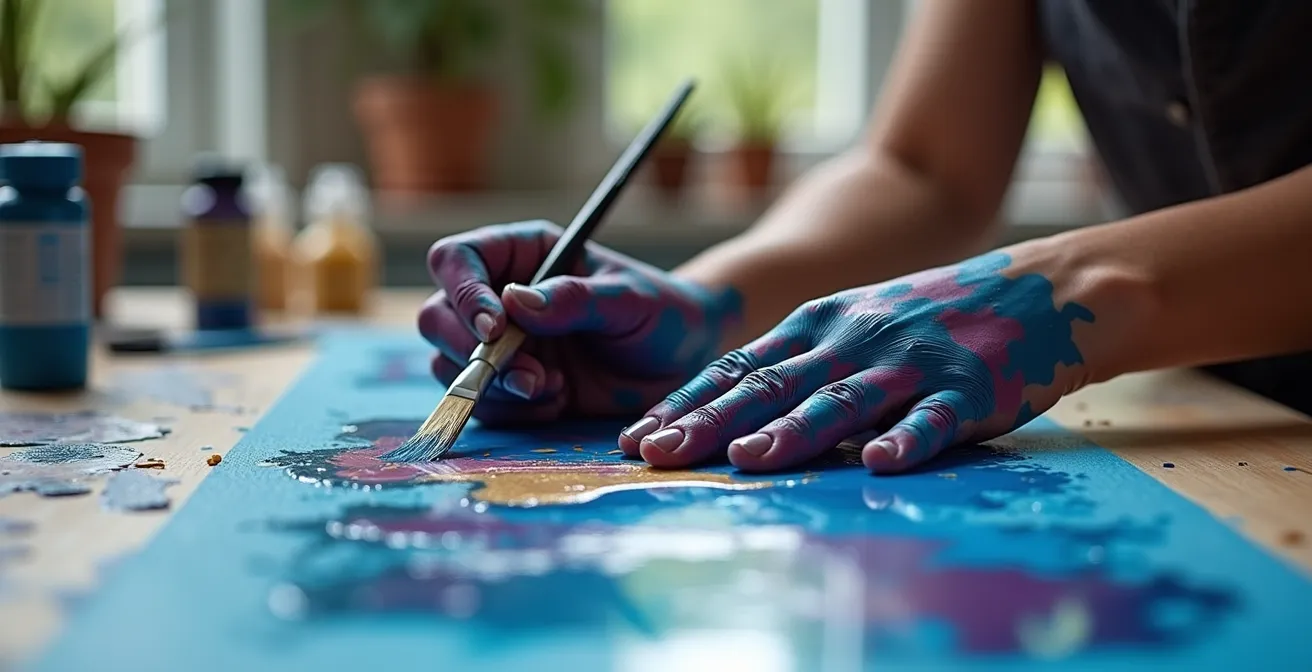
For stressed professionals, the pressure to “be creative” can feel like another task. But art therapy isn’t about producing a masterpiece; it’s about the physical process of externalizing your stress. This guide reframes art as a simple, accessible tool for emotional release. You will learn non-intimidating techniques, like Neurographic art, that require zero artistic skill and focus solely on the calming, sensory experience of putting pen to paper to quiet your mind.
After a long day of meetings, deadlines, and digital overload, your brain feels full. The common advice is to meditate or exercise, but sometimes you’re too mentally exhausted for even that. You’ve likely heard of art therapy as a way to decompress, but for many busy professionals, the immediate reaction is a dismissive one: “I’m not an artist. I can’t even draw a convincing stick figure.” This belief, that you need talent to benefit from art, is the single biggest barrier to one of the most effective stress-relief tools available.
This creates a paradox: the very people who could most benefit from a creative outlet feel excluded from it. The pressure to create something “good” transforms a potential release into another source of performance anxiety. But what if the entire point of therapeutic art wasn’t the final product, but the physical, sensory experience of the process itself? What if the goal wasn’t to create a beautiful drawing, but simply to feel the friction of charcoal on paper or watch ink flow from a pen?
The secret to unlocking art for stress relief lies in shifting your focus from the outcome to the action. It’s not about making art; it’s about using art-making as a vehicle for mindfulness and emotional externalization. The true value is in giving your anxious thoughts a physical form outside of your head, allowing you to process them in a tangible way. This is a skill anyone can learn, regardless of their perceived artistic ability.
This guide is designed for the skeptical professional. We will explore simple, practical, and non-intimidating ways to integrate these principles into your life. You will discover how to disarm your inner critic, choose materials that match your emotional state, and use specific techniques to transform anxiety into a sense of calm, proving that you don’t need to be an artist to find relief in art.
Summary: A Practical Guide to Art Therapy for Daily Stress Management
- Why Focusing on the Result Blocks Your Creative Release?
- How to Start “Neurographic Art” to Calm Your Anxiety?
- iPad Drawing vs Charcoal: Which Is Better for Emotional Release?
- The Inner Critic Mistake That Stops You After 5 Minutes
- How to Set Up a Tiny Art Corner in a Small Apartment?
- Reading vs Netflix: Which Actually Recharges Your Brain?
- How to Reframe Anxiety as Excitement Before a Presentation?
- How to Boost Your Professional Confidence Using Improv Theater Techniques?
Why Focusing on the Result Blocks Your Creative Release?
The “I can’t draw” mindset is rooted in a fundamental misunderstanding of therapeutic art. We are conditioned to see art as a product to be judged, an artifact that must be beautiful or meaningful to others. When you approach a blank page with this pressure, your brain activates its prefrontal cortex—the seat of judgment, planning, and self-criticism. This is the exact opposite of the state of “flow” and relaxation you are trying to achieve. Instead of a release, the activity becomes another performance review.
The primary goal of art as therapy is process, not product. It’s about engaging in a sensory, mindful activity that anchors you in the present moment. The focus should be on the physical sensations: the sound of the pencil, the texture of the paper, the movement of your hand. When you are absorbed in these physical acts, you create a space for your mind to quiet down. This isn’t just a feeling; it’s physiological. A study from Drexel University confirmed that just 45 minutes of creative activity significantly decreases cortisol levels, the body’s primary stress hormone.
Focusing on a perfect outcome sabotages this benefit. You start judging every line, erasing constantly, and feeling frustrated. This cycle of self-critique reinforces stress rather than alleviating it. To truly unlock the benefits, you must consciously give yourself permission to create something “bad,” “ugly,” or meaningless. The value is not in what you’ve made, but in the stress you’ve processed while making it.
By setting an intention to simply have an experience, you liberate yourself from the tyranny of the result and open the door to genuine creative release.
How to Start “Neurographic Art” to Calm Your Anxiety?
Neurographic art is a perfect entry point for anyone who feels intimidated by a blank page. Developed by psychologist Pavel Piskarev, this technique is less about drawing and more about transforming subconscious stress into a harmonious visual pattern. It requires no artistic skill and follows a simple, meditative process designed to calm the nervous system. The core idea is to draw chaotic, intersecting lines and then methodically round the intersections, which is believed to create new neural connections and reduce internal conflict.
To begin, take a piece of paper and a pen. Close your eyes for a moment and think about the stress or anxiety you’re feeling. Then, in a single, continuous motion over about 30 seconds, let your hand move across the page, creating a series of random, overlapping, and flowing lines. Don’t lift the pen. The result will look like a chaotic scribble. This is the externalization of your stress. The next, most important step is to go back and carefully round every sharp intersection where lines cross. This slow, deliberate act of softening the hard edges is deeply meditative and symbolic. It transforms the visual chaos into a cohesive, organic pattern.
This is precisely the technique that has shown remarkable success in therapeutic settings. For example, a program at Northwestern Medicine found that neurographic art classes helped cancer patients manage anxiety during the pandemic. One patient described it as life-changing, a tool she now uses whenever anxiety strikes. The power lies in its accessibility and its tangible effect on the mind.
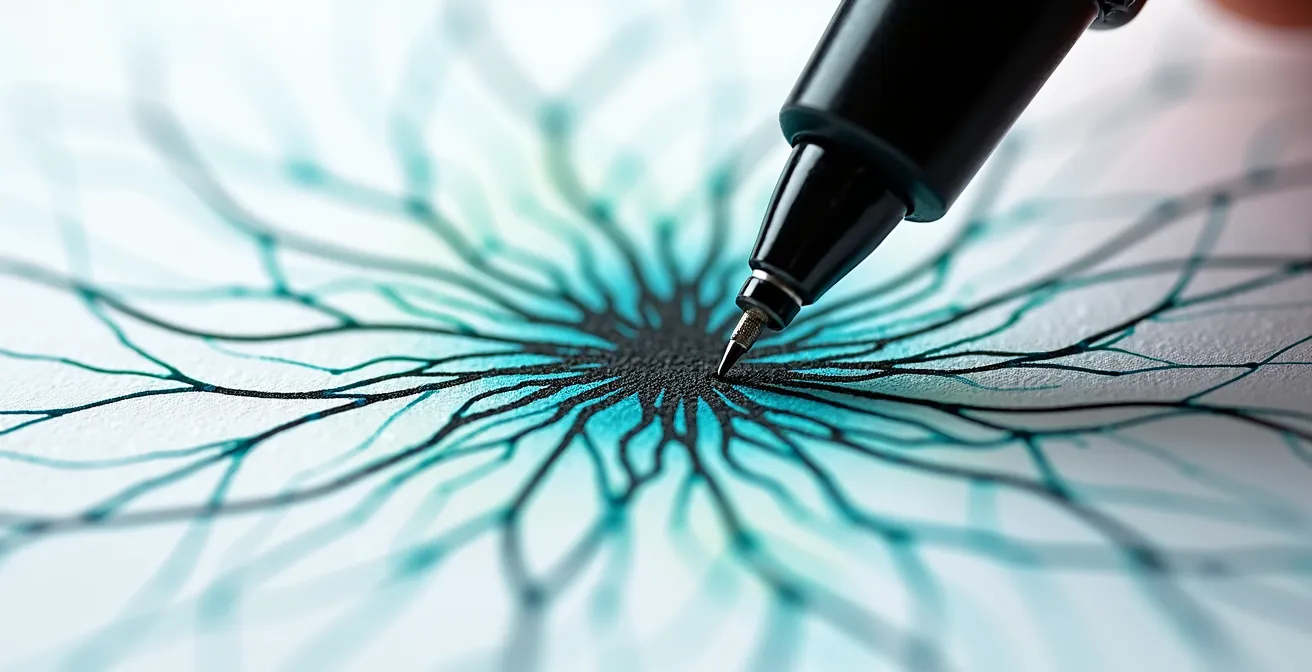
After rounding all intersections, you can begin filling the resulting cells with color. This final step is an opportunity to be playful and intuitive, further deepening the meditative state. This process shows that engaging in creative activities has a measurable impact; indeed, over 6,000 adults showed lower levels of stress and anxiety when participating in such practices.
It provides a clear framework that bypasses the need for inspiration or talent, offering a direct path to a calmer state of mind.
iPad Drawing vs Charcoal: Which Is Better for Emotional Release?
The tool you choose is not just a matter of preference; it’s a way to match a physical experience to an emotional need. Different art materials offer different levels of resistance, control, and sensory feedback. Understanding this allows you to select a medium that will be most therapeutic for what you’re feeling in the moment. A digital stylus and a messy piece of charcoal are not interchangeable—they are prescriptions for different emotional states.
For feelings of anger or frustration, you need a medium that can handle force and provides strong tactile feedback. Charcoal is perfect for this. It’s messy, requires pressure, and allows for bold, physical marks. The act of smudging and blending the dark powder with your hands is a powerful grounding experience, connecting you directly to the physical expression of your pent-up energy. The resistance of the material provides a satisfying outlet for frustration.
Conversely, if you are struggling with perfectionism or anxiety, a digital medium like an iPad can be more beneficial. The ‘undo’ button is not a cheat; it’s a tool for self-forgiveness. It allows you to experiment without the fear of making an irreversible “mistake.” The clean, precise nature of a digital stylus can feel less intimidating than uncontrollable materials. It provides a contained, manageable environment to explore creativity when the thought of making a mess feels overwhelming.
For those needing to let go of control, watercolor is an ideal choice. Its fluid and unpredictable nature forces you to surrender to the process. You can guide the pigment, but you can’t entirely control how it will bleed, blend, and dry. Working with watercolors becomes a practice in accepting unexpected outcomes and finding beauty in imperfection, a powerful lesson for anyone feeling overwhelmed by the need to manage every detail of their life.
This table from a recent sensory-emotional pairing guide summarizes these connections:
| Material | Sensory Experience | Best For | Therapeutic Benefit |
|---|---|---|---|
| Charcoal | Messy, high-resistance, physical | Anger/frustration release | Grounding through tactile feedback |
| iPad/Digital | Clean, precise, forgiving | Perfectionism/anxiety | Self-forgiveness through undo function |
| Watercolor | Unpredictable, fluid | Letting go of control | Acceptance of unexpected outcomes |
Instead of randomly grabbing a pen, you can ask yourself, “What emotion do I need to process today?” and choose the material that will best facilitate that release.
The Inner Critic Mistake That Stops You After 5 Minutes
You’ve set aside the time, you have your materials, and you draw your first line. Almost immediately, a voice in your head chimes in: “That’s not right. This looks childish. What are you even doing?” This is the inner critic, and for many aspiring creatives, its arrival is so discouraging that the session ends before it truly begins. The biggest mistake people make is believing this voice and treating it as an authority. They see its presence as proof that they are, in fact, “not good at this.”
In reality, the appearance of the inner critic is a sign of progress. It only shows up when you are stepping outside of your comfort zone and trying something new. The key is not to silence the critic—which is often impossible—but to change your relationship with it. You must learn to acknowledge its presence without giving it power. One of the most effective ways to do this is to externalize and even ridicule it. By separating the voice from your sense of self, you can rob it of its authority.
This shift in perspective is echoed in a testimonial on the importance of creative practice. As one individual in mental health recovery shared with MQ Mental Health Research:
The days I didn’t create were the days I felt disconnected and more likely to experience intrusive thoughts or unhealthy coping strategies.
– Mental health recovery testimonial, MQ Mental Health Research
Pushing past that initial 5-minute barrier is crucial. It’s in the moments just beyond the first wave of self-doubt that the therapeutic benefits begin to emerge. The following checklist offers a structured way to manage that critical inner voice when it appears.
Your Action Plan: Auditing Your Inner Critic
- Acknowledge and Name: The moment you hear the critical thought, greet it by a specific name. Saying “Hello, Susan” in your mind immediately creates distance.
- Assign a Silly Job: Give your critic a distracting, pointless task. For example, tell it, “Your job is to count all the right angles in this room while I draw.” This trivializes its role.
- Take the ‘Ugly Art Dare’: Set a 5-minute timer and deliberately challenge yourself to create the messiest, “ugliest” art possible. This directly defies the critic’s demand for perfection.
- Reframe its Arrival: Remind yourself that the critic’s voice is a milestone. It means you are challenging yourself and growing. Thank it for showing up, as it signals you’re on the right track.
- Distinguish Helper from Hurter: Ask the voice directly, “Are you here to help or to hurt?” This question forces you to differentiate between unhelpful, shaming criticism and constructive, gentle feedback.
This practice transforms the inner critic from a gatekeeper of your creativity into an irrelevant background noise.
How to Set Up a Tiny Art Corner in a Small Apartment?
For busy professionals, especially those living in compact urban spaces, the idea of setting up an “art studio” can seem laughable. The lack of a dedicated space becomes another excuse not to start. However, the key to a consistent practice is not a large area, but instant accessibility. The goal is to reduce the “activation energy” required to begin, making it as easy to start drawing as it is to open Netflix. You don’t need a room; you need a ritualized, compact kit.
The most effective solution is to create a portable “Art Therapy Go-Bag.” This could be a simple tote bag, a shoebox, or a magnetic container that lives on your fridge. The principle is that all your essential materials are in one place, ready to be deployed on your coffee table, your desk, or even your lap. This removes the friction of having to search for a pen, find paper, or clear a large surface. The act of simply opening the kit becomes the first step of your stress-relief ritual.
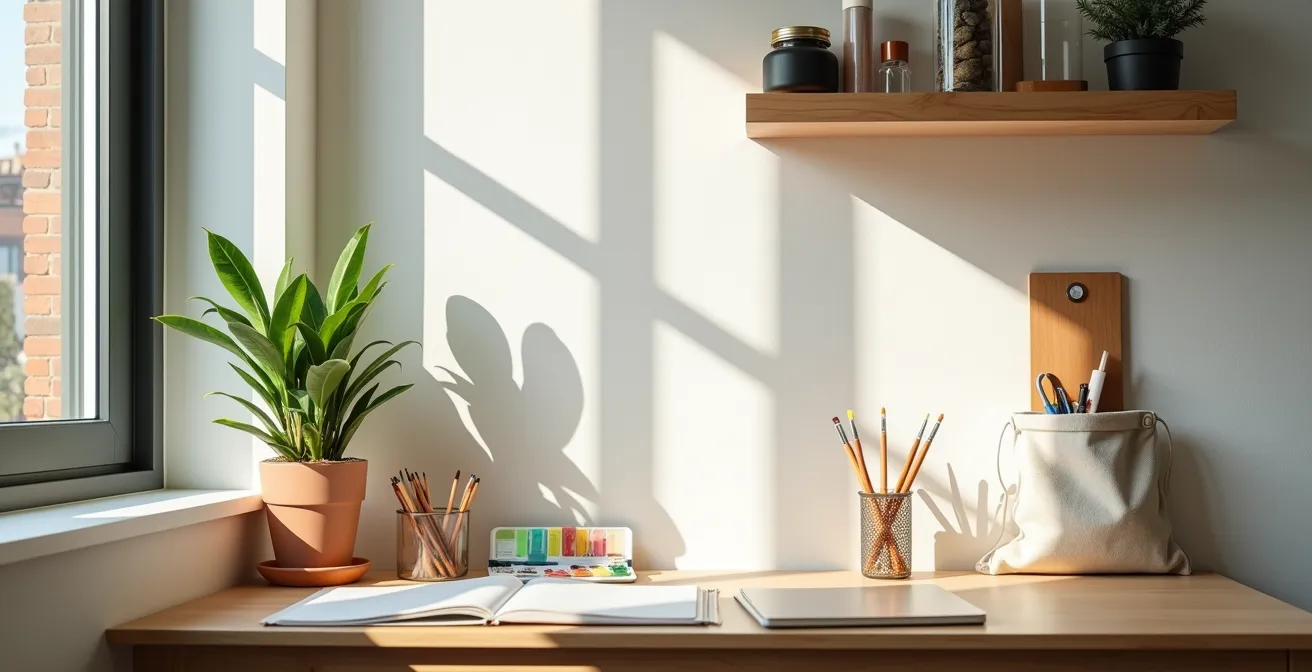
When assembling your kit, think in terms of “micro-materials.” You don’t need a full set of 64 crayons. A curated, minimal selection is far less intimidating and more effective. For example:
- A single high-quality black pen and a pocket-sized notebook for Neurographic art or quick sketches.
- A water brush pen and a small, travel-sized watercolor palette. These brushes have a built-in water reservoir, eliminating the need for cups of water and reducing mess.
- A set of three primary color markers (red, yellow, blue) and a black one. This limited palette encourages creativity through constraint.
- An adult coloring book and a small pack of colored pencils, kept visible on a bookshelf for an easy, 5-minute mental break.
The location of your kit is just as important as its contents. Store it somewhere visible and easily accessible—a single “art ritual” drawer in the kitchen, a floating shelf in the living room, or a pegboard by your desk. This visual cue serves as a gentle reminder to take a creative break. It transforms a forgotten hobby into an integrated part of your daily wellness routine.
This approach ensures that no matter how small your apartment or how little time you have, a moment of creative release is always within arm’s reach.
Reading vs Netflix: Which Actually Recharges Your Brain?
At the end of a stressful day, the siren call of passive entertainment like scrolling through social media or binge-watching a series on Netflix is powerful. It feels like the path of least resistance to “shutting off” your brain. However, there is a significant difference between distraction and true recharge. While passive consumption can offer a temporary escape, it often leaves you feeling numb or even more drained. Active creative engagement, by contrast, works on a deeper level to genuinely restore your mental energy.
Passive activities like watching TV place your brain in a receptive, low-engagement state. They distract you from stress but do little to help you process it. It’s like putting a lid on a simmering pot; the pressure is still there underneath. When the show ends, the unprocessed stress and anxiety often rush back in, sometimes accompanied by a feeling of time lost. This can leave a “numbing residue” rather than a feeling of genuine replenishment.
In contrast, active pursuits like reading or, even more powerfully, making art, engage the brain differently. They require a level of focus and imagination that promotes a state of mindfulness. A 2021 study analyzing well-being during the pandemic highlighted this distinction clearly. It found that engaging in creative pursuits was directly associated with greater well-being and lower stress levels. These activities actively change your mental and emotional state, rather than just providing a temporary diversion.
The key difference is the “residue” they leave behind. The residue of watching Netflix is often just the memory of a plot. The residue of spending 20 minutes drawing, however, is a tangible artifact of your self-expression, a feeling of accomplishment (no matter the “quality” of the art), and a neurologically calmer state. You haven’t just escaped your stress; you have actively transformed it. Making art gives you a sense of agency over your inner world that passive consumption can never provide.
Even a few minutes of active creativity can be more restorative than an hour of passive viewing, offering a more sustainable way to manage daily stress.
How to Reframe Anxiety as Excitement Before a Presentation?
For many professionals, public speaking or a high-stakes presentation is a major source of anxiety. The physical symptoms are familiar: a racing heart, sweaty palms, a knot in your stomach. These sensations are the result of your sympathetic nervous system kicking into gear. Interestingly, these are the exact same physiological responses the body has when it feels excitement. The only difference is the cognitive label you apply to them. Art therapy offers a powerful, tangible way to perform this “cognitive reframing.”
Instead of trying to suppress the nervous energy, the goal is to acknowledge it and relabel it. You can use a simple 5-minute art ritual to visually transform the feeling of anxiety into one of excitement. This isn’t about ignoring the feeling; it’s about changing your relationship to it and repurposing its energy. By giving the abstract feeling a physical form on paper, you can manipulate it in a way that feels empowering.
Here’s a practical ritual to try before your next big presentation:
- Draw Your Anxiety: On a piece of paper, use a dark-colored pen or marker to represent your anxiety as a chaotic, tangled scribble. Don’t think, just let the nervous energy flow onto the page.
- Transform It with Energy: Now, take a bright, vibrant color like yellow or orange. Physically draw over the dark scribble with powerful, energetic lines—like sun rays, lightning bolts, or an expanding aura. You are visually overpowering the anxiety with energy.
- Create a Success Storyboard: Divide a new page into three panels. In the first, draw a simple stick figure of you feeling nervous. In the second, draw yourself on stage, standing tall and confident. In the third, draw a positive outcome, like an applauding audience. This visualizes the entire arc from nervousness to success.
- Label Your Energy: Draw your body’s energy as a neutral force, perhaps a vibrant energy field around a stick figure. Then, literally write the word “Excitement” and draw an arrow pointing to it. You are consciously assigning the feeling a positive purpose.
This practice is more than just a distraction; it engages your brain in a way that can lead to measurable physiological changes. As a randomized controlled trial found, art therapy improved not just psychological well-being but also physical markers of stress, including resting heart rate variability and executive functioning.
You learn to work with your body’s natural response, transforming what feels like a threat into fuel for a dynamic performance.
Key Takeaways
- The goal of therapeutic art is the process of creating, not the final product. Let go of the need for perfection.
- Simple, structured techniques like Neurographic art can calm anxiety by transforming chaotic scribbles into harmonious patterns, requiring no artistic skill.
- Match your art materials to your emotion: charcoal for anger, digital tools for perfectionism, and watercolor for letting go of control.
How to Boost Your Professional Confidence Using Improv Theater Techniques?
Confidence, particularly in a professional setting, is not about being fearless; it’s about being able to act in the face of uncertainty. This is the exact skill that improvisational theater (improv) trains. The core principles of improv—accepting what’s given, building upon it, and letting go of a predetermined plan—are directly applicable to building resilience and spontaneity in your career. You can practice these very same principles visually, using simple drawing exercises to quiet your analytical brain and activate a more confident, spontaneous state of mind.
One of the foundational rules of improv is “Yes, and…” This means you accept whatever your scene partner offers (“Yes”) and you add to it (“and…”). This principle is a powerful antidote to the perfectionism that often paralyzes professionals. You can apply this directly to your drawing. If you make an accidental mark or a line you don’t like, your job is not to erase it. Your job is to say “Yes, and…” and build upon it. That accidental smudge becomes a shadow; that crooked line becomes a tree branch. This trains your brain to see mistakes as opportunities, a critical skill for navigating unpredictable work environments.
Another powerful technique is to use art to create a “Confident Alter-Ego.” Spend some time drawing a version of yourself at your professional best. What colors represent this confidence? What posture does this person have? This isn’t about creating a realistic portrait; it’s about externalizing the feeling of confidence. You can then create small “visual anchors” or talismans from this drawing—a tiny symbol of confidence you can keep in your wallet or on your desk. Glancing at it before a difficult meeting can serve as a potent psychological trigger, reminding you of that confident state.
These visual improv games work by quieting the analytical prefrontal cortex and activating flow states. By forcing spontaneity, such as with a “one-line drawing” where you don’t lift the pen, you bypass the inner critic and tap into a more intuitive, confident way of being. This practice builds mental agility, helping you respond to unexpected challenges at work with creativity rather than anxiety.
To put these ideas into practice, start by choosing just one exercise from this guide—perhaps the “Ugly Art Dare” or a 5-minute Neurographic drawing—and try it the next time you feel stressed. The journey to creative confidence begins not with talent, but with a single, small action.