
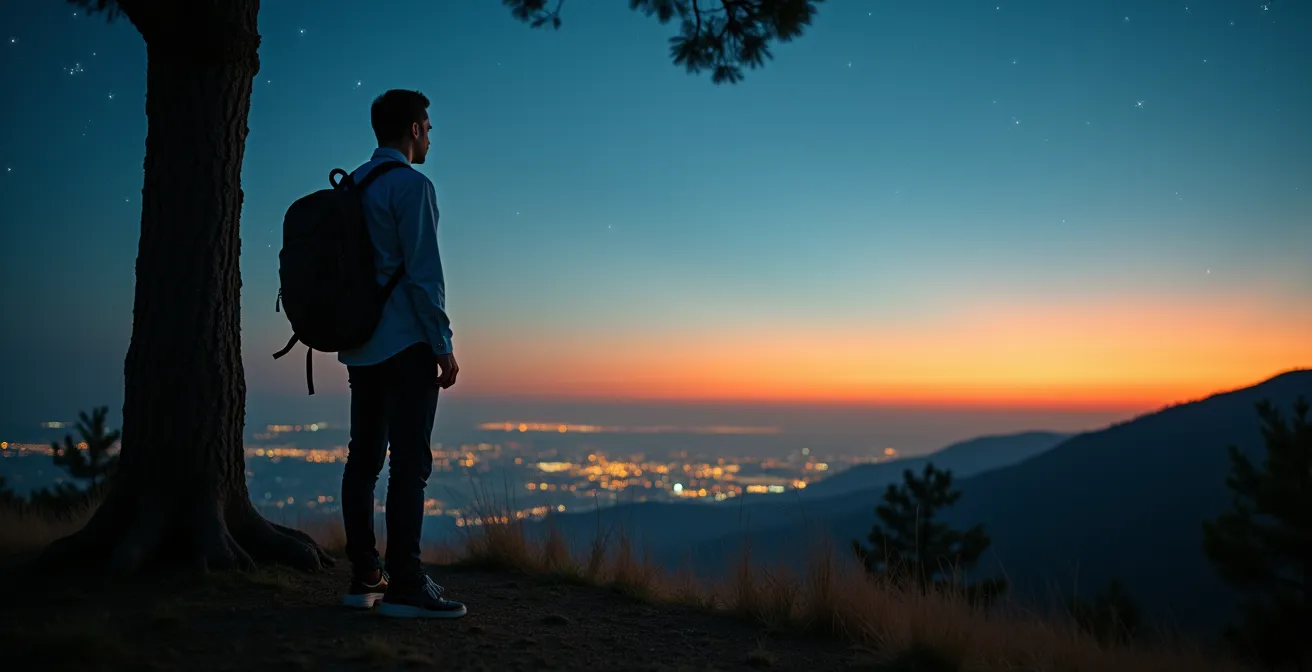
Contrary to popular belief, you don’t need a week-long vacation to fight burnout; a 16-hour “5-to-9” micro-adventure is a more potent tool for a complete neurological reset.
- This guide focuses on the science of how nature deactivates the brain’s anxiety centers and restores cognitive function.
- It provides a strategic framework for packing, planning, and seamlessly transitioning from a campsite back to your office desk by 9 AM.
Recommendation: Frame your next weeknight not as “time off,” but as a targeted recovery session to boost your mental clarity and professional performance.
That feeling of dread creeping in on a Monday morning is a classic sign of burnout. For many professionals, the “always-on” culture has blurred the lines between work and life, leaving mental batteries completely drained. The common wisdom suggests booking a long vacation, but who has the time or energy for that? We save up our precious vacation days for major trips, leaving the day-to-day grind to slowly erode our well-being and personal relationships.
The typical advice involves generic “self-care” tips that barely scratch the surface. But what if the solution wasn’t another spa day or a far-flung getaway? What if you could achieve a profound mental reset in the 16 hours between the end of one workday and the start of the next? This is the power of the 5-to-9 micro-adventure. It’s not just about a night outdoors; it’s a strategic intervention. It’s about leveraging the restorative power of nature to actively combat the neurological patterns of burnout.
This guide abandons the platitude of “just go outside” and instead provides a tactical roadmap. We will explore the neuroscience that makes these short trips so effective. We’ll build a system for packing efficiently, decide between solo and group trips for maximum mental benefit, and, most crucially, master the art of transitioning from the wild back to your work desk, feeling not just rested, but genuinely transformed. Get ready to reclaim your weeknights.
To help you navigate this exciting concept, this article is structured to guide you from the “why” to the “how.” Explore the sections below to build your first successful 5-to-9 adventure.
Summary: Your Guide to a Weeknight Brain Reset
- Why Sleeping Under the Stars on a Tuesday Resets Your Brain?
- How to Pack for an Overnight Adventure in a Single Backpack?
- Solo Bivouac vs Group Hike: Which Is Better for Mental Clarity?
- The Weather Check Mistake That Ruins Micro-Adventures
- How to Transition From Campsite to Office Desk by 9 AM?
- The “Always-On” Trap: How It Destroys Personal Relationships
- How to Sleep Comfortably on a Night Train to Save Hotel Costs?
- How to Transition Your Team to a 4-Day Workweek Without Losing Revenue?
Why Sleeping Under the Stars on a Tuesday Resets Your Brain?
The magic of a mid-week night under the stars isn’t just about fresh air; it’s a powerful neurological event. Our modern, urban lives keep our brains in a state of constant, low-grade stress. This is linked to an overactive part of our brain called the Default Mode Network (DMN), which is associated with mind-wandering, anxiety, and rehashing past events. To truly reset, you need to quiet this internal chatter. This is where nature performs its most critical work.
Scientific research shows that exposure to nature fundamentally alters brain activity. A landmark study revealed that even short walks in a natural setting decrease neural activity in the subgenual prefrontal cortex, a brain region tied to rumination and emotional regulation. As one neuroscience analysis on nature’s impact explains, this process helps replenish our depleted cognitive reserves. The effect is not just psychological; it’s physiological. Research in *Scientific Reports* demonstrates that exposure to natural sounds increases parasympathetic activity by 184% compared to artificial environments. This is your body’s “rest and digest” system kicking into high gear, actively lowering your heart rate and stress levels.
So, when you’re lying in a bivvy bag looking at the stars, you’re not just escaping the office. You are performing a targeted intervention, forcing your DMN to power down and allowing your prefrontal cortex—the part of your brain responsible for problem-solving and focus—to recharge. It’s the most effective neurological reset you can perform in 16 hours.
How to Pack for an Overnight Adventure in a Single Backpack?
The idea of packing for an overnight trip can feel daunting, but the key to a successful micro-adventure is a ruthless commitment to minimalism and modularity. Your goal isn’t to replicate your home in the wild; it’s to carry only what is essential for safety, sleep, and a seamless transition back to civilization. Think of your backpack not as luggage, but as a self-contained restoration kit.
A systematic approach is your best friend. Divide your gear into logical modules: shelter, sleeping system, safety, food, and the all-important “Campsite-to-Boardroom” kit. This ensures you can pack and unpack efficiently, even in the dark. Below is a checklist of essentials that form the foundation of a lightweight overnight pack.
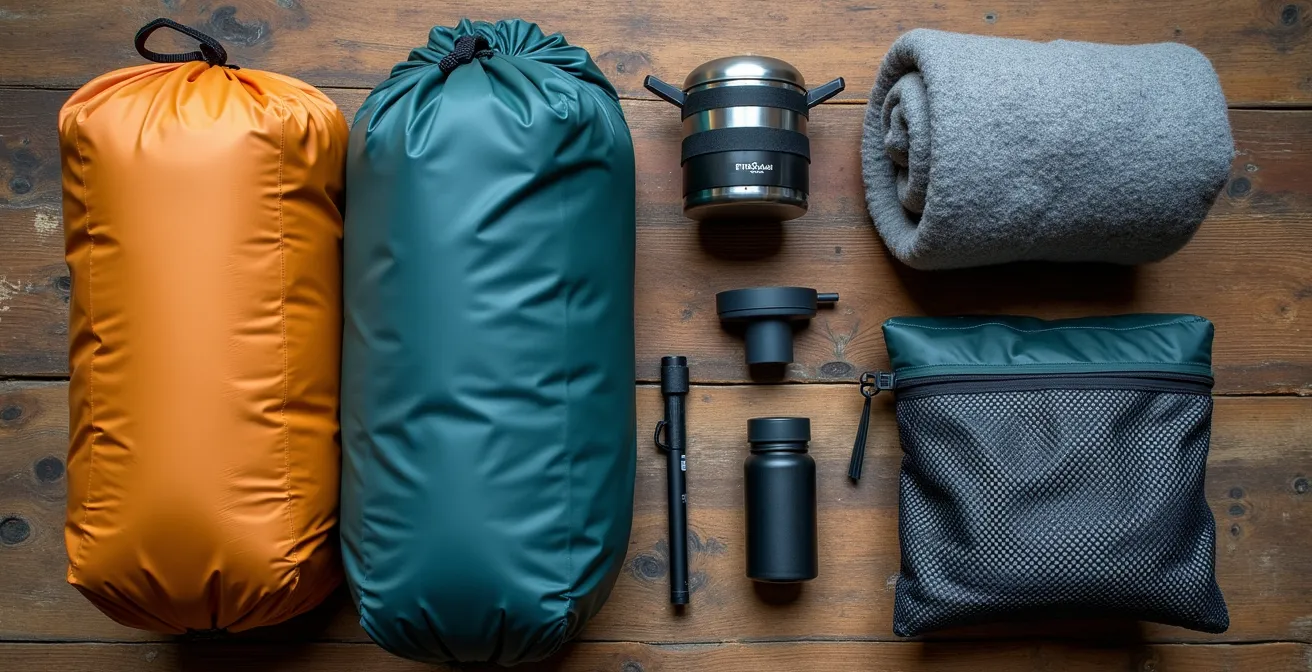
As the image above illustrates, an organized layout is half the battle. Each item should have its place. This system eliminates decision fatigue and makes your pre-dawn pack-up swift and certain. Your essential gear should include:
- Bivvy bag: This is the heart of minimalist camping. It’s a waterproof, breathable sack that goes over your sleeping bag, offering a lighter, more packable, and more intimate-with-nature alternative to a tent.
- Sleeping system: A 3/4 length inflatable mat like a Therm-a-rest and a compact sleeping bag rated for the current season are non-negotiable for a restorative night’s sleep.
- Campsite-to-Boardroom module: This is your secret weapon. A dedicated packing cube with a non-wrinkle shirt, face wipes, solid cologne, and even a portable steamer ensures you walk into the office looking sharp.
- Safety essentials: A headlamp (with extra batteries), a basic first aid kit, an emergency whistle, and your fully charged phone with offline maps downloaded.
- Food and water: For a single night, simplicity is key. A lightweight stove for coffee is a great morale booster, but a cold meal (like a pre-made sandwich or wrap) is even easier. Carry a minimum of 2 liters of water and a few high-energy bars.
Solo Bivouac vs Group Hike: Which Is Better for Mental Clarity?
Once you’ve committed to a 5-to-9 adventure, the next question is: who do you go with? The choice between a solo expedition and a group hike isn’t just about logistics; it dictates the very nature of the mental clarity you’ll achieve. Neither is inherently better, but they serve different restorative purposes. Understanding this difference allows you to choose the experience your mind needs most at that moment.
A solo bivouac is an exercise in introspective clarity. It is the ultimate tool for quieting the DMN and engaging in deep self-reflection. When you are alone in nature, with no social obligations, your mind is free to wander productively or simply be still. It’s an opportunity to confront challenges, make decisions independently, and build profound self-reliance. This is the path for personal breakthroughs and untangling complex problems. In contrast, a group hike fosters connective clarity. Sharing the challenge and beauty of an experience builds powerful social bonds and reduces stress through a sense of shared purpose. A TravelPerk survey found that 40% of participants reported significant personal and professional growth after adventure-based corporate experiences, highlighting the power of shared challenges.
To help you decide, consider the following breakdown of benefits, which shows how each style of adventure serves a unique purpose for mental restoration.
| Aspect | Solo Bivouac | Group Hike |
|---|---|---|
| Mental Clarity Type | Introspective clarity for problem-solving and self-reflection | Connective clarity through social bonding and shared challenges |
| Stress Reduction | DMN reset through solitude and nature immersion | Cortisol reduction through social support and shared experience |
| Safety Considerations | Requires more preparation and emergency planning | Built-in safety network and shared resources |
| Skill Development | Self-reliance, decision-making, mindfulness | Communication, teamwork, leadership |
| Best For | Personal breakthroughs and deep reflection | Team building and relationship strengthening |
The Weather Check Mistake That Ruins Micro-Adventures
For aspiring micro-adventurers, the single biggest point of failure isn’t gear or location; it’s the weather. But the critical mistake isn’t failing to check the forecast. It’s checking it with the wrong mindset. Most people look for a perfect, clear night and cancel if conditions are anything less. An experienced adventurer, however, knows that “bad” weather is just “weather,” and the real goal is to be prepared for it, not to avoid it.
Embracing this mindset shift from “weather-dependent” to “weather-prepared” is liberating. It opens up far more opportunities for adventure and introduces the concept of “Type 2 Fun”—activities that might be challenging or uncomfortable in the moment but become rewarding stories afterward. To do this safely, you need to go beyond a simple temperature and precipitation check. An advanced weather check involves looking at the data that truly impacts an overnight stay:
- Dew Point Temperature: This is a game-changer. If the dew point is close to the overnight low temperature, condensation will form on everything, including inside your bivvy bag. Knowing this allows you to choose a site with better airflow.
- Wind Speed and Direction: This dictates your campsite selection. Look for natural windbreaks like a line of trees or the lee side of a hill to ensure a quieter, warmer night.
- Hourly Cloud Cover: If a key goal is stargazing, an hourly forecast will tell you the best windows of opportunity between passing clouds.
- Microclimate Variations: Remember that valley floors and low-lying areas can be significantly colder (5-10°F or more) than nearby ridges due to cold air sinking.
Sometimes, even with the best planning, the weather turns. This is not a failure; it is the adventure. As one first-time micro-adventurer shared after an unexpectedly difficult night, the experience is what matters. In an account on Alastair Humphreys’ blog, he wrote:
I camped – alone – (and sober) for the first time in my life. I was incredibly unprepared and a storm started blowing in so the wind kept me up most of the night. I’m at work today – insanely tired – but grateful for the inspiration. Thank you for giving me the inspiration to break the mold of my 9-5 and go for a 5-9 microadventure. I hope it’s just the beginning.
– Real Experience with Unexpected Weather, Alastair Humphreys’ Blog
How to Transition From Campsite to Office Desk by 9 AM?
The true art of the 5-to-9 micro-adventure lies in the final act: the seamless transition from your sleeping bag back to your office chair. This is where most people hesitate, fearing they’ll arrive at work exhausted and disheveled. But with a disciplined protocol, you can walk into the office by 9 AM feeling refreshed, carrying the quiet confidence of your secret adventure. The key is efficiency and having a pre-planned “glide path” back to civilization.
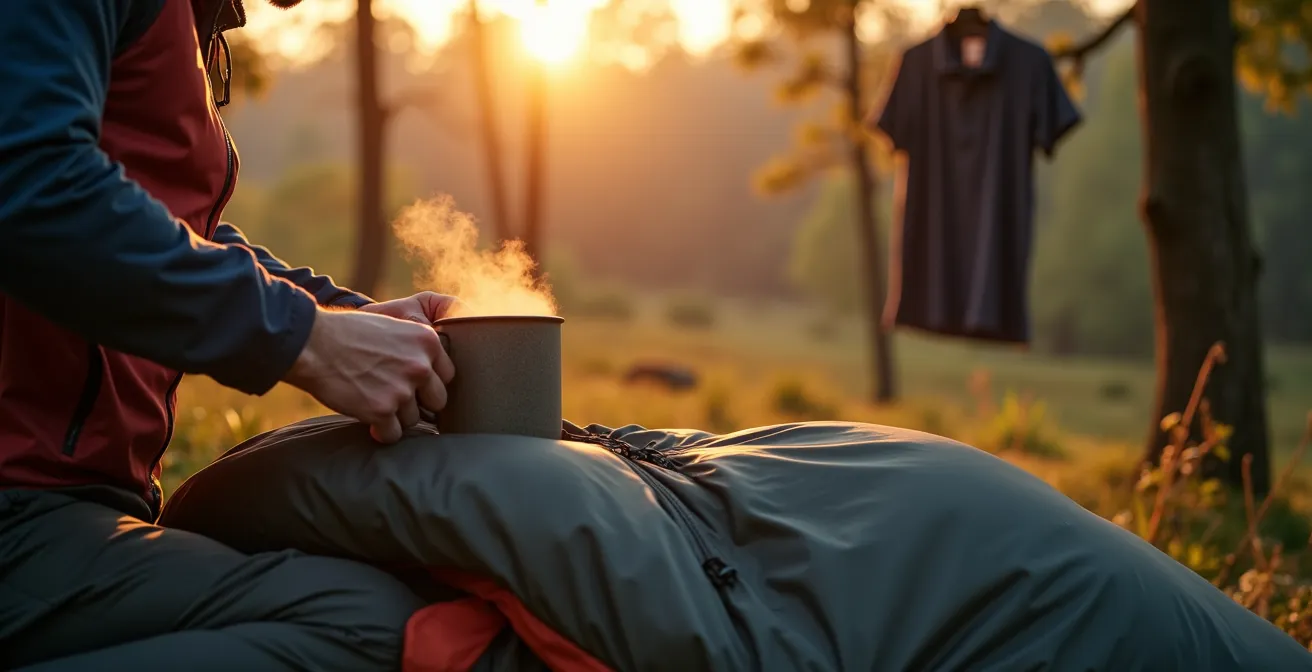
Forget a jarring alarm clock. Your goal is to wake naturally with the first light, which syncs your circadian rhythm and makes the early start feel energizing, not abrupt. The moments that follow should be a well-rehearsed dance of efficiency. As you sip your camp coffee, your body and mind are already shifting gears. The feeling isn’t one of frantic rushing, but of calm, purposeful action. The reward for this discipline is profound, as one adventurer described it:
Back home we quickly unpacked bags, showered and headed out the door to work. I got to my desk before nine, and sat down with a coffee and breakfast to deal with the morning’s emails. Just like any other day. Except that bubbling inside of me was the excitement of our secret.
– Windswept Writing Blog Author, Personal Account of 5-to-9 Microadventure
This “secret excitement” is the residual benefit of your neurological reset, a buffer against the day’s stresses. To achieve this state, your morning routine must be flawless, transforming the logistical challenge into a graceful ritual.
Your Action Plan: The 7 AM Pack-Down Protocol
- 5:30 AM – Natural Wake-Up: Rise with the first light. Spend a few moments absorbing the dawn chorus and quiet of the morning. This is the final dose of nature’s restorative power.
- 5:45 AM – Pack & Brew: Begin packing your sleeping system while your coffee or tea brews on a portable stove. Stuff your sleeping bag and deflate your mat. The muscle memory from your modular packing system is key here.
- 6:15 AM – Leave No Trace: With your pack nearly full, conduct a final, meticulous inspection of your campsite. The goal is to leave it looking as if you were never there. Pack out all trash.
- 6:30 AM – Transit Begins: Start your journey back towards your “urban transition point.” This could be your home, a local 24-hour gym, or even a quiet café with good facilities.
- 7:30 AM – The Urban Transition: Arrive at your chosen point. This is where your “Campsite-to-Boardroom” module shines. Change into your work clothes, use face wipes, and take five minutes to mentally prepare for the day ahead.
The “Always-On” Trap: How It Destroys Personal Relationships
The modern workplace has engineered an “always-on” culture that extends far beyond the office walls. The constant barrage of emails, notifications, and the pressure to be perpetually available puts our nervous systems in a state of hyper-vigilance. This digital tether not only leads to professional burnout but also quietly erodes our most important personal relationships. When our brains are never truly offline, we are physically present with our loved ones, but mentally absent, our minds still cycling through work problems.
This cognitive state is directly linked to the over-activity of the Default Mode Network (DMN) we discussed earlier. When the DMN is constantly running, our ability to be present, listen deeply, and empathize is severely compromised. A field experiment with preteens found that just five days at an outdoor camp without screens led to a significant improvement in their ability to read nonverbal emotional cues. This suggests that disconnecting from technology and immersing in nature is a powerful way to re-tune our social-emotional circuits.
A 16-hour micro-adventure serves as a powerful antidote to this trap. It’s a forced digital detox. By physically removing yourself from the digital world, you are not just taking a break; you are creating the necessary conditions for your brain to switch off its work-related loops. Much like meditation, which has been shown to reduce DMN activity and curtail mind-wandering, a night in nature quiets the internal noise. This mental silence allows you to return to your personal relationships with a renewed capacity for genuine connection, able to offer your full, undivided attention.
How to Sleep Comfortably on a Night Train to Save Hotel Costs?
While the title suggests a journey by rail, the “night train” is a powerful metaphor for any unconventional overnight stay that breaks the mold of a standard hotel room. It represents a mindset of finding adventure and rest in unexpected places, whether it’s a sleeper car, a friend’s balcony, or a carefully chosen urban bivouac. For the 5-to-9 adventurer, this means expanding your definition of “campsite” to include the hidden green spaces and overlooked corners of your own city.
The key to a successful urban micro-adventure is research and a creative approach to site selection. Your primary goal is to find a spot that is legal, safe, and quiet enough for a decent night’s sleep. An urban bivouac can be surprisingly comfortable and restorative if you know where to look. Sometimes, the adventure is in the search itself, as one adventurer in Antwerp discovered:
We found out that all the ships were heading back into town. So then we spent the night under a bush along the quay, deep in industrial terrain. It was the only green patch in the area, right up against the Schelde River.
– Urban Microadventure Experience
This spirit of adaptation is essential. To find your own urban oasis, you can use a strategic framework to scout locations:
- Legal Dispersed Camping: Use search terms like “dispersed camping + [your area]” or check the websites of national forests or Bureau of Land Management (BLM) offices for designated areas near city limits.
- Private & Permitted Spaces: Consider rooftops, balconies of friends with a view, or city parks that may offer overnight permits for special cases. A polite ask can go a long way.
- Car Camping Overlooks: Many cities have scenic overlooks with parking. “Car camping” in a discreet vehicle can be a comfortable and legal option if local regulations permit overnight parking.
- Noise-Mapping: Use noise-mapping apps to identify quieter zones within the urban landscape. A spot near a park or waterway is often a better bet than one near a major road.
Key Takeaways
- A 5-to-9 micro-adventure is a scientific tool for a “neurological reset,” not just a mini-trip. It works by quieting the brain’s anxiety centers.
- Success depends on a minimalist, modular packing system and a flawless “Campsite-to-Boardroom” transition plan.
- Embracing challenges like unpredictable weather is a core part of the experience and its mental benefits, shifting the mindset from avoidance to preparation.
How to Transition Your Team to a 4-Day Workweek Without Losing Revenue?
The global conversation around the 4-day workweek is gaining momentum, driven by a desire for better work-life balance and increased productivity. Companies that make the switch often report happier employees and stable revenue. But what if your organization isn’t ready for such a radical policy shift? The principles of a 4-day week—deep focus, radical efficiency, and meaningful rest—don’t have to be a top-down corporate mandate. You can achieve them on a personal level through the strategic use of micro-adventures.
Think of your 5-to-9 adventure as your own personal, rolling 4-day workweek. The commitment to leave the office on time forces you to be ruthless with your priorities and engage in deep, focused work during the day. You don’t have time for pointless meetings or procrastination when a hilltop sunset is waiting. This compressed focus mirrors the efficiency gains seen in 4-day week trials. The adventure itself then provides the profound rest and mental recharge that makes the following days more productive.
The impact of this nature-based reset on productivity is not just anecdotal. A workplace study found a remarkable 45% increase in productivity after spending just 29 minutes outdoors in nature. By integrating a 16-hour dose of nature into your workweek, you are essentially creating a powerful feedback loop: the adventure forces you to work more efficiently, and the resulting mental restoration makes that efficiency sustainable. You are reaping the cognitive and emotional rewards of a better work-life balance without waiting for a change in company policy.
By embracing the 5-to-9 philosophy, you are taking active control of your mental well-being and professional performance. Your next step is to stop dreaming and start planning. Pick a date, scout a location, and commit to your first neurological reset.